

You can unlock steady monthly cash from your house without selling it or moving away. American retirees hold a record $14.92 trillion in home equity, yet millions struggle on tight monthly budgets.
Sitting on a paid-off property while inflation eats your savings makes zero financial sense. Smart homeowners treat their accumulated real estate wealth as a dependable retirement paycheck.
Tapping home equity creates flexible cash flow that shields your investment portfolio during market drops. Here are seven tactical strategies retirees use to generate reliable home equity income for retirees.
Tip #1: HECM Tenure Payments for Lifetime Cash Flow
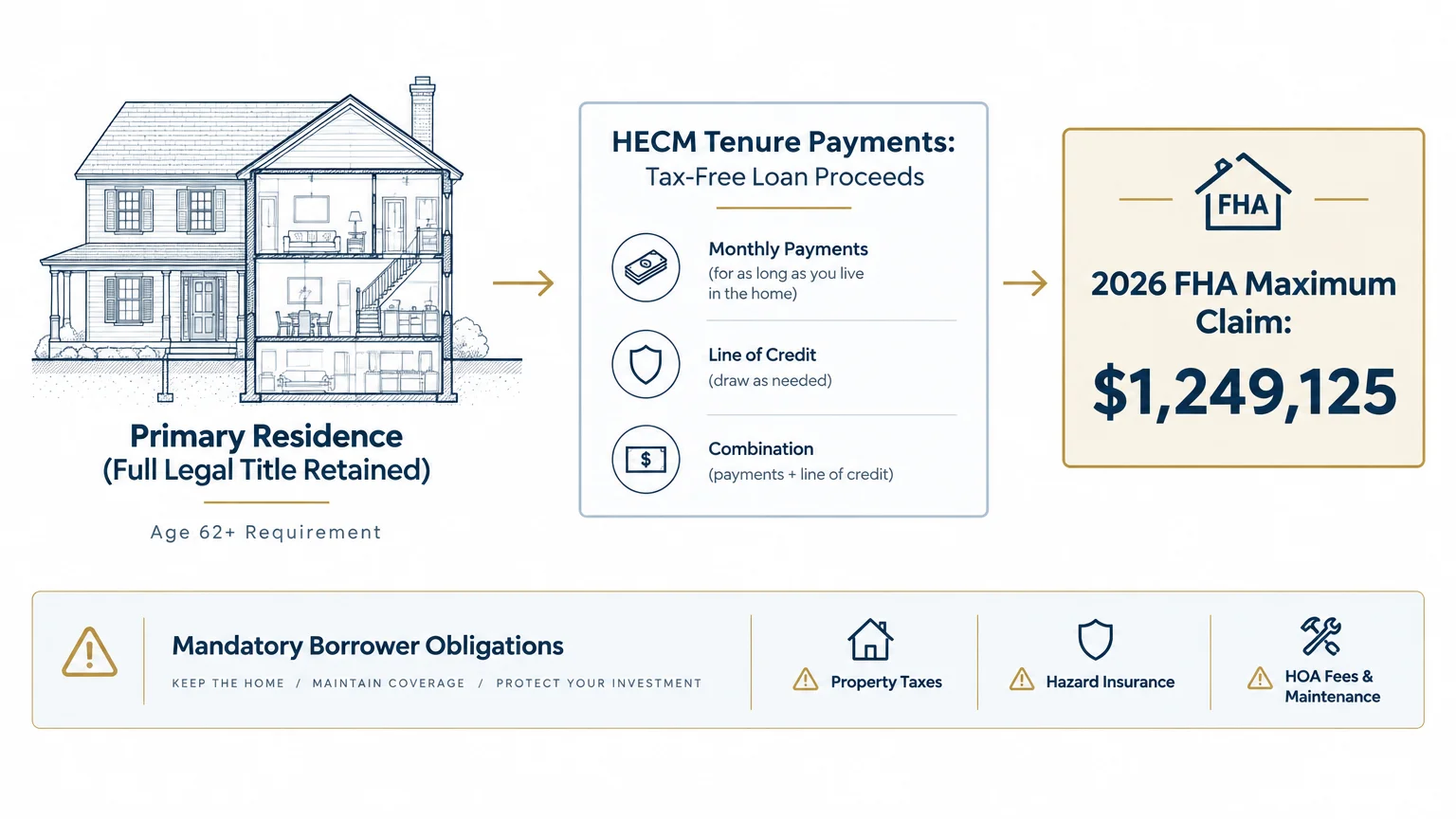
A federally insured Home Equity Conversion Mortgage offers one of the safest paths to monthly cash. This specialized reverse mortgage allows homeowners age 62 and older to convert property value into guaranteed monthly checks.
When you select tenure payments under a HECM loan, the lender sends you a fixed monthly sum for life. As long as you occupy the home as your primary residence, those payments never stop.
The Federal Housing Administration sets strict lending caps to protect your borrowing capacity. For 2026, the maximum claim amount for an FHA HECM reached an all-time high of $1,249,125.
Unlike traditional employment earnings or pension distributions, these tenure payments are classified by the IRS as loan proceeds. That means you receive 100% tax-free cash each month without increasing your taxable income bracket.
You retain full legal title to your property throughout the life of the loan. The lender never takes ownership of your home, and you can stay there indefinitely.
Before closing on any HECM loan, federal regulations mandate that you complete independent HUD-approved counseling. This session guarantees that you understand the fee structure, repayment terms, and alternative options before signing.
You must remain diligent about your ongoing property obligations while receiving these monthly checks. Borrowers must pay all property taxes, hazard insurance, and HOA fees, while keeping the property in good repair.
Failing to satisfy these basic homeowner responsibilities triggers a technical loan default. If that happens, the lender can accelerate the debt, which could ultimately lead to foreclosure.

Tip #2: The Standby Reverse Mortgage Line of Credit Hack
Savvy financial planners often recommend opening an FHA reverse mortgage line of credit well before you actually need the money. This contrarian strategy turns untapped home equity for retirement into an expanding reservoir of tax-free liquidity.
Unlike a conventional bank line of credit, the unused portion of a HECM line of credit grows automatically over time. The compounding growth rate matches your current loan interest rate plus the annual mortgage insurance premium.
Retirees exploit this unique growth feature by setting up scheduled monthly disbursements during severe equity market downturns. Drawing monthly cash from your house prevents you from liquidating depressed stock holdings at fire-sale prices.
This tactic directly neutralizes sequence-of-returns risk, which is the single biggest threat to a modern retirement portfolio. You allow your equities time to recover while your house pays your monthly living expenses.
Standard commercial banks can freeze, reduce, or cancel a traditional home line during economic contractions. However, the federal government legally guarantees your HECM credit line against cancellation or arbitrary cuts.
You control the payout frequency and can pause or restart your monthly draws at your discretion. That flexibility lets you customize your cash flow to match real-time grocery, healthcare, or utility bills.
Keep in mind that interest accrues only on the funds you actually withdraw from the line. Leaving the unused balance alone accelerates its growth, maximizing your potential future income stream.

Tip #3: Downsizing and Reinvesting Through the Section 121 Exclusion
Sometimes the most effective way of tapping home equity involves selling your oversized primary residence entirely. Downsizing into a smaller, cheaper home unlocks a massive lump sum of accumulated property wealth.
The tax code provides an enormous advantage through the Section 121 capital gains exclusion. Single filers can pocket up to $250,000 in home profits completely tax-free.
Married couples filing jointly can shelter up to $500,000 of home appreciation from capital gains taxes. To qualify, you only need to have lived in the residence for two out of the past five years.
After purchasing a smaller home with cash, retirees channel the leftover tax-exempt proceeds into high-yield financial assets. Building a diversified monthly income portfolio delivers dependable cash flow without debt obligations.
You can allocate your capital across short-term Treasury bills, dividend-paying exchange-traded funds, and high-yield money market accounts. Many retirees also allocate a portion toward a single-premium immediate annuity for guaranteed lifetime checks.
Downsizing also slashes your ongoing recurring expenses by hundreds of dollars every month. Smaller floor plans immediately lower your property taxes, utility bills, maintenance costs, and homeowners insurance premiums.
This double-barreled approach boosts incoming monthly income while systematically cutting outgoing living expenses. The resulting surplus gives your household budget immense breathing room during persistent inflationary cycles.

Tip #4: Building a House Hacking Rental Suite
You do not need to leave your neighborhood to generate significant monthly income from your property. Thousands of retirees are tapping home equity to build an accessory dwelling unit or convert an existing garage.
Financing the construction of an independent rental suite creates an immediate, recurring monthly revenue stream. This arrangement turns dead square footage into a productive cash-generating commercial asset right in your backyard.
Municipalities across the country have relaxed zoning restrictions to encourage backyard cottages and basement conversions. These private suites feature their own entrances, full bathrooms, and compact kitchenettes for complete tenant autonomy.
Retirees frequently lease these units to traveling medical professionals, local graduate students, or quiet single professionals. A well-placed rental suite can produce between $1,200 and $2,500 in gross monthly rental income.
You can deduct operating expenses, property insurance portions, and physical depreciation against your rental revenues at tax time. These legitimate paper write-offs shield a large portion of your tenant income from federal taxation.
Having an on-site tenant also provides an extra layer of personal security and everyday social interaction. Some retirees even trade partial rent discounts for light chores, gardening assistance, or local transportation.
Adding an approved auxiliary dwelling unit substantially raises the total appraised market value of your property. You generate dependable monthly cash flow today while leaving a more valuable physical asset to your heirs.

Tip #5: Home Equity Sharing Agreements for Dividend Arbitrage
Retirees who dislike debt and monthly loan repayments are exploring home equity sharing agreements. In these arrangements, an institutional investor provides upfront cash in exchange for a contractual share of your home’s future value.
Unlike traditional banking products, an equity share requires no monthly debt service and zero interest payments. That makes qualifying exceptionally easy, even if you report modest monthly income on your tax returns.
Retirees deploy this cash lump sum into income-producing dividend portfolios to generate their own monthly distributions. Earning steady yields while making zero monthly payments represents a powerful form of personal financial arbitrage.
These investment agreements typically run for terms spanning ten to thirty years. The agreement concludes when you eventually sell the home, refinance, or settle the investor’s equity position with cash.
If your home loses value or stays flat over the agreement window, the investor shares in that downside risk. You are not forced to make up for market depreciations out of your own pocket.
However, you must read the contract terms with extreme care before agreeing to an equity split. If your home appreciates substantially, buying out the investment firm down the road can prove quite costly.
This tool works best for retirees who prioritize immediate monthly income over maximizing the estate left to heirs. It releases frozen equity into your hands without burdening your monthly budget with mandatory loan payments.
Tip #6: Strategic HELOC Draws for Cash-Flow Smoothing
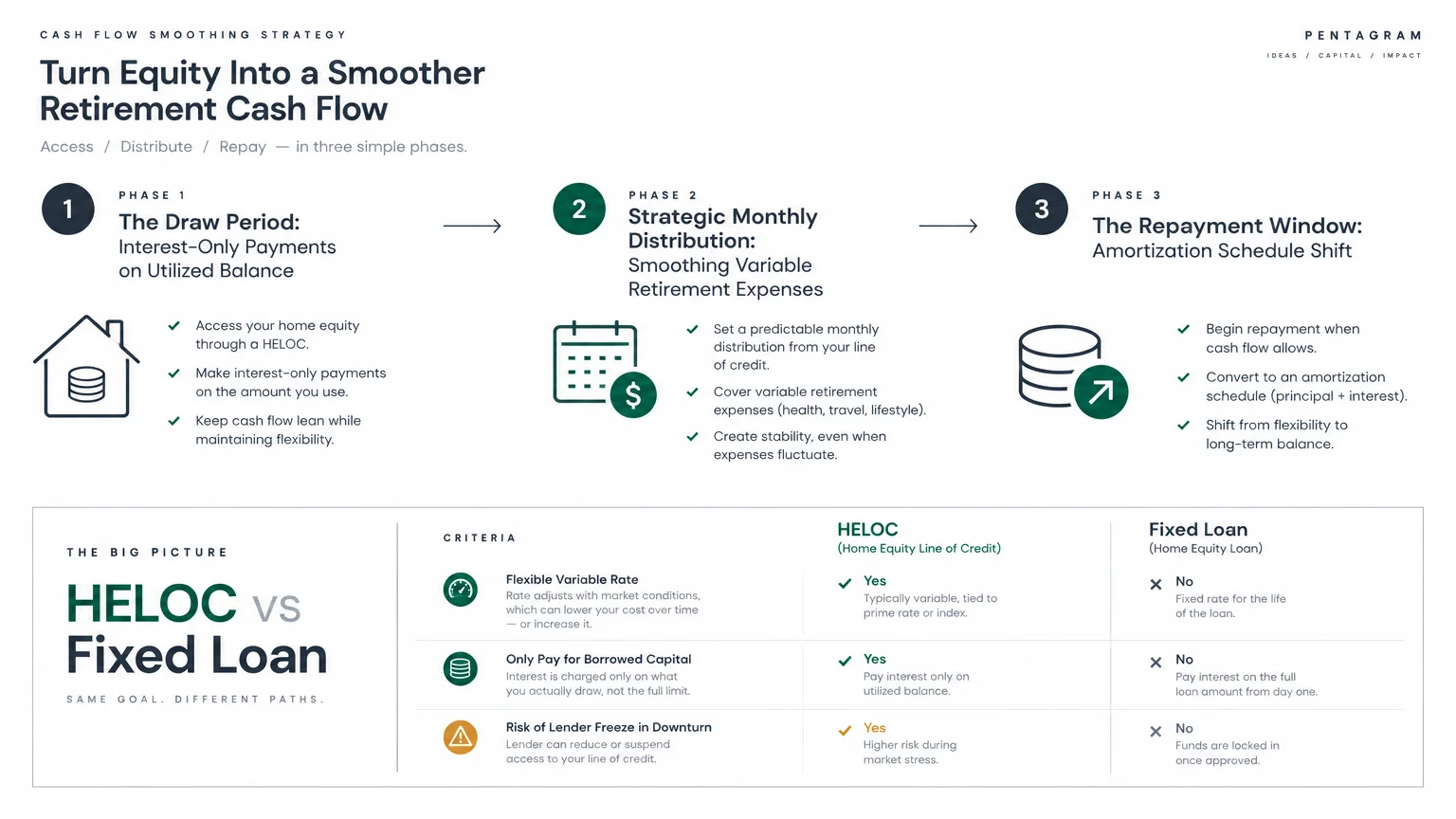
A Home Equity Line of Credit remains a popular, flexible tool for managing monthly retirement expenses. National average variable HELOC interest rates hover around 7.3% following recent Federal Reserve interest rate cuts.
Many retirees use disciplined monthly HELOC draws to bridge their living expenses between ages 62 and 70. This calculated move allows you to delay claiming your Social Security benefits until the absolute maximum age.
Delaying Social Security past your full retirement age increases your guaranteed monthly payout by roughly 8% per year. Using short-term equity debt to lock in a permanent 24% to 32% government benefit increase is brilliant math.
Traditional HELOCs require immediate monthly interest payments during the initial ten-year draw window. Because of these mandatory payments, lenders enforce strict debt-to-income underwriting standards before approving your application.
You should secure your HELOC before you officially exit the workforce and step away from your W-2 job. Lenders evaluate active pay stubs far more favorably than pension vouchers or volatile investment distributions.
Once the draw period closes, the line of credit converts into a fully amortizing repayment loan. You must formulate a clear exit plan to repay the outstanding balance through downsized assets or higher Social Security checks.
Used cautiously, a variable-rate credit line acts as a powerful shock absorber for your everyday monthly budget. It lets you cover periodic cash shortfalls without liquidating taxable investment assets.

Tip #7: Sale-Leaseback Programs to Cash Out Without Moving
A residential sale-leaseback allows you to convert 100% of your accumulated home equity into liquid cash today. You sell your residential property to an institutional buyer or specialized firm and immediately execute a long-term lease.
This arrangement eliminates the emotional disruption, physical strain, and high transactional friction of packing up your belongings. You remain in the exact same home and familiar neighborhood as a dependable, long-term tenant.
Selling the home sheds all ongoing financial liability for real estate taxes, hazard insurance, and structural maintenance. The acquiring investment firm assumes legal responsibility for roof repairs, heating system overhauls, and exterior maintenance.
You take the massive net cash payout from the sale and construct an automated monthly income portfolio. Retirees invest in conservative dividend funds, Treasury ladders, and fixed annuities to generate substantial monthly yields.
Those newly established monthly investment earnings easily cover your required monthly lease payment while leaving a healthy surplus. You convert a non-yielding illiquid asset into a steady, predictable retirement paycheck.
Before signing any sale-leaseback paperwork, scrutinize the annual rent escalation clauses inside your lease agreement. Predictable, capped lease increases protect you against unaffordable rent spikes down the road.
Work with a licensed real estate attorney to verify that your occupancy protections and renewal options remain ironclad. This ensures you maintain the legal right to stay in your home as long as you wish.

The Bottom Line: What This Means for Your Wallet
Your home should serve your retirement lifestyle, not drain your monthly bank account. With American seniors holding $14.92 trillion in housing wealth, tapping that value can transform your day-to-day standard of living.
Generating reliable home equity income for retirees requires matching the right financial tool to your specific personal goals. A tenure-based HECM loan provides lifetime guarantees, while a sale-leaseback or downsizing frees up maximum capital.
Always examine upfront origination costs, ongoing interest rates, and the long-term impact on your surviving heirs. Every dollar extracted from your property should support a well-defined financial purpose.
Never rush into any home equity product under pressure from aggressive loan officers or unsolicited mailers. Take your time to compare competitive loan estimates and consult an independent fee-only financial planner.
Smart equity management frees you from the stress of market volatility and rising grocery costs. By treating your property as a functional financial asset, you can fund a comfortable, dignified retirement.
Frequently Asked Questions
Does tapping home equity affect my Social Security or Medicare?
Home equity loan proceeds and reverse mortgage disbursements are classified as borrowed funds rather than earned income. Therefore, these payments do not trigger higher taxes on Social Security benefits or elevate your Medicare Part B premiums.
How do monthly home equity withdrawals impact Medicaid eligibility?
While reverse mortgage payments are not taxable income, unspent cash sitting in your bank account past the calendar month counts as a liquid asset. Exceeding state asset thresholds can jeopardize your eligibility for needs-based programs like Medicaid or Supplemental Security Income.
Can the bank take my home if I take out a HECM reverse mortgage?
The lender cannot take your home as long as you fulfill your basic legal obligations under the mortgage contract. You must occupy the house as your primary residence, maintain the structure, and pay property taxes and hazard insurance on time.
What happens to the loan balance when I pass away or move into assisted living?
When the last surviving borrower permanently leaves the home for twelve consecutive months, the loan becomes due and payable. Your heirs can sell the property to satisfy the balance, refinance the debt, or surrender the deed with zero personal liability.
For consumer protection information, visit the Federal Trade Commission (FTC) and the Consumer Financial Protection Bureau (CFPB). For product safety and reviews, consult Consumer Reports.
Disclaimer: This article is for informational purposes only and does not constitute financial advice. The content reflects the author’s opinion and research at the time of writing. Always do your own research before making financial decisions.









Leave a Reply