

Living a sun-drenched Florida retirement on a strict budget of $2,000 a month sounds like a financial myth, but you can absolutely make it a reality if you look beyond the overpriced coastal hotspots. The secret to a low cost retirement involves targeting hidden gem cities where housing, groceries, and healthcare won’t drain your fixed income. While Miami and Naples command premium prices that shatter standard budgets, inland communities and northern coastal towns offer the exact same sunshine and tax benefits at a fraction of the cost. By choosing the right location, you secure an affordable Florida retirement without sacrificing safety, amenities, or quality of life.

Tip #1: Ocala
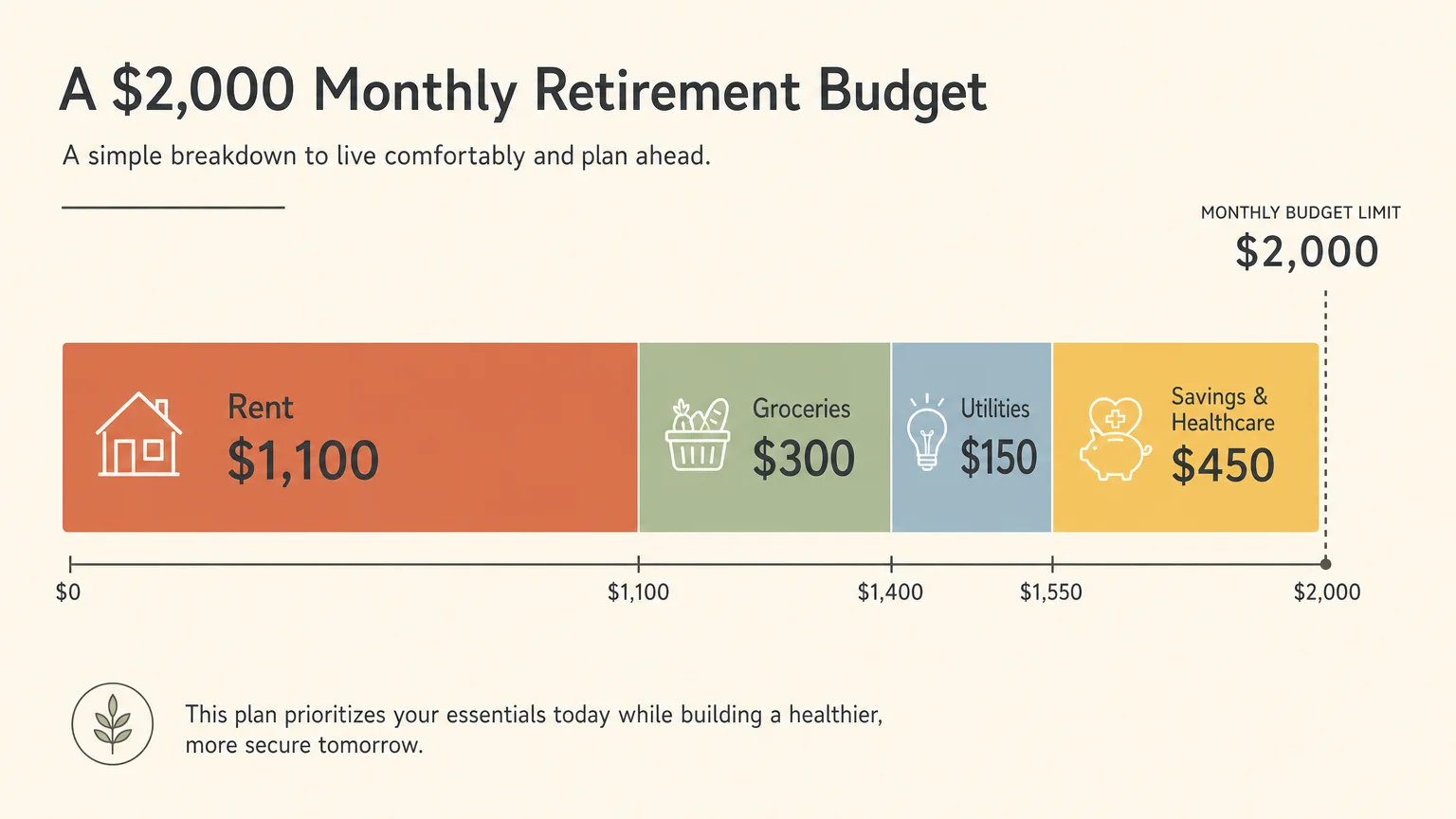
Ocala sits in the heart of Marion County, famously known as the Horse Capital of the World. This central location keeps you insulated from the massive hurricane insurance premiums that plague coastal residents; you rent instead of buy, sidestepping those unpredictable costs entirely. A comfortable one-bedroom apartment in Ocala averages around $1,100 per month.
When you subtract rent from your $2,000 budget, you retain $900 for remaining living expenses. Ocala features numerous discount grocers and local farmers’ markets where a single retiree can easily eat well on $300 a month. Healthcare costs remain manageable thanks to a robust network of clinics catering to the large senior population.
Central Florida summers demand air conditioning, but Ocala’s utility rates run close to the national average. Budgeting $150 for electricity and water leaves plenty of room for a comprehensive Medicare Advantage plan and personal transportation. Your dollars stretch further here because the city prioritizes low-cost, high-quality outdoor entertainment over expensive tourist traps, allowing you to explore the crystal-clear waters of Silver Springs State Park without spending a dime.

Tip #2: Sebring
Nicknamed the “City on the Circle” due to its unique circular historic downtown, Sebring offers an incredibly low cost of living tucked away in Highlands County. You will not find ocean views here, but you gain immediate access to massive freshwater lakes that provide outstanding fishing, boating, and scenic walking paths.
Renters find excellent deals in Sebring, with standard one-bedroom apartments frequently listing for $950 to $1,050 a month. Securing housing near the $1,000 mark guarantees your fixed income goes the distance. You can allocate $300 for groceries, $150 for utilities, and $150 for a reliable car’s gas and insurance. The remaining $400 comfortably covers your healthcare premiums, out-of-pocket medical expenses, and local entertainment.
Sebring features a tight-knit community of retirees who share resources, carpool to larger medical facilities, and organize free social events. This makes it an ideal destination to retire in Florida without feeling isolated. Highlands County also boasts lower sales taxes compared to the coastal megacities, which keeps local retail prices heavily in your favor.

Tip #3: Pensacola
Most people assume that retiring near the beach automatically disqualifies a location from a tight budget. Pensacola shatters that assumption. Located in the Florida Panhandle, this historic city offers stunning white-sand beaches and a cost of living significantly lower than South Florida.
You can find modest, comfortable apartments a short drive inland from the water for around $1,150 a month. The financial hack to living in Pensacola lies in utilizing the massive military infrastructure. Because of the Naval Air Station, the area features a heavy concentration of veterans and military retirees, leading to a surplus of affordable healthcare options, VA clinics, and senior-focused services.
If you qualify for military benefits, your out-of-pocket medical costs plummet, freeing up hundreds of dollars in your monthly budget. Even non-veterans benefit from Pensacola’s competitive retail market. Multiple discount supermarket chains battle for your grocery dollars, allowing savvy shoppers to keep food expenses well below $350. Furthermore, the panhandle experiences cooler winters than the rest of the state, which drastically reduces your air conditioning expenses from November through March.

Tip #4: Titusville
If you want to live on the Atlantic coast without paying Miami or Boca Raton prices, Titusville stands out as the ultimate Space Coast compromise. Situated directly across the Indian River from the Kennedy Space Center, this town provides front-row seats to rocket launches entirely for free.
Housing takes up the largest chunk of any budget, but Titusville maintains rental rates around $1,150 for one-bedroom units. This leaves $850 for your other necessities. You can keep transportation costs incredibly low here because the town is compact, flat, and highly navigable. Biking to local parks or running quick errands minimizes your gasoline expenditure.
Healthcare access remains a major selling point. Parrish Medical Center anchors the local health network, providing top-tier services without the need to travel to larger, more expensive cities like Orlando. When you need to fly out to visit family, the proximity to Orlando International Airport means you can easily hunt for budget airline tickets rather than relying on expensive regional airports. Titusville delivers coastal breezes and exciting skies on a blue-collar budget.

Tip #5: Lake City
Known as the “Gateway to Florida,” Lake City sits in the northern-central part of the state at the intersection of major interstates. It is decidedly rural, deeply southern, and exceptionally affordable. For those looking to escape traffic congestion and high property costs, Lake City provides a peaceful haven.
Rent in Lake City easily ranks among the cheapest in the state; securing a clean, safe apartment for $900 a month is a realistic goal. With $1,100 left over, your financial stress evaporates. You can comfortably budget $350 for groceries, $200 for utilities, $200 for transportation, and still have $350 left over for healthcare and hobbies.
The secret to maximizing your budget in Lake City involves leaning into the local lifestyle. Instead of expensive country clubs, residents utilize the extensive network of state parks, natural springs, and fishing lakes. The Suwannee River runs nearby, offering endless opportunities for kayaking and wildlife viewing. The incredibly low day-to-day living expenses make Lake City an absolute powerhouse for a low cost retirement.

Tip #6: Winter Haven
Nestled squarely between Tampa and Orlando, Winter Haven features the famous Chain of Lakes—a series of connected freshwater lakes that define the town’s geography and culture. You get the benefits of waterfront living without the crushing expenses associated with the oceanfront.
Renting a comfortable apartment near the water in Winter Haven typically costs about $1,150 a month. Polk County remains a stronghold for an affordable Florida retirement, largely because it avoids the tourist markups found in neighboring Orange County. You can easily keep your grocery budget under $350 by shopping at local fruit stands, discount grocers, and farmers’ markets that source directly from Central Florida’s agricultural heartland.
Winter Haven also features excellent medical infrastructure, with comprehensive senior care available locally. Because you are perfectly positioned in the center of the state, you avoid the highest tier of coastal insurance premiums and the worst of the hurricane storm surges. The town offers a relaxed, unpretentious atmosphere where $2,000 a month covers all your needs with enough left over for the occasional matinee or lakeside dinner.

Tip #7: Leesburg
Leesburg represents one of the smartest financial hacks in Central Florida. Located just a short drive from The Villages—the massive, world-famous retirement mega-community—Leesburg allows you to enjoy the same climate, the same regional medical facilities, and the same geographic advantages at a much lower price point.
While The Villages commands premium home prices and high monthly amenity fees, a retiree in Leesburg can secure a solid one-bedroom rental for roughly $1,100. This proximity hack means you can still participate in the surrounding area’s massive senior-focused economy. Dozens of highly competitive medical practices, dental offices, and specialists fight for the local senior demographic, which drives out-of-pocket healthcare costs down and quality up.
With $900 remaining for living expenses, you can navigate your monthly budget with ease. Leesburg’s downtown area features free community events, street festivals, and affordable dining options. The nearby Harris Chain of Lakes provides spectacular scenery and free outdoor recreation. By choosing Leesburg over its famous neighbor, you stretch your fixed income to its absolute limit.
Tip #8: Port Charlotte
Finding a Gulf Coast destination that accommodates a budget of $2,000 requires looking in the spaces between the luxury markets. Port Charlotte sits perfectly situated between the expensive enclaves of Sarasota to the north and Fort Myers to the south.
You can find older, well-maintained rental units or mobile home park rentals in Port Charlotte for around $1,200 a month. This leaves a tighter margin of $800 for your remaining expenses, meaning you must manage your grocery and entertainment budgets with strict discipline. However, the payoff is immense. You gain access to the spectacular Charlotte Harbor, miles of tranquil waterways, and some of the best fishing in the United States.
To make the budget work here, you will rely heavily on free entertainment. Walking the harbor, utilizing public beaches on nearby Manasota Key, and attending free community concerts become your primary social outlets. Healthcare in Charlotte County caters heavily to retirees, offering competitive rates on supplemental care and generic prescriptions. Port Charlotte requires careful spending, but it proves you can still enjoy the Gulf of Mexico on a tight budget.

Tip #9: Gainesville
Retiring in a college town offers massive, often-overlooked benefits for seniors on fixed incomes. Gainesville, home to the University of Florida, provides an unmatched combination of world-class healthcare, free cultural amenities, and affordable housing on the city’s outskirts.
By avoiding the immediate campus area, you can secure a quiet, senior-friendly apartment for about $1,100 a month. The true financial magic of Gainesville lies in the university itself. The local teaching hospitals rank among the best medical facilities in the state; you gain access to cutting-edge treatments and specialists without traveling to a major metropolis. Furthermore, you can utilize the university’s dental and optometry schools for routine care at a fraction of the cost of private practices.
Your entertainment budget drops to zero when you take advantage of the local natural history museum, art museums, and the continuous stream of free university-sponsored concerts and lectures. Gainesville’s robust public transportation system also allows you to minimize driving, saving you hundreds of dollars annually on gas and vehicle maintenance.

Tip #10: Daytona Beach
Daytona Beach is globally recognized for racing and tourism, but behind the vacation facade lies a highly functional, surprisingly affordable city for permanent residents. Volusia County offers some of the most competitively priced coastal real estate on the eastern seaboard.
If you look just west of the Halifax River—staying off the immediate beachside peninsula—you can consistently find comfortable rentals for $1,100 to $1,150 a month. A strict budget survives here because the local economy heavily subsidizes the cost of living through year-round tourism. Supermarkets, big-box retailers, and discount stores are plentiful, making it easy to keep your grocery and household supply costs under $350.
Daytona Beach also excels in senior discounts. Countless local restaurants and service providers offer aggressive early-bird specials and retiree discounts. You can spend your mornings walking the hard-packed sands of the beach for free, and your afternoons enjoying excellent healthcare access via the local hospital networks. By leveraging the permanent-resident lifestyle in a tourist hub, you secure a vibrant, active lifestyle on a strictly limited budget.
The Bottom Line: What This Means for Your Wallet
You do not need a multi-million-dollar portfolio to enjoy your golden years in the Sunshine State. Managing a retirement on $2000 a month simply requires strategic geographic choices and a willingness to step away from the heavily marketed luxury destinations. When comparing Florida retirement cities, the math dictates that keeping your rent near or below $1,100 is the critical anchor for this lifestyle. By choosing inland cities, utilizing military or university infrastructure, and targeting northern or central counties, you instantly reduce your housing costs by thousands of dollars a year.
Once you secure affordable housing, Florida’s lack of a state income tax ensures you keep every penny of your Social Security or pension. You must strictly monitor your grocery, utility, and transportation spending, relying on discount markets, free public parks, and strategic energy usage to balance the books. Ultimately, an affordable lifestyle is not a fantasy; it is a mathematical reality for those willing to trade oceanfront status for smart, sensible living.
Frequently Asked Questions
Can I really find a decent apartment in Florida for under $1,200?
Yes, but you must avoid the high-demand coastal markets of South Florida. Cities in the Panhandle, Central Florida, and rural northern counties frequently offer standard one-bedroom apartments and senior living community rentals between $900 and $1,200. You may have to compromise on square footage or modern luxury upgrades, but clean, safe housing exists at this price point.
How does Florida’s lack of state income tax help a fixed budget?
Because Florida does not collect state income tax, your entire check reaches your bank account without state-level deductions. If you draw that money from a pension, 401(k), or Social Security, you avoid the tax penalty that many other states impose, effectively giving you extra spending power every single month.
What about the cost of hurricane insurance?
The most effective strategy for managing property insurance costs on a strict budget is to rent rather than own. When you rent, the landlord absorbs the exorbitant hurricane and flood insurance premiums. You only need to carry a standard renter’s insurance policy, which generally costs less than $20 a month and protects your personal belongings.
For consumer protection information, visit the Federal Trade Commission (FTC) and the Consumer Financial Protection Bureau (CFPB). For product safety and reviews, consult Consumer Reports.
Disclaimer: This article is for informational purposes only and does not constitute financial advice. The content reflects the author’s opinion and research at the time of writing. Always do your own research before making financial decisions.









Leave a Reply