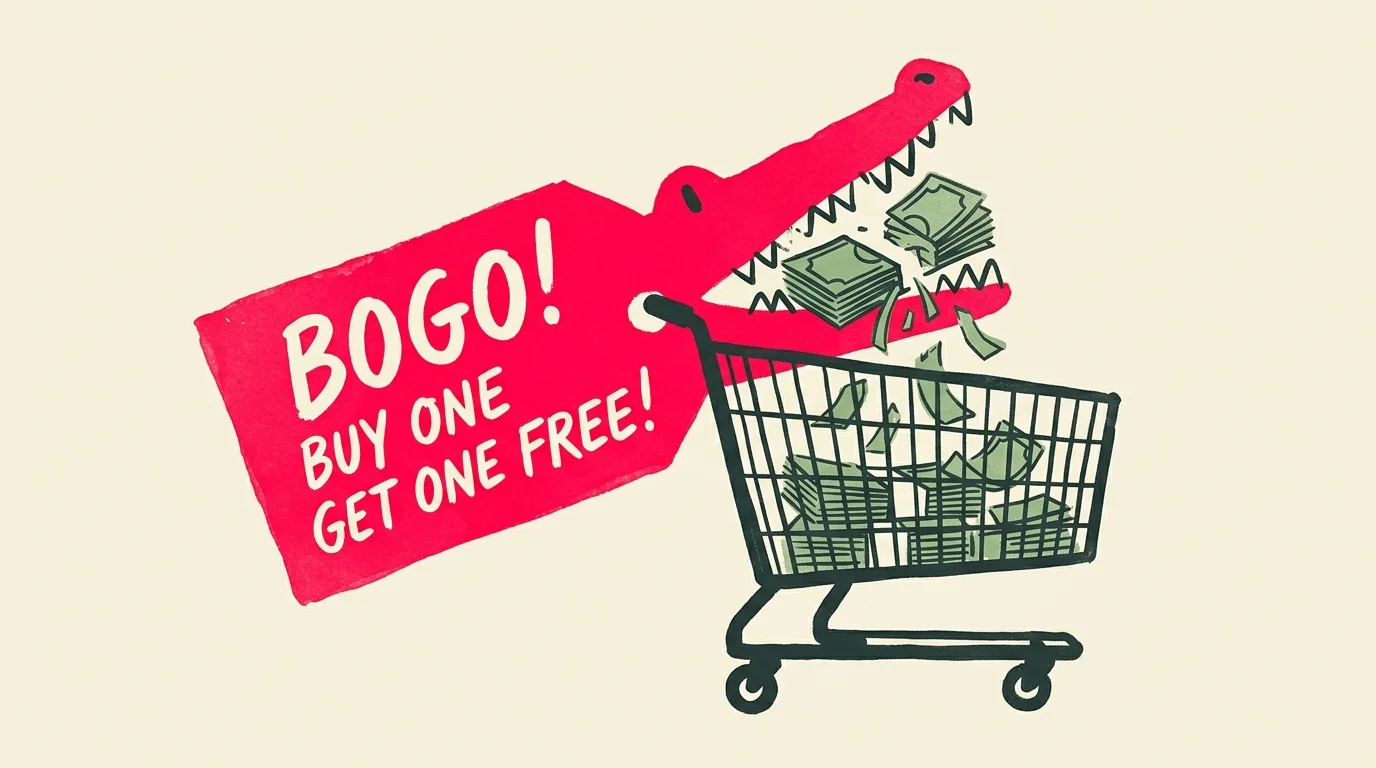
Retailers use Buy One, Get One Free promotions to trigger your brain’s fear of missing out, but these flashy shelf tags frequently cost you more money than standard purchases.
When you spot a BOGO sticker, hidden retail markups and volume manipulation often conceal the fact that the promotion provides zero authentic savings. Understanding these marketing maneuvers protects your hard-earned dollars from deceptive sales tactics.
Before you load your cart with duplicate merchandise you never planned to purchase, watch out for the warning signs that reveal when a BOGO promotion fails to deliver real value.
Tip #1: The Base Item Suffered an Overnight Price Hike
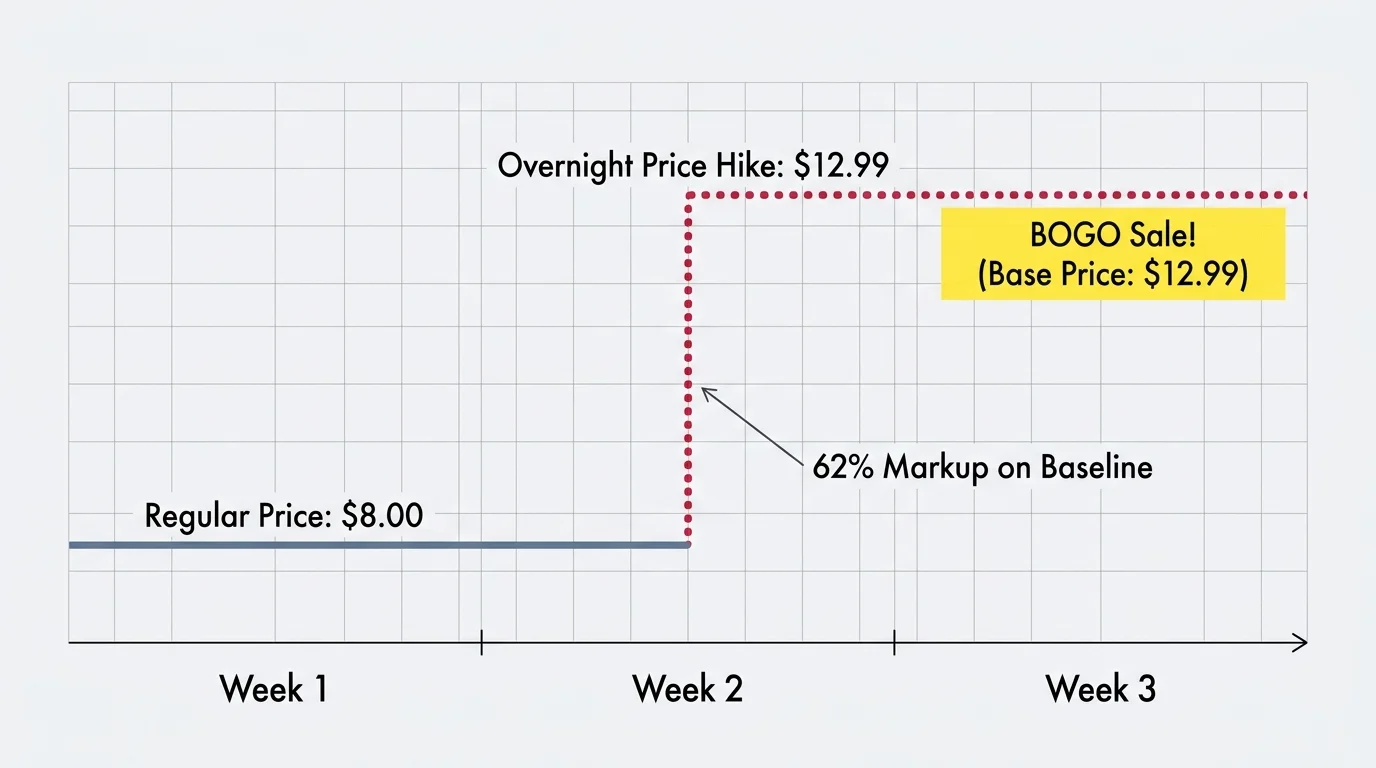
One of the most pervasive retail pricing tricks BOGO promotions hide is artificial reference price inflation. Retailers often quietly raise the baseline sticker price on an item days or weeks before slapping a bright promotional sticker on the display.
When a box of coffee pods normally retails for $8.00, an unscrupulous store might inflate the primary shelf tag to $12.99 before launching a Buy One, Get One promotion.
You walk away thinking you received a free box worth $12.99, but you actually paid a steep 62% markup on the initial item, significantly degrading your true discount.
Federal regulators actively monitor this deceptive practice. Under Federal Trade Commission regulations outlined in 16 CFR Part 233, an advertised regular price must represent the bona fide, prevailing market price at which the retailer openly offered the product for a substantial period.
When companies manipulate baseline price tags to make promotional markdowns look dramatic, they violate federal truth-in-advertising laws. Several states enforce even stricter boundaries; California Business and Professions Code Section 17501, for instance, requires retailers to base discounts on prevailing market prices established within the preceding 90 days.
Supermarket giant Safeway faced massive consumer backlash over this exact maneuver, ultimately agreeing to a $107 million class-action settlement.
The lawsuit proved that Safeway systematically raised base shelf prices on club card items right before running BOGO promotions, effectively making consumers subsidize the “free” second item through inflated initial charges.
When evaluating any promotional shelf tag, check the underlying price tag beneath the sale sticker or use price-history apps to confirm whether the regular retail price jumped recently.
Tip #2: The Unit Price Still Exceeds Store-Brand Alternatives
A major reason BOGO deals are not a real discount lies in the persistent price gap between brand-name goods and private-label alternatives.
Big brands coordinate with retail category managers to run high-profile BOGO campaigns, hoping the illusion of getting something free distracts you from comparing the cost per ounce, pound, or count on nearby shelves.
Even with a 50% promotional reduction across two items, name-brand shelf staples frequently carry a higher unit cost than standard store brands sold at everyday prices.
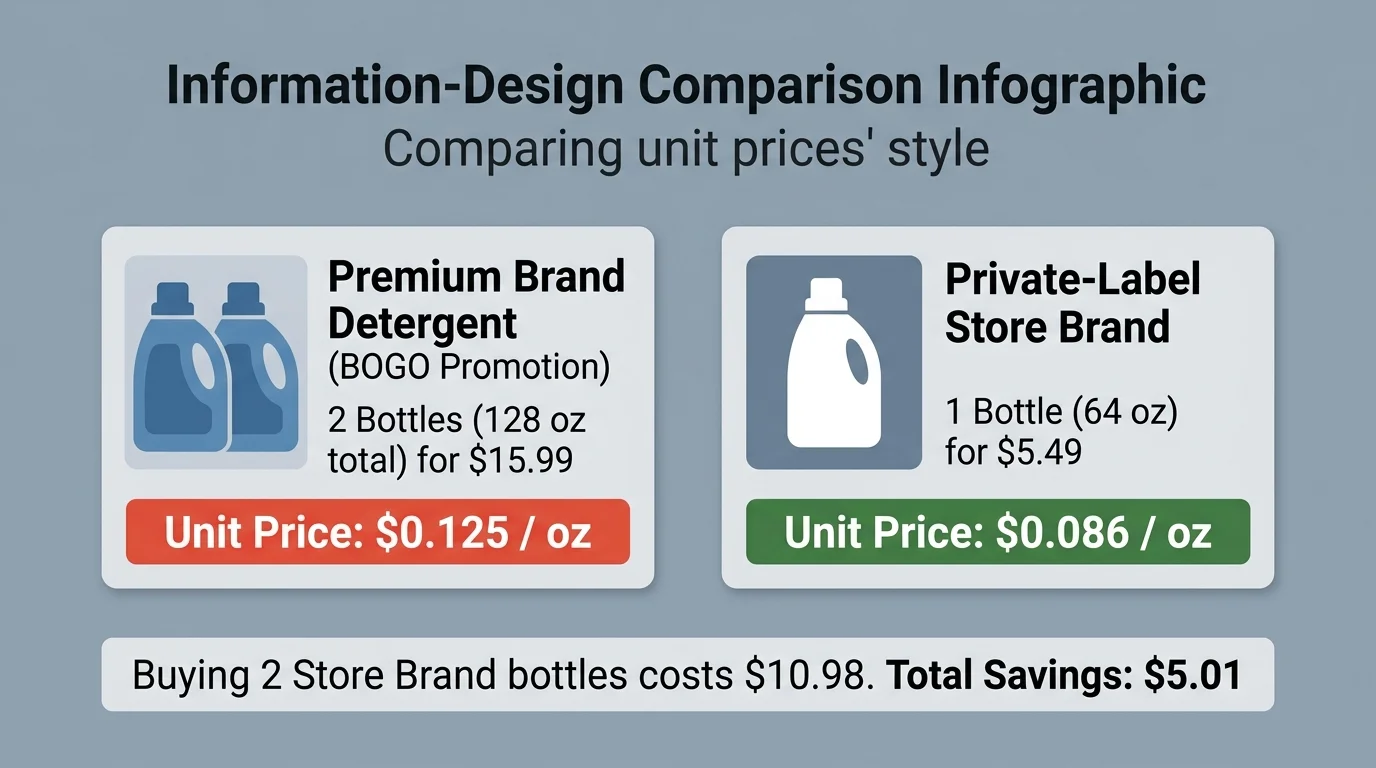
Consider a standard grocery scenario involving laundry detergent. A premium name-brand 64-ounce liquid detergent retails for $15.99 on a BOGO deal, giving you two bottles (128 ounces total) for $15.99, which works out to approximately $0.125 per fluid ounce.
Right next to that display, the supermarket’s private-label 64-ounce detergent sells at its everyday non-promotional price of $5.49 per bottle, or $0.086 per ounce. Buying two private-label bottles costs you $10.98 total—saving you over $5.00 compared to the celebrated brand-name BOGO sale.
Savvy consumers always ignore promotional banners and look directly at the small unit-price calculation printed on the bottom left corner of shelf tags. Store brands often match national brands in ingredients and manufacturing standards while bypassing massive national advertising budgets.
If buying two store-brand items costs less cash out of pocket than the promotional name brand, the BOGO sticker functions as an expensive marketing distraction rather than a genuine bargain.
5. **Final check of requirements:**
* Exactly ONE sentence? Yes.
* 10-18 words maximum? “These BOGO salad greens sitting
Tip #3: Perishable Goods Spoil Before You Can Eat Them
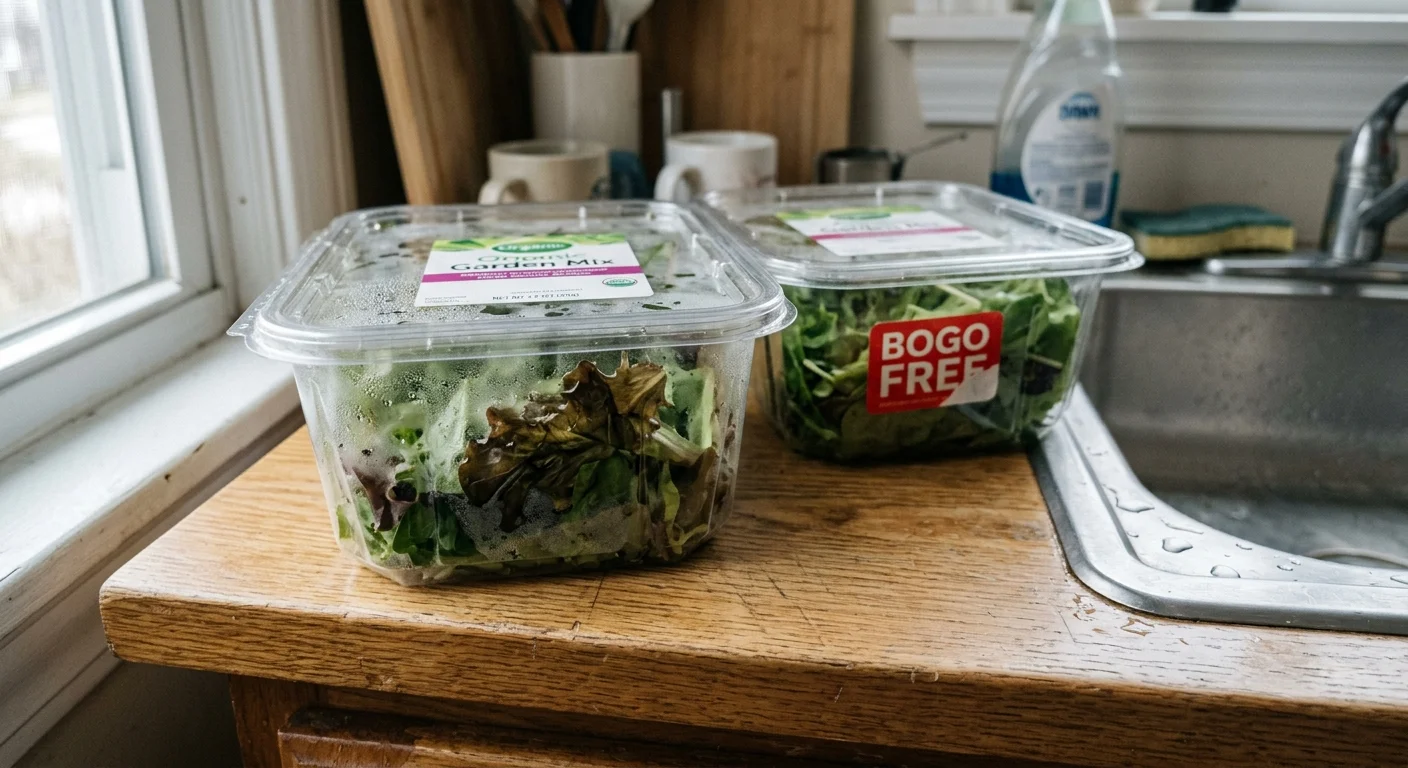
Promotional volume buying presents severe financial pitfalls when applied to perishable groceries like dairy, fresh produce, meat, and bakery goods. Supermarkets frequently launch BOGO promotions on expiring inventory to clear warehouse overstock before the products reach their sell-by dates. If your household fails to consume both items before they turn rancid or moldy, your realized discount drops to zero while your grocery budget takes an unnecessary hit.
Data from the U.S. Department of Agriculture (USDA) indicates that between 30% and 40% of the entire American food supply is wasted, exceeding 130 billion pounds of discarded food each year.
This staggering level of waste costs the average American family of four roughly $1,500 annually in discarded food expenses.
When you purchase two large containers of salad greens or artisan bread on a BOGO promotion and toss the second spoiled package into the trash, you effectively paid full retail price for the single container you actually ate.
To avoid falling into the spoilage trap, run a rapid inventory check before tossing double perishable items into your cart.
Ask yourself whether your household has a concrete meal plan to consume the volume within five days, or whether the second product can safely go into long-term freezer storage.
If the answer to both questions is no, leave the promotional package on the shelf and buy only the single quantity you need.
Tip #4: The BOGO 50% Off Tag Only Delivers a 25% Discount
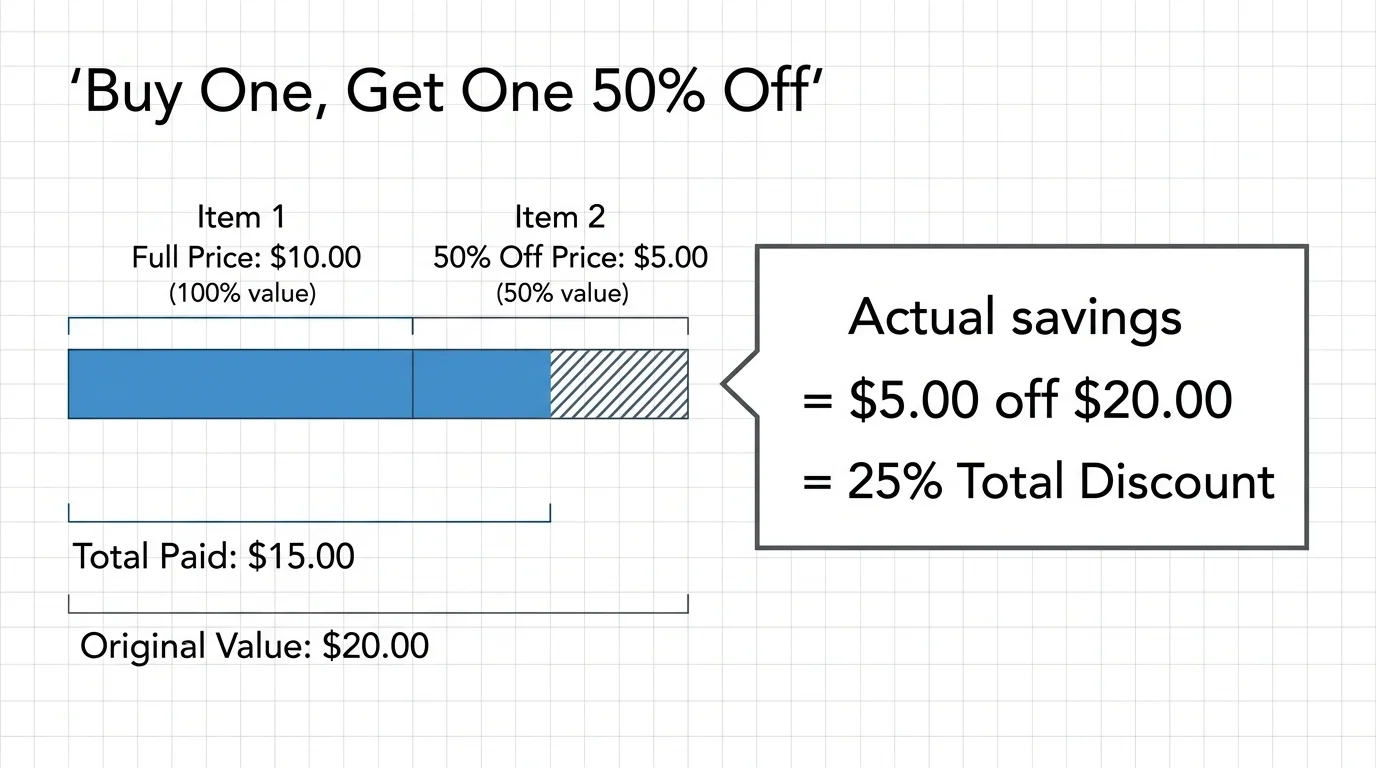
Retailers frequently deploy “Buy One, Get One 50% Off” tags because consumer psychology conflates the bold “50% Off” lettering with a half-price markdown.
In reality, purchasing one item at full price and a second item at half price yields a maximum total savings of only 25% across the entire transaction.
If you purchase two $20.00 shirts under this promotion, you pay $20.00 for the first and $10.00 for the second, totaling $30.00 for $40.00 worth of merchandise—a modest 25% markdown that rarely justifies buying extra apparel.
Retail pricing tricks BOGO displays employ become even worse when you mix and match items of unequal value.
Store policies almost universal stipulate that the 50% discount applies exclusively to the item of “equal or lesser value.” If you purchase a premium item for $50.00 and a secondary qualifying accessory for $10.00, the register applies the 50% discount to the $10.00 accessory, saving you a paltry $5.00 on a $60.00 purchase—an effective discount of just 8.3%.
Do not let complex promotional phrasing disguise minor price cuts.
If an item requires buying a duplicate product to unlock a modest 25% net savings, wait for a standalone clearance sale or sitewide promotion that discounts single items without forcing you to inflate your total transaction size.
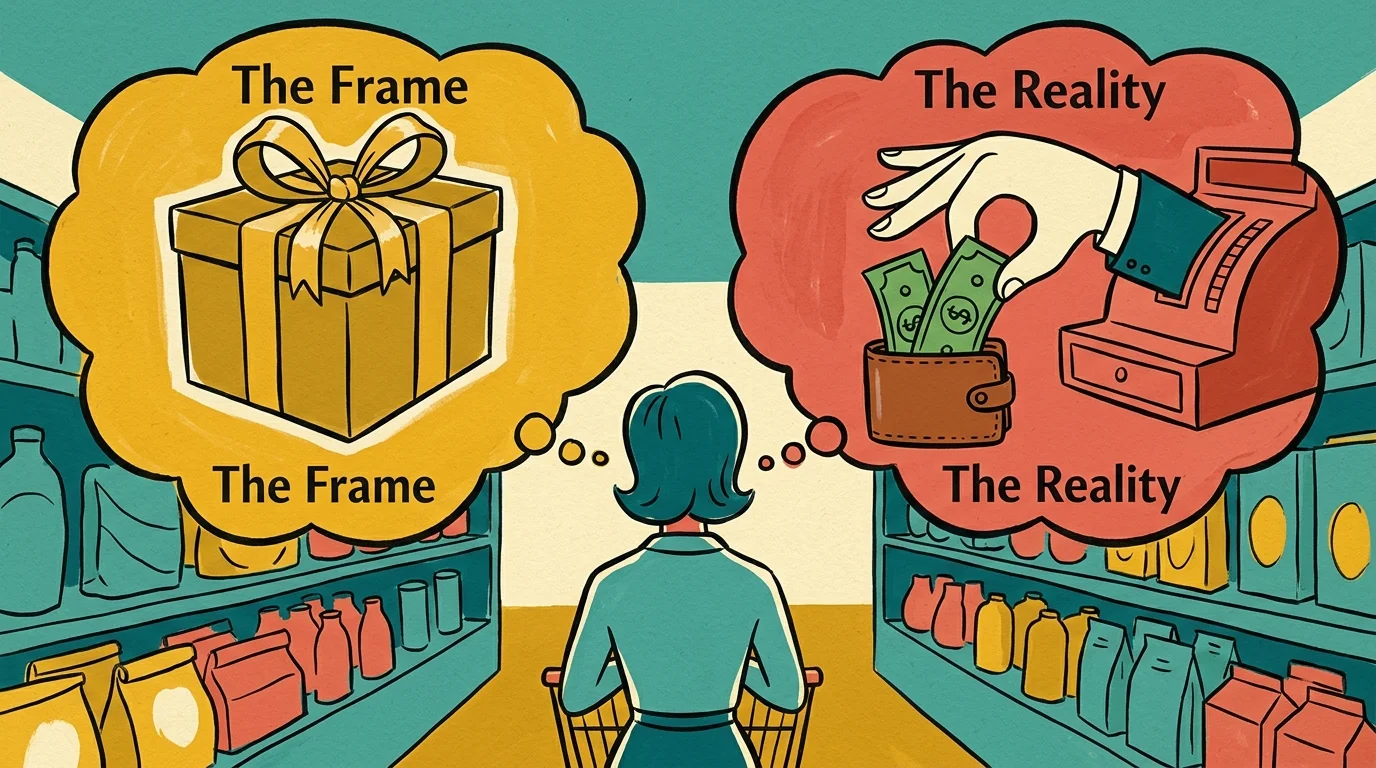
Tip #5: Framing Bias Tricks You Into Doubling Out-of-Pocket Cash
Behavioral economists have long documented the “Zero Price Effect,” which shows that consumers exhibit an irrational preference for free items over deeply discounted items.
In retail settings, shoppers overwhelmingly perceive a “Buy One, Get One Free” offer as far more valuable than a straight 50% discount on a single item, even though both represent identical mathematical savings per unit.
Retailers exploit this framing bias to coerce shoppers into doubling their immediate cash outflow.
When you walk down an aisle seeking a single bottle of shampoo priced at $9.00, a direct 50% discount requires you to spend $4.50. A BOGO promotion, conversely, forces you to hand over the full $9.00 out-of-pocket to claim the “free” second bottle.
You leave the store having parted with double the cash you initially budgeted, reducing your household’s immediate cash flow for essential bills and savings goals. You did not save $9.00; you spent an extra $4.50 to acquire surplus inventory for your bathroom closet.
Evaluating whether buy one get one is worth it requires focusing squarely on your total checkout register total rather than theoretical savings tallies printed on the receipt.
If a promotion compels you to spend surplus cash on non-immediate needs, it functions as an upsell mechanism designed to pad the retailer’s quarterly gross revenue at your expense.
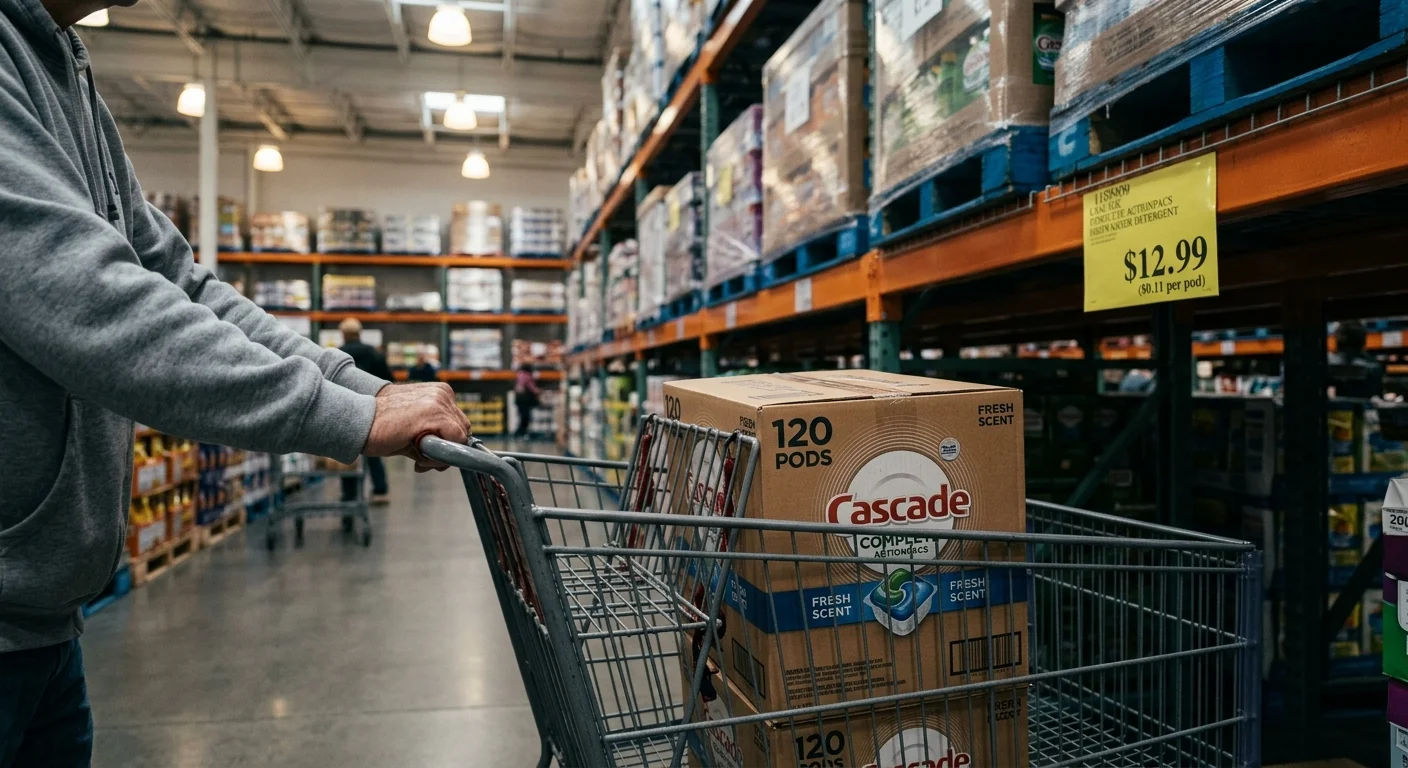
Tip #6: Warehouse Clubs Beat the BOGO Price Per Unit Everyday
Big-box grocery stores and drugstores often design BOGO sales to mimic the bulk savings of wholesale warehouse clubs like Costco, Sam’s Club, or BJ’s Wholesale.
However, a close inspection of package sizes and unit costs reveals that supermarket BOGO promotions frequently cost more per measure than the standard everyday pricing offered by membership clubs. Supermarkets rely on promotional hype to prevent shoppers from calculating real wholesale math.
Consider pantry staples like peanut butter, rolled oats, or canned tuna. A supermarket might offer 16-ounce jars of peanut butter on a BOGO sale at $4.99, netting you 32 ounces of product for $4.99 ($0.155 per ounce).
At a wholesale club, a dual-pack containing two 40-ounce jars (80 ounces total) sells at an everyday baseline price of $8.99, yielding a unit price of $0.112 per ounce.
The warehouse club provides an everyday unit rate that is nearly 28% cheaper than the supermarket’s temporary promotional BOGO price.
Never assume that promotional flags beat everyday bulk rates. If your household regularly consumes shelf-stable goods, purchasing commercial quantities at wholesale clubs or through bulk co-ops delivers superior long-term budget efficiency compared to chasing cyclical grocery store BOGO promotions.
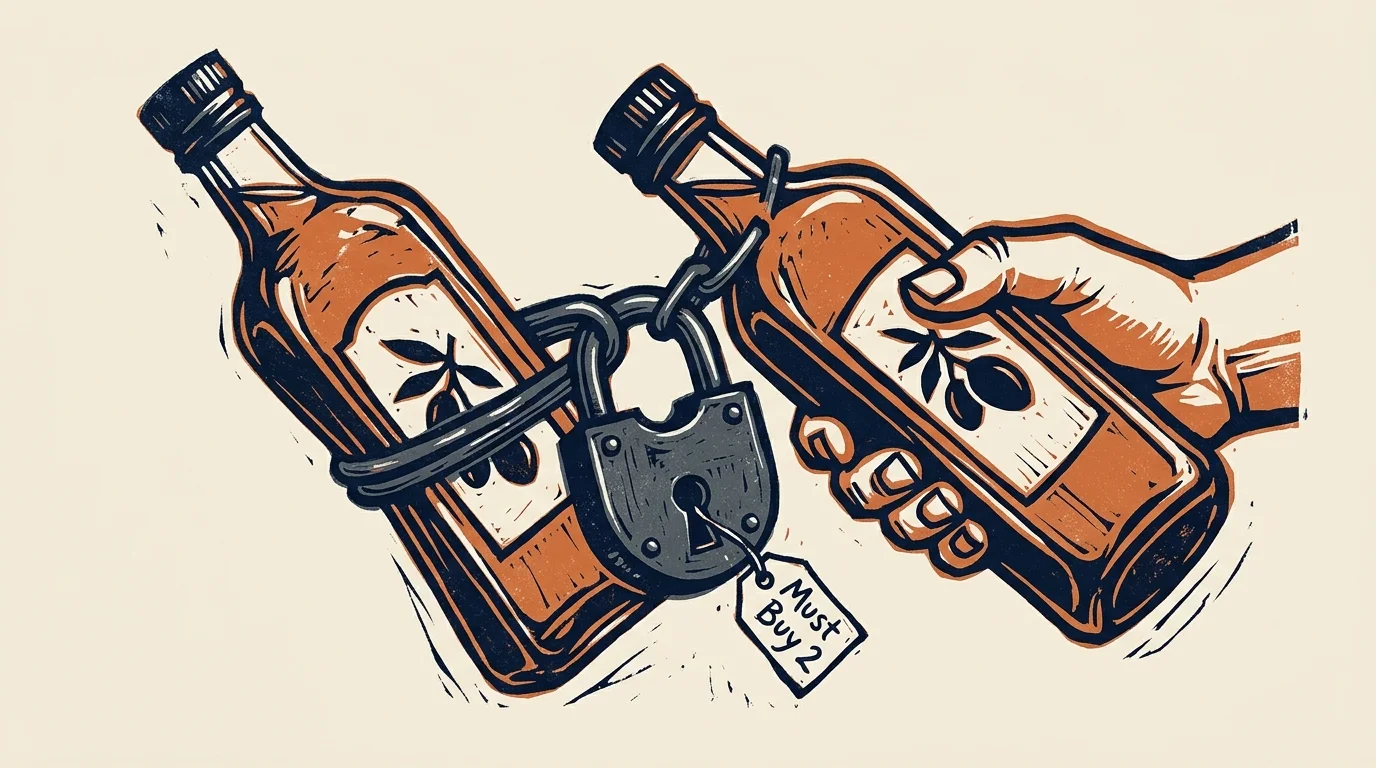
Tip #7: The Store Forces You Into an All-or-Nothing Volume Lock-In
A crucial factor in spotting fake BOGO sales involves understanding your local grocery chain’s register scanning rules. In some regions and select supermarket chains, such as Publix in parts of the Southeast, a BOGO deal rings up each item individually at 50% off.
You can place a single item in your cart and receive the full half-price discount without buying a companion item. However, the majority of nationwide grocers, including Kroger and Safeway, enforce an all-or-nothing policy where buying a single item rings up at full retail price.
When stores mandate that you buy both products to trigger promotional pricing, they intentionally lock you into higher volume commitments. This practice harms low-income shoppers, singles, and apartment dwellers who face tight cash restrictions or lack physical pantry storage space.
Forcing consumers to buy extra inventory to avoid an overpriced single-unit penalty represents a coercive pricing framework that rewards excessive consumption while penalizing lean shopping habits.
Always test your store’s scanning policy at checkout or ask customer service for clarification. If your supermarket does not discount individual items under BOGO banners, evaluate whether you actually have the cash liquidity and domestic storage capacity to justify taking on duplicate merchandise.
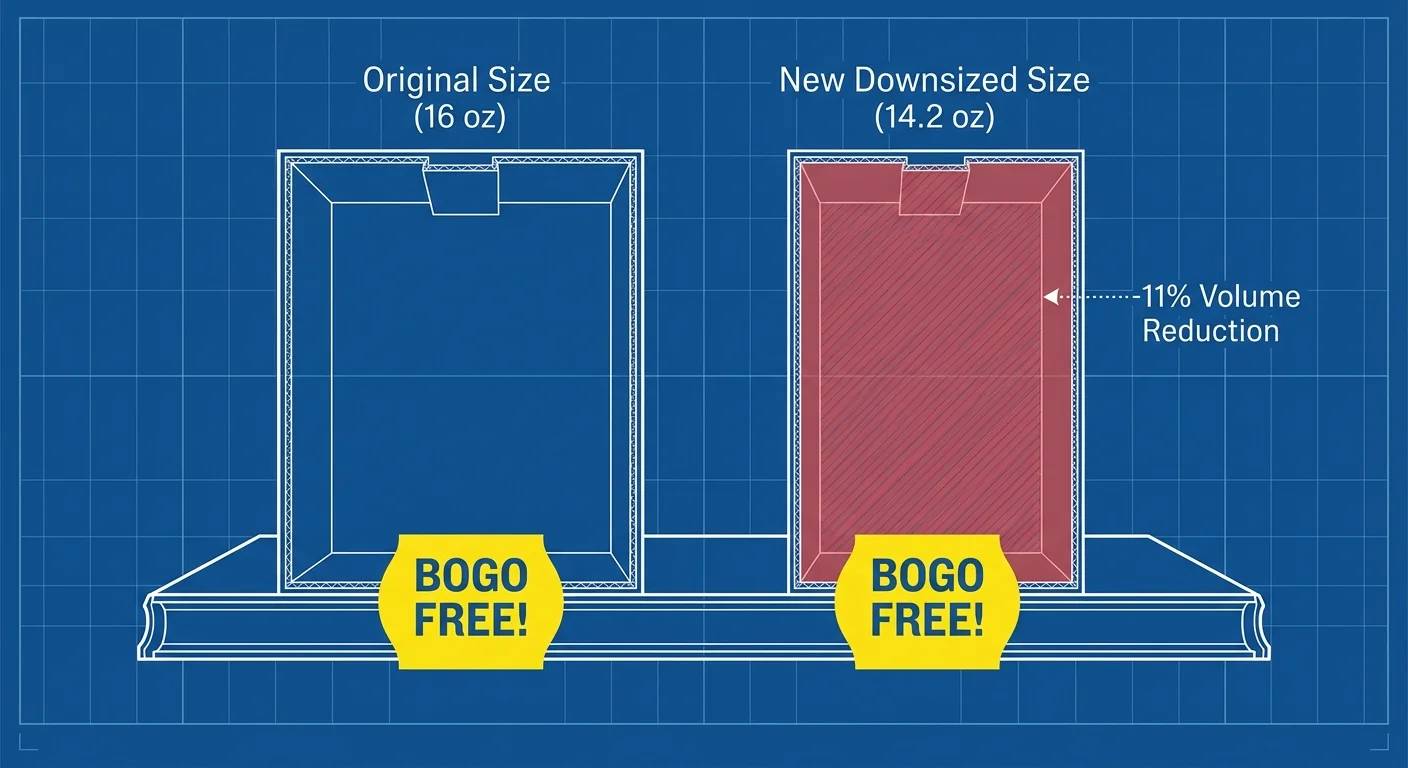
Tip #8: Shrinkflation and Downsized Packaging Mask a Hidden Price Hike
Consumer packaged goods companies frequently align product downsizing initiatives—known as shrinkflation—with massive BOGO marketing blitzes.
When a manufacturer reduces a cereal box from 18 ounces to 14.2 ounces or shrinks a snack bag from 12 ounces to 9.5 ounces while retaining the old retail price, consumers generally react with frustration.
To distract shoppers from noticing the reduced contents, brands frequently coordinate with supermarkets to run aggressive BOGO promotions during the exact packaging transition window.
Bright promotional shelf tags and colorful cardboard endcap displays visually obscure the smaller net weight printed along the bottom of the new packaging.
Shoppers rush to grab two boxes under the impression that they are securing double their historic volume, failing to realize that the combined volume of the two new boxes barely exceeds the volume of single packages sold in previous years.
Once the promotional period concludes, the downsized packaging remains on the shelf at the old full retail price, completing a stealthy price increase.
Protect yourself by checking the net weight on promotional packages against older stock or alternative brands. If you notice a sudden reduction in ounce counts on newly promoted BOGO items, calculate the true cost per ounce before deciding whether the offer provides legitimate value.
Tip #9: Phantom Reference Prices Anchor Fake Value on Non-Perishables
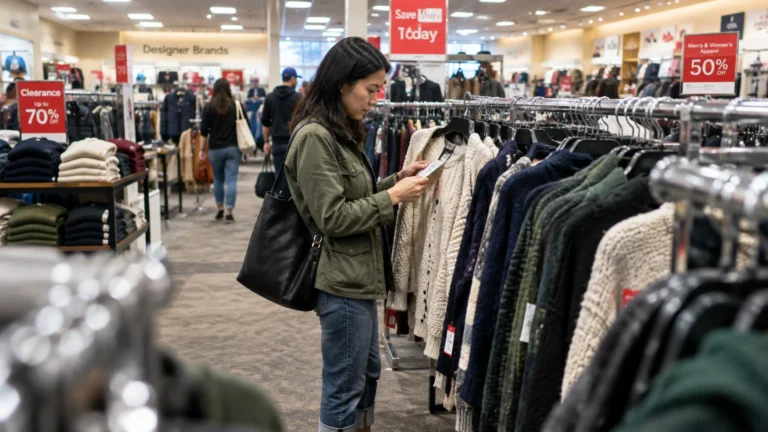
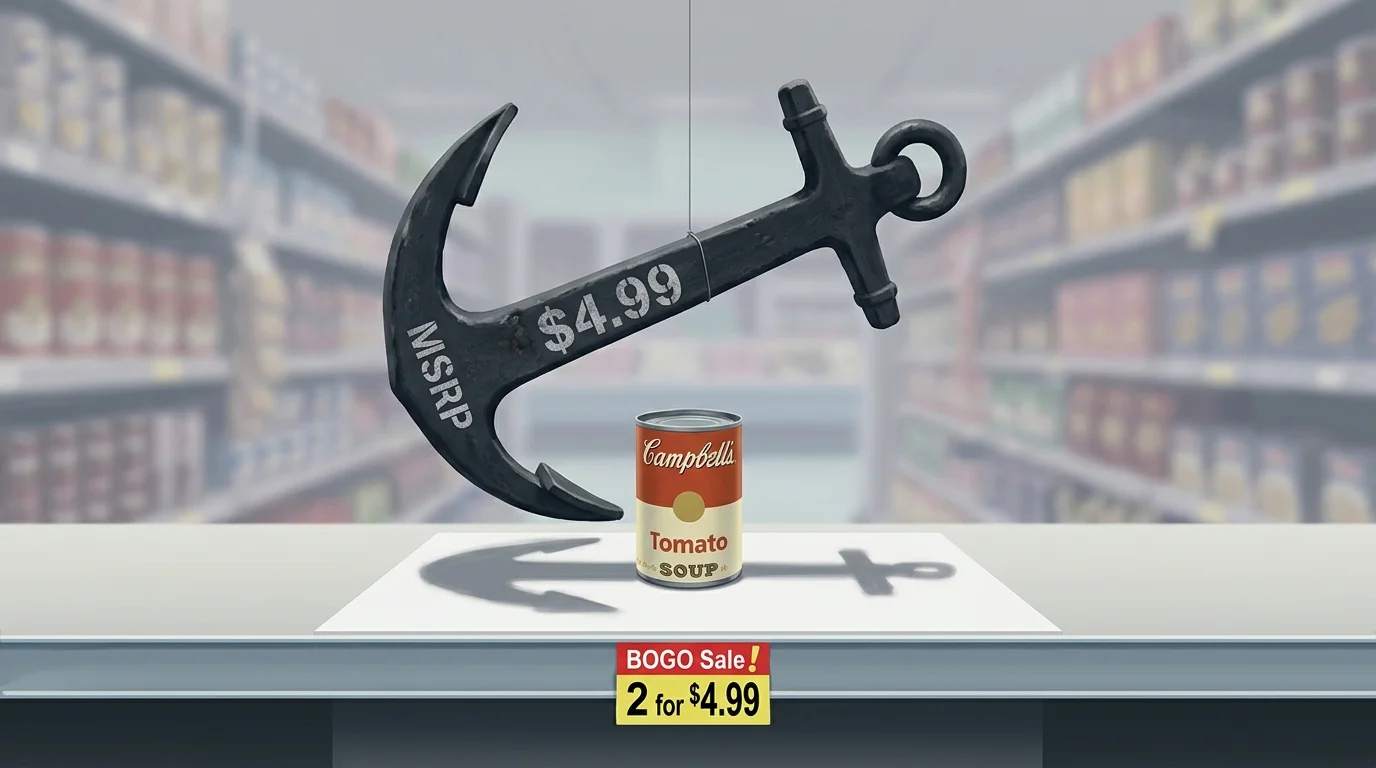
Deceptive BOGO promotions extend far beyond the grocery aisle into fast fashion, department stores, footwear outlets, and vitamin shops. Retailers in these sectors frequently employ “phantom reference pricing”—the practice of inventing inflated manufacturer suggested retail prices (MSRP) that no consumer ever actually paid.
By establishing a fabricated baseline price, retailers make BOGO promotions look like incredible windfalls when they are simply selling products at their intended profit margins.
Fast-fashion giant Boohoo, parent company to PrettyLittleThing and Nasty Gal, settled a major federal class-action lawsuit for $197 million over allegations of deceptive reference pricing and fake markdown sales across its digital storefronts.
Similarly, legacy department stores JCPenney and Kohl’s settled landmark false reference pricing lawsuits for $50 million and $6.15 million, respectively.
These legal actions revealed that apparel items frequently carried original price tags inflated by 100% to 300%, ensuring that BOGO sales generated massive profit margins despite looking like deep discounts.
Vitamin and supplement chains run similar BOGO campaigns year-round on proprietary house brands. If a bottle of multivitamins continuously carries an inflated $39.99 sticker price alongside a permanent “Buy One, Get One Free” banner, the actual retail value of each bottle is simply $20.00.
Treat permanent BOGO promotions on apparel and supplements with extreme skepticism, and always compare prices against independent third-party retailers before buying.
The Bottom Line: What This Means for Your Wallet
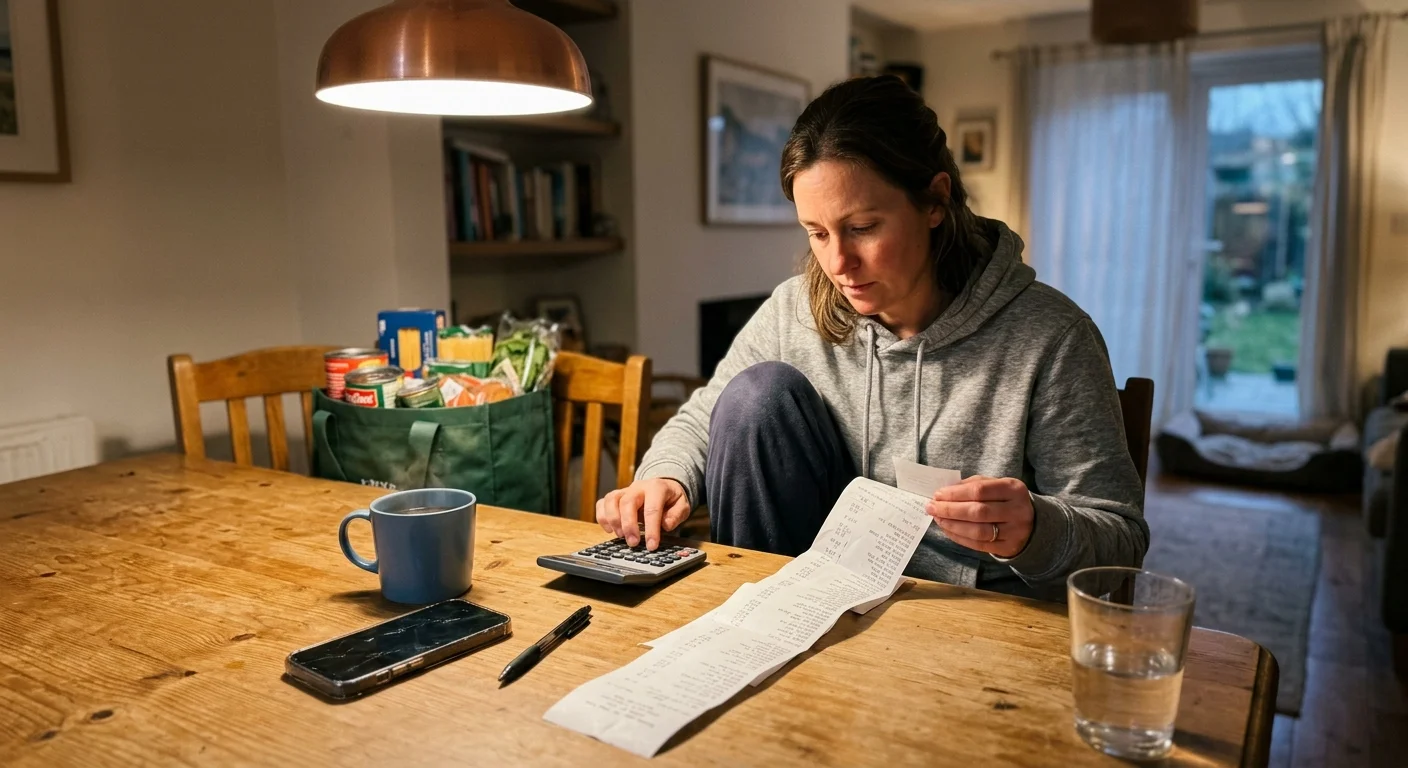
Buy One, Get One promotions serve the financial interests of retail corporations and brand manufacturers by accelerating inventory turnover, masking stealth price hikes, and forcing consumers to double their out-of-pocket spending.
While authentic BOGO sales on shelf-stable goods you already use can provide meaningful household savings, uncritical shopping based on bright promotional tags reliably drains your wallet.
To keep your household budget secure, adopt a strict evaluation process whenever you encounter a BOGO promotion.
Compare the promotional unit price against generic store brands and bulk warehouse rates, verify baseline price histories, and honestly assess your household’s ability to consume perishable items before they spoil.
By focusing on total cash outlay and true unit costs rather than the psychological allure of the word “Free,” you retain complete control over your grocery and retail budget.
For consumer protection information, visit the Federal Trade Commission (FTC) and the Consumer Financial Protection Bureau (CFPB). For product safety and reviews, consult Consumer Reports.
Disclaimer: This article is for informational purposes only and does not constitute financial advice. The content reflects the author’s opinion and research at the time of writing.
Always do your own research before making financial decisions.
Frequently Asked Questions
Is a BOGO deal always worse than a direct 50% discount?
A BOGO promotion is almost always mathematically inferior or equal to a direct 50% discount on a single item. A direct 50% discount gives you complete spending flexibility, allowing you to purchase only the quantity you need while keeping extra cash in your bank account.
BOGO deals force you to double your purchase volume and out-of-pocket expenditure to access the discount, increasing the risk of product expiration and unnecessary domestic clutter.
How can I verify whether a store marked up a price before a BOGO promotion?
You can verify historical pricing by using barcode-scanning price tracking apps, checking online retail aggregators, or inspecting physical shelf tags for recently placed price stickers over older baseline tags.
In addition, comparing the primary price against competitor grocery chains will instantly reveal whether the base item has been marked up above the prevailing regional market rate.
Do grocery stores allow you to buy just one item for half price on a BOGO sale?
Store scanning policies vary significantly by supermarket chain and regional market regulations. Some grocery retailers automatically ring up a single BOGO item at half price at the register, giving you the full discount without requiring duplicate purchases.
However, many national supermarket chains enforce an all-or-nothing rule that requires you to purchase both units to trigger the promotional discount. Check your store’s weekly circular or scan a single item at a price-check terminal to verify how your local store handles BOGO transactions.
Can I combine manufacturer coupons with BOGO promotions?
Most major grocery stores permit shoppers to apply manufacturer coupons to BOGO sales, but coupon redemption policies differ.
Some stores allow you to apply two manufacturer coupons to a BOGO transaction—one for each physical item purchased—while others only accept a single coupon for the primary paid item.
When stacked successfully with bona fide BOGO promotions on non-perishable goods, manufacturer coupons can drive your net unit cost below generic store-brand prices.