Walking into a supermarket on Saturday morning is the fastest way to blow your food budget. Retail chains count on rushed weekend shoppers grabbing full-price items without checking unit prices or markdown racks.
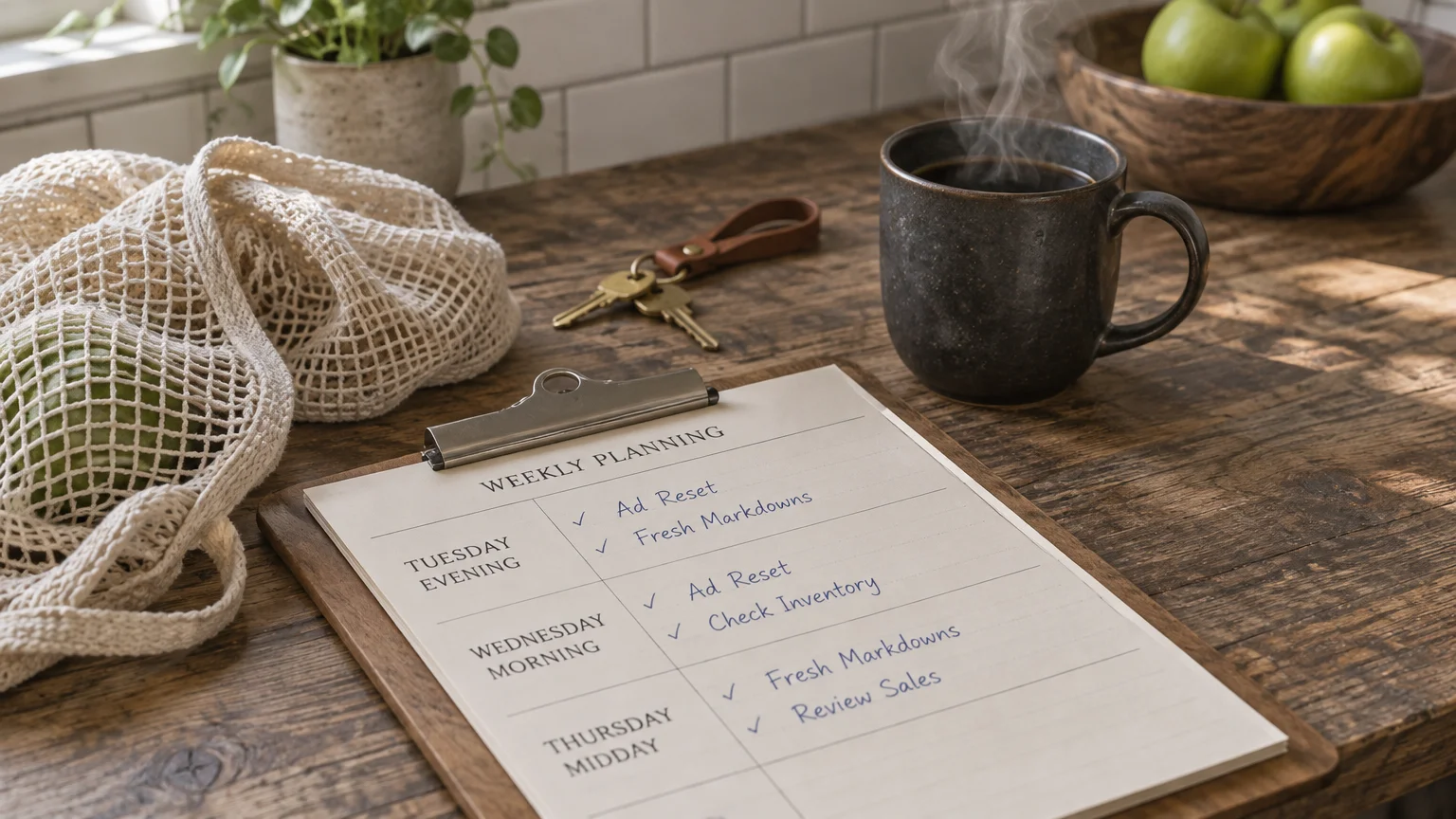
Timing your trips around store ad resets, clearance schedules, and quiet traffic windows flips that script immediately. You get first dibs on fresh promotions and deep perishable discounts before shelves are picked clean.
This insider guide breaks down the exact days and hours to hit Walmart, Target, and Kroger so you keep more cash in your pocket every single week.
Shopping Trap #1: Following the Weekend Crowd Straight Into Full-Price Traps
Most Americans shop on autopilot, loading up their carts between Friday afternoon and Sunday evening. Stores love this predictable stampede because crowded aisles trigger urgency and impulse spending.
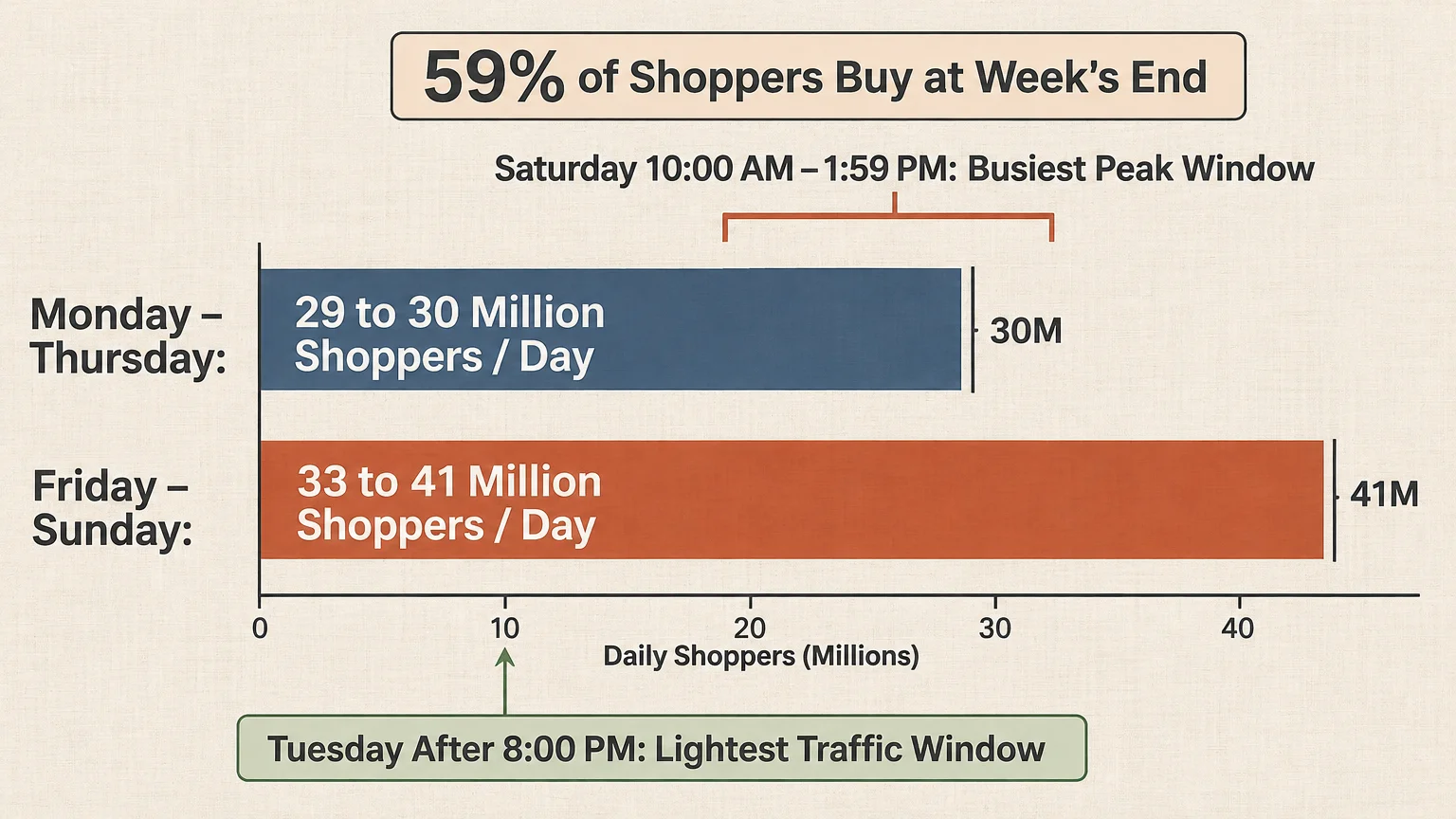
According to consumer research firm Drive Research, 59% of shoppers buy groceries at the end of the week. That habit turns Saturday between 10:00 a.m. and 1:59 p.m. into the busiest shopping window in the country.
Time Use Institute data cited by Business Insider paints the same lopsided picture. U.S. grocery stores average 29 to 30 million shoppers per day from Monday through Thursday, compared with 33 to 41 million per day Friday through Sunday.
Why Crowded Aisles Cost You More in 2026
When food prices climb, shopping alongside millions of distracted weekend buyers becomes an expensive habit. You skip price comparisons just to escape long checkout lines faster.
Data from the U.S. Bureau of Labor Statistics Consumer Price Index released November 10, 2026, shows food at home prices rose 0.4% month-over-month in October 2026. Meats, poultry, fish, and eggs jumped 0.5%, beef rose 0.9%, and dairy and produce climbed 0.6%.
Those incremental hikes add up quickly against real household budgets. The 2025 BLS Consumer Expenditure Survey shows one-person households spent an average of $282 per month on groceries, while married couples without children spent about $574 per month.
Families of four spent roughly $743 per month on groceries in that survey, alongside $512 per month on food away from home. Meanwhile, the USDA October 2026 Cost of Food at Home report estimates a family of four spends $1,025 monthly on the Thrifty Plan.
Under the USDA Low-Cost Plan, that monthly grocery figure climbs to $1,129, and the Moderate-Cost Plan hits $1,393. A couple aged 19 to 50 faces monthly USDA benchmarks ranging from $631 on the Thrifty Plan to $1,009 on the Liberal Plan.
The Quietest Grocery Shopping Days
Shifting your routine toward quieter grocery shopping days instantly lowers your stress and improves your discount odds. Drive Research reports that Tuesday nights after 8:00 p.m. see the lightest shopper traffic of the week.
Shorter, more targeted midweek runs are also gaining ground nationwide. Location analytics firm Placer.ai found that trips lasting under 15 minutes exceeded 40% of all U.S. grocery visits in 2025, up from 37.9% in 2022.
Low- and middle-income shoppers use these quick, focused visits to grab targeted markdowns instead of wandering massive aisles. When you shop midweek without a crowd breathing down your neck, sticking to a tight list gets dramatically easier.
Shopping Trap #2: Waiting for a Weekly Grocery Circular at Walmart
Many shoppers hunt every week for a traditional Tuesday or Wednesday grocery flyer from Walmart. That habit stems from confusing U.S. stores with Walmart Canada, which runs a Thursday-through-Wednesday weekly flyer.
In the United States, Walmart skips rigid weekly grocery circulars in favor of Everyday Low Prices and temporary Rollbacks. Walmart executives note that more than 7,000 Rollbacks can be active across stores during a single quarter.
Those Rollbacks last anywhere from a few days to several months on specific items. Food and beverage made up 59% of Walmart U.S. net sales—roughly $285 billion—in fiscal 2026, with like-for-like inflation around 1.3% in the third quarter.
The Real Best Day to Shop Walmart for Clearance
If you want the best day to shop walmart for steep markdowns, aim for Wednesday mornings before 10:00 a.m. Deal-tracking communities including StealAlert, The Krazy Coupon Lady, and Scavenger.ai report that stores commonly process weekly general merchandise clearance overnight Tuesday into Wednesday.
Arriving early Wednesday puts freshly marked-down home goods, electronics, and seasonal items directly in your path. Waiting until the weekend guarantees those red-and-yellow clearance endcaps are already empty.
Smart Walmart regulars also watch the calendar beyond single weekdays. Stores frequently conduct broader monthly inventory sweeps during the first five days of each month, followed by occasional final cuts during the last three days.
Morning Perishable Markdowns and Sunday Event Drops
Fresh food follows a daily clock rather than a weekly one at Walmart. Deal trackers note that meat and bakery departments routinely apply reduced-price stickers early each morning around 8:00 a.m. as items approach their sell-by dates.
Shopping around 8:00 a.m. on Tuesday, Wednesday, or Thursday lets you freeze discounted steaks, roasts, and artisan bread for pennies on the dollar. You avoid weekend traffic while intercepting freshly tagged perishables.
Major seasonal promotions follow predictable Sunday schedules as well. For example, Walmart Baby Days ran February 12 through March 30 and September 1 through September 30, 2026, delivering 35% to 70% off with new markdowns rolling out every Sunday.
How to Decode Walmart Clearance Tag Endings
Retailers rarely explain the numbers at the end of their clearance price tags, yet those digits tell you whether to buy now or wait. Practitioner reports from deal-tracking groups highlight a reliable pattern on Walmart shelf labels.
A clearance price ending in 5, such as $4.25, usually signals a first markdown that has room to drop again. Unless the item is down to the last unit on the shelf, waiting a week often saves you more.
By contrast, prices ending in 0 or 1, like $3.00 or $7.01, typically indicate a final floor price before store removal. When you spot a 0 or 1 ending on something you genuinely need, grab it immediately.
Shopping Trap #3: Shopping Target Before Sunday—Or Missing the Midweek Clearance Wave
Walking into Target on Saturday afternoon means shopping the tail end of a dying ad cycle. Popular sale items have been picked over for six days, and the next wave of discounts has not launched yet.
According to Target help documentation and promotions terms cited by Scavenger.ai and TotallyTarget, the Target Weekly Ad resets every Sunday between midnight and 2:00 a.m. Central time. Weekly promotional prices run Sunday through Saturday night at 11:59 p.m. Pacific time.
Shopping Sunday morning gives you first crack at fresh circular deals, gift card promos, and restocked shelves. If you prefer online pickup, placing your order Sunday morning locks in inventory before local shoppers clear out high-demand essentials.
The Truth About Target Clearance Schedules
One of the biggest myths in target shopping tips is that every store follows a rigid national clearance calendar. Longtime Target trackers AllThingsTarget and The Krazy Coupon Lady confirm that Target no longer enforces a strict universal day-by-department rule.
Actual markdown timing now shifts based on local store staffing and inventory backlogs. Even so, experienced trackers observe that heavy markdown waves still happen on Mondays and Tuesdays, while fresh clearance tags frequently print on Wednesdays.
Some individual locations still loosely echo an older unofficial department rhythm reported by DealHawk and Scavenger.ai. Under that pattern, electronics, kids’ apparel, and baby items lean Monday, while women’s apparel and domestics lean Tuesday.
Midweek tends to bring men’s apparel, health and beauty, and diapers on Wednesday, followed by housewares, home decor, toys, and shoes on Thursday. Cosmetics, automotive, and hardware often wrap up the week on Friday.
Reading Target Tag Endings and Markdown Tiers
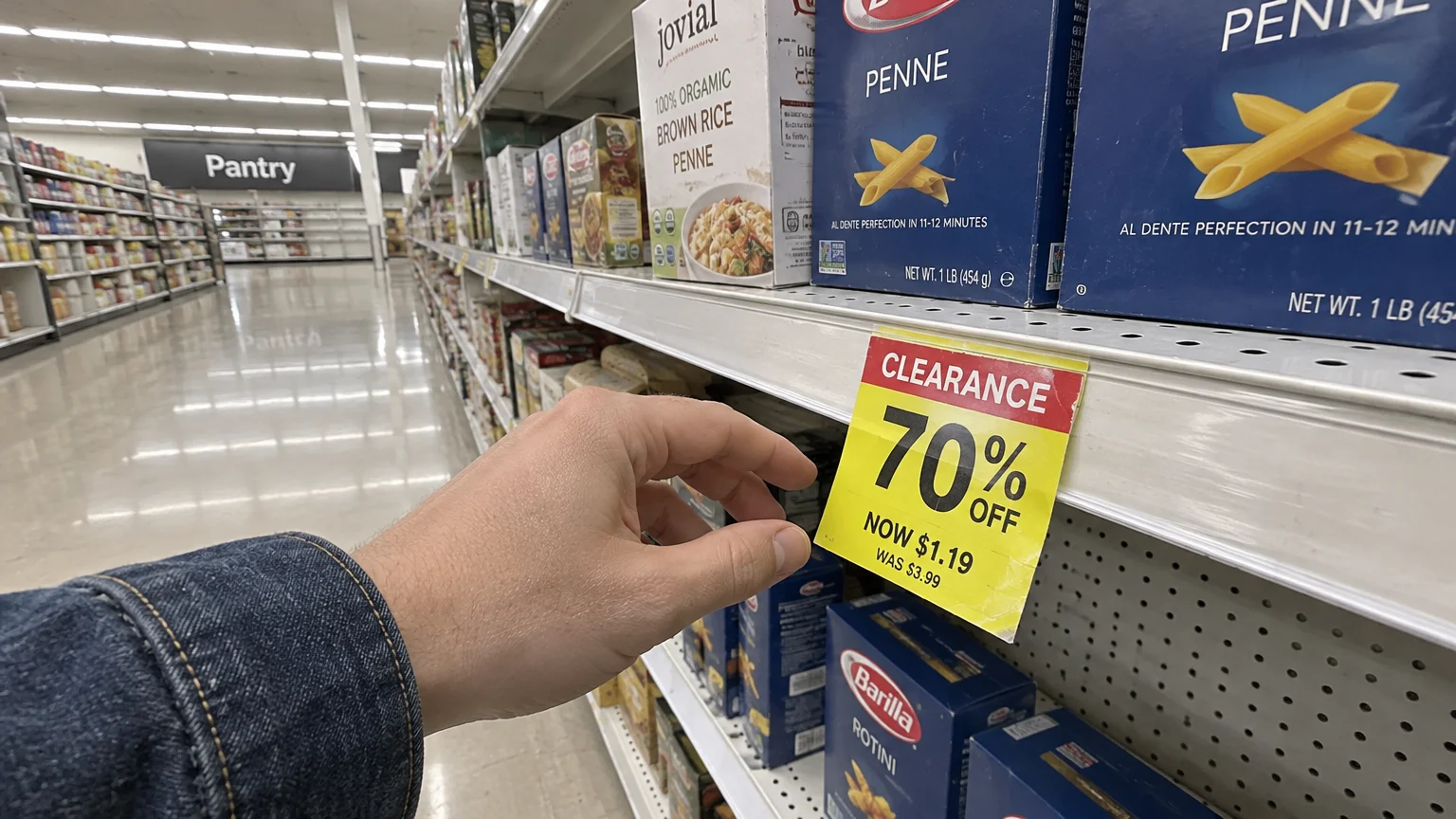
Standard Target clearance steps down predictably every one to two weeks in 30%, 50%, and 70% off increments before unsold goods head to salvage outlets. Checking the final two digits on a yellow clearance sticker reveals where an item sits in that cycle.
Price endings of .08 or .06 generally point to earlier markdown rounds, meaning another price cut may arrive soon. An ending of .04 signals a final markdown that will not drop further before disappearing.
Target reserves its famous 90% off clearance almost exclusively for post-holiday merchandise after Christmas, Halloween, Easter, and Valentine’s Day. According to The Krazy Coupon Lady, seasonal non-food items usually hit 50% off the day after a holiday, while candy starts at 30% off.
Around days three and four, non-food drops to 70% off and candy hits 50% off. Roughly one week after the holiday, remaining non-food drops to 90% off and candy bottoms out at 70% off.
Stacking Circle Offers and Event Windows
You leave easy money at the register if you shop Target without connecting your free Target Circle account. Target notes that most Circle offers now apply automatically at checkout both in-store and online.
Pairing free Circle promos with the Target Circle Card—available as a credit, debit, or reloadable card—shaves an everyday 5% off your total and unlocks free shipping on most online orders.
Target also anchors its calendar around major Target Circle Deal Days, which ran March 25–27, June 23–26, and October 6–7 in 2026 with discounts reaching 40% to 65% off. During the holidays, Target runs daily Deal of the Day offers from November 1 through December 24.
Shopping Trap #4: Missing Kroger’s Wednesday Reset and Tuesday Overlap
Unlike Target’s Sunday kickoff, Kroger operates on a midweek clock that trips up casual weekend buyers. Kroger’s standard weekly ad runs Wednesday through the following Tuesday, with new sales launching every Wednesday morning.
Official local ads usually appear on Kroger.com and inside the Kroger app on Tuesdays, while third-party preview sites often leak circulars as early as Saturday. That schedule makes Tuesday and Wednesday the two smartest days to plan your kroger deals.
Shopping on Tuesday lets you grab lingering end-of-cycle markdowns while previewing the next day’s ad on your phone. Returning—or waiting—until Wednesday morning gives you full shelves on brand-new weekly specials and digital coupons.
Hunting Morning Manager’s Specials
Kroger does not publish a fixed chain-wide clearance day for general merchandise or groceries. Instead, department managers walk the meat, dairy, bakery, and produce cases daily to mark down items approaching their sell-by dates.
Deal trackers Scavenger.ai, KrogerWeekly, and DontPayFull report that yellow or orange Woohoo!, Reduced, and Manager’s Special stickers typically go up on weekday mornings before 10:00 a.m., most often between 7:00 a.m. and 9:00 a.m. Those stickers slash prices by 30% to 70%.
Monday and Tuesday mornings are especially productive because staff clear lingering inventory ahead of the Wednesday ad reset. Dropping in early with freezer space waiting at home turns pricey proteins into budget staples.
Friday Fuel Points, 3-Day Sales, and Coupon Stacking
Friday earns a special spot on the Kroger calendar whenever Fuel Points promotions go live. Kroger periodically offers 4X Fuel Points on Fridays—such as June 12 through July 24, 2026, and November 2026—when you clip a digital coupon before shopping in-store, pickup, or delivery.
Kroger Plus is free and required for weekly sale prices and digital deals. Under official terms, shoppers earn 1 Fuel Point per $1 on groceries, 25 points per qualifying prescription, 75 points per 90-day refill, and 2X points year-round on participating gift cards.
Every 100 points equals $0.10 off per gallon at the pump, redeemable up to 1,000 points for $1.00 off per gallon on up to 35 gallons where permitted. Timing a large pantry stock-up on a 4X Fuel Points Friday stacks serious gas savings onto your grocery run.
Kroger also spices up weekends with rotating 3-Day Sales running Saturday through Monday alongside multi-week Mega Events, such as buying five or more participating items to save $1 each.
Per DontPayFull, Kroger allows stacking one manufacturer coupon—paper or digital—with one store coupon or sale per item, and Weekly Digital Deals usually apply up to five times in a single transaction.
Shopping Trap #5: Overpaying for Delivery Memberships You Barely Break Even On
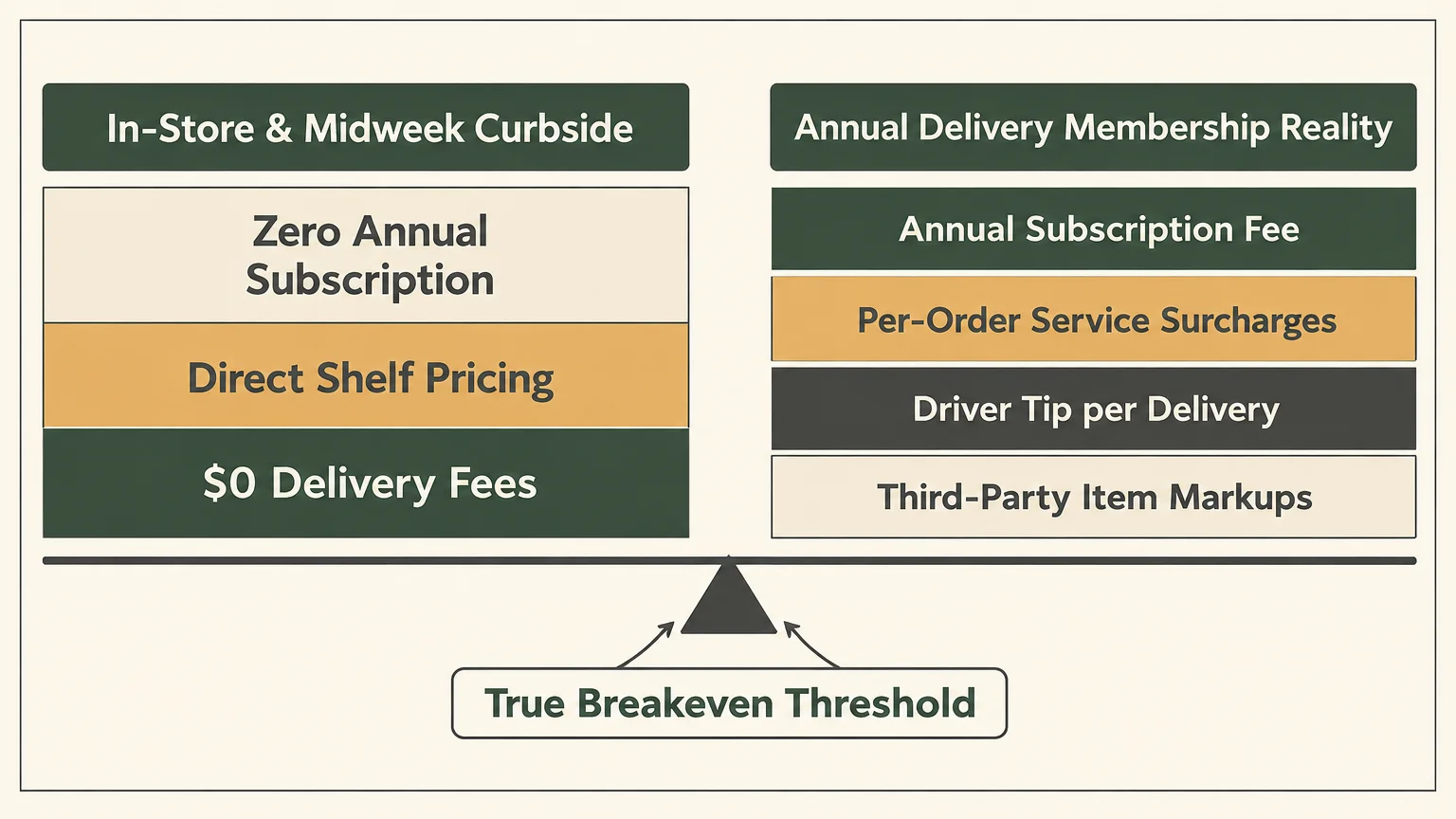
Retailers push paid annual memberships aggressively at checkout, promising effortless convenience and massive savings. Before handing over $69 to $99 a year, run the math on how often you actually order delivery.
At Walmart, standard curbside pickup and shipping are already free on orders of $35 or more without any membership. Paying $98 per year or $12.95 per month for Walmart+—or $120 bundled with Sam’s Club Plus—only makes sense if you use the extra perks consistently.
Walmart+ includes free store grocery delivery on $35+ orders, free shipping and pharmacy delivery with no minimum, up to $0.10 off per gallon of fuel at participating stations, and either Paramount+ Essential or Peacock Premium.
Members also get 25% off daily digital Burger King orders and three to five hours of early access to Black Friday and Cyber Monday deals.
Walmart estimates 12-month annual members save an average of $382 per year before subtracting the $98 fee. College students and qualifying government-assistance recipients can cut that cost in half through Walmart+ Assist at $49 per year or $6.47 per month.
Comparing Kroger Boost and Target Circle 360
Kroger raised Boost prices on April 10, 2025, creating two distinct tiers. Boost Essential runs $69 per year or $8.99 per month for free next-day delivery on $35+ orders, 2X Fuel Points daily, and a six-month trial of ad-supported Disney+, Hulu, or ESPN+.
Premium Boost costs $99 per year or $12.99 per month, upgrading you to same-day delivery in as little as two hours alongside an ongoing ad-supported streaming subscription. Verified SNAP, WIC, and Medicaid recipients qualify for 50% off through SheerID, lowering those annual rates to $34.50 and $49.50.
Target Circle 360 sits at $99 per year or $10.99 per month, delivering no-fee same-day Shipt orders over $35, extended return windows, and 24-hour early access to Target Circle Deal Days. Eligible Circle Card holders, students, teachers, military members, and government-assistance recipients qualify for 50% off in 2026.
Here is the contrarian takeaway: if you already drive past these stores on quiet Tuesday nights or Wednesday mornings, skip the annual fee. Using free curbside pickup on $35+ orders keeps your money working toward actual food instead of subscription overhead.

Shopping Trap #6: Getting Caught in Pre-Holiday Inventory and Markup Chaos
Even the sharpest bargain hunter loses leverage during major holiday rushes. Stores slash deep-discount variety and jack up crowd stress right before Thanksgiving, Christmas, and big summer weekends.
Placer.ai traffic data from November 26, 2025—known as Turkey Wednesday, the day before Thanksgiving—shows overall U.S. grocery traffic spiked 82.6% above the 12-month daily average. Traditional chains like Kroger surged an astonishing 104.1% above a typical Wednesday.
Holiday weeks also disrupt normal circular calendars. For instance, Kroger shifted its standard Wednesday schedule for its November 18–26, 2026 Thanksgiving ad, while Target routinely alters its Sunday–Saturday pattern around Black Friday.
Treat holiday weeks like an early-bird sprint to save money groceries without panic buying. Grab shelf-stable baking ingredients, butter, and frozen items two weeks early when Tuesday nights are still empty, then grab only fresh produce on the Monday before the rush.
Shopping Trap #7: Ignoring Store-Specific Protections and Unit-Price Illusions
A bright yellow clearance tag or a massive endcap sign does not automatically guarantee a good deal. Stores frequently place full-price convenience sizes next to discounted multi-packs or shrink package weights while keeping prices flat.
Always divide the sticker price by ounces, pounds, or count before dropping any sale item into your cart. A Mega Event discount or Rollback loses its shine fast if a smaller store brand sits two shelves higher for 20% less per ounce.
Watch your receipt at checkout, too, because weekly reset days occasionally trigger register pricing glitches when old signs come down late. Catching an unapplied digital coupon or a missed markdown at customer service protects your budget immediately.
To check for scams and false advertising, visit the FTC. For unbiased product reviews, consult Consumer Reports.
Business ratings are available at the Better Business Bureau.
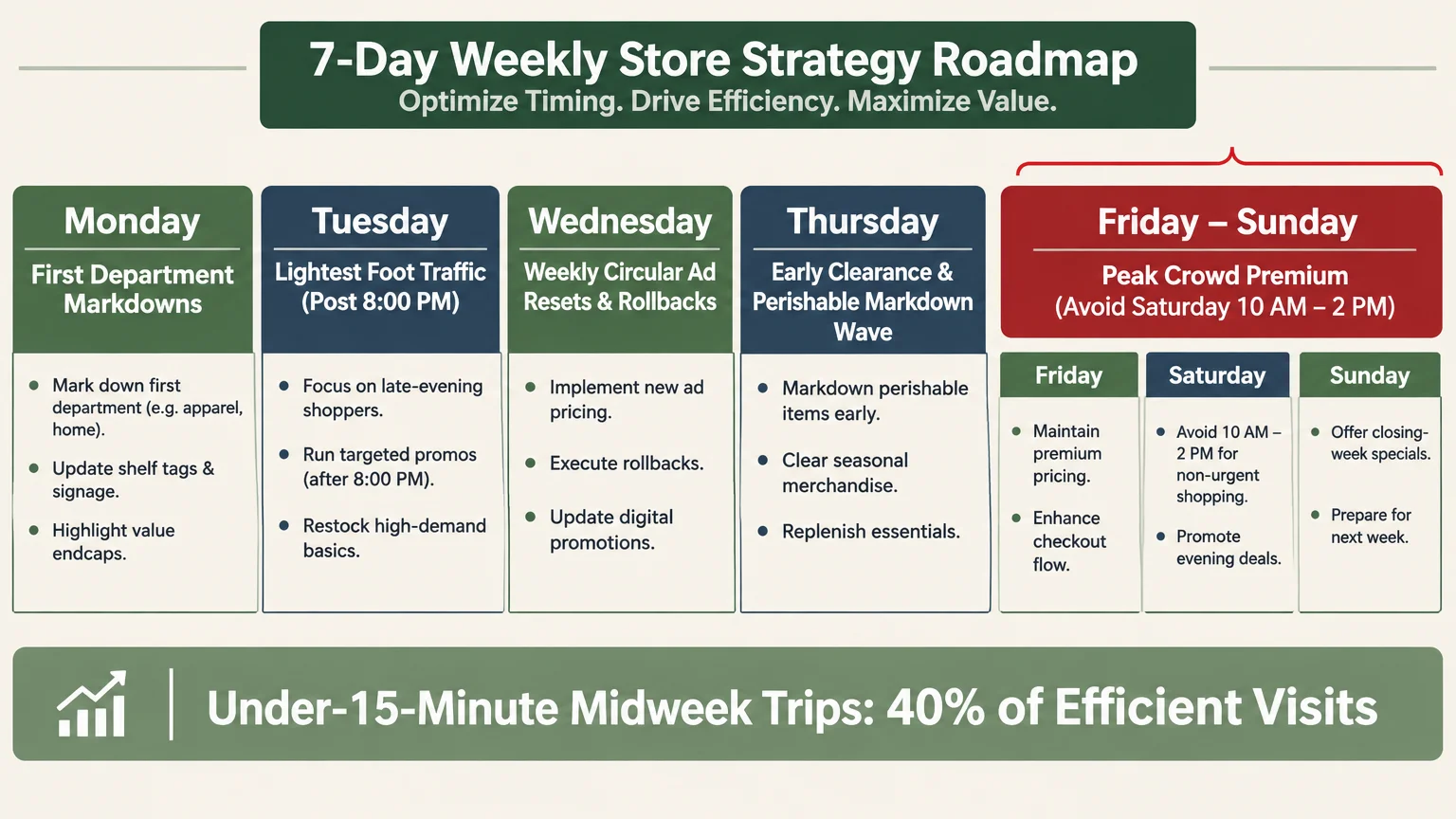
Your Action Plan: How to Be a Smarter Shopper
You do not need to visit three different stores every day to beat retail pricing games. Pick your primary store based on your weekly route, then match your shopping trip to its exact reset and markdown schedule.
On Sunday mornings, browse Target’s fresh Weekly Ad right after its midnight-to-2:00 a.m. Central reset and place a free Circle pickup order or stack your 5% Circle Card discount. Sunday also brings fresh seasonal event markdowns at Walmart during promotions like Baby Days.
On Monday and Tuesday mornings, swing by Kroger before 10:00 a.m. for pre-reset Woohoo! meat and bakery stickers while previewing Wednesday’s upcoming circular in the app.
If you need a quiet, full-cart grocery run anywhere, Tuesday night after 8:00 p.m. offers the calmest aisles in America.
Make Wednesday morning before 10:00 a.m. your powerhouse bargain window. Hit Walmart for overnight general merchandise clearance and fresh 8:00 a.m. perishable cuts, or shop Kroger to claim brand-new Wednesday ad deals while shelves are full.
Save Friday exclusively for Kroger pantry stock-ups whenever a 4X Fuel Points digital coupon is active. Pair that Friday trip with gift cards you already use—or routine pharmacy pickups—to push your gas savings toward $1.00 off per gallon.
Frequently Asked Questions
What is the single quietest time to go grocery shopping?
Tuesday night after 8:00 p.m. consistently ranks as the quietest grocery window nationwide. Weekend crowds drop sharply Monday through Thursday, while Saturday between 10:00 a.m. and 1:59 p.m. remains the worst time for congestion.
Do Walmart, Target, and Kroger follow a guaranteed national clearance day?
No major chain enforces a strict, published national clearance schedule across every store. However, deal trackers consistently see Walmart general merchandise markdowns hit Wednesday mornings, Target markdowns cluster Monday through Wednesday, and Kroger perishable stickers appear weekday mornings before 10:00 a.m.
Is a paid delivery membership worth it if you only shop once a week?
If you already drive past your favorite store, free $35+ curbside pickup at Walmart or standard in-store shopping usually beats paying $69 to $99 per year.
Memberships like Walmart+, Kroger Boost, or Target Circle 360 mainly pay off for families ordering delivery weekly, using included streaming services, or qualifying for 50% assistance discounts.
How can you tell if a clearance tag at Walmart or Target is at its lowest price?
Look closely at the last digit or two on the yellow clearance price tag.
At Walmart, tags ending in 5 usually mean an initial markdown that could drop again, while 0 or 1 endings typically signal a final price; at Target, .08 or .06 endings suggest early cuts, whereas .04 usually marks the bottom.
Disclaimer: The opinions in this article are for informational and entertainment purposes. Brands, products, and store policies can change.
Always verify information and prices before making a purchase.