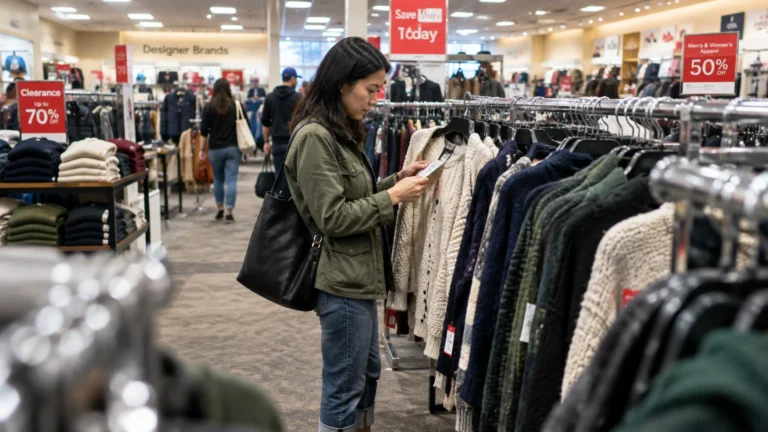
Retailers use flash sales to trigger panic buying, but most of these time-sensitive bargains are carefully engineered psychological traps rather than genuine discounts.
You can protect your hard-earned cash by learning how brands manipulate list prices, inventory counters, and artificial deadlines to force immediate checkout decisions. Marketing departments know that when you fear missing out, your critical thinking takes a backseat to urgency.
Understanding deceptive flash sale marketing tactics gives you the upper hand every time you shop online. Instead of falling for manufactured scarcity, you can easily verify whether a limited-time deal represents a real bargain or an overpriced illusion designed to drain your wallet.
Tip #1: The Inflated Reference Price (Fake Anchor Pricing)
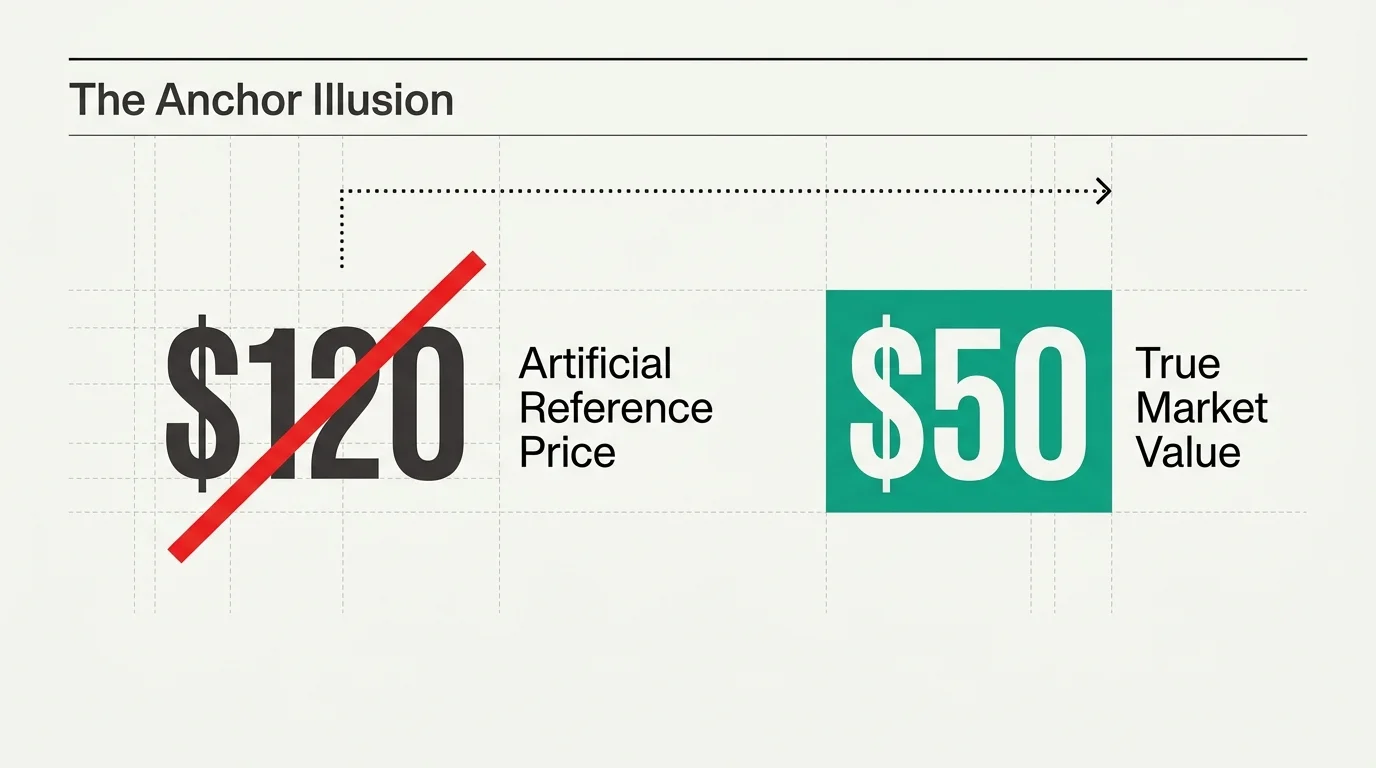
The most widespread deception in modern retail involves price anchoring. A retailer advertises a jacket for 50 dollars, crossing out an “original” price of 120 dollars to make you feel like you just captured a massive 70-dollar windfall.
In reality, the store never sold that jacket for 120 dollars; they established an artificial reference price solely to make the current transaction look irresistible.
These flash sale pricing tricks rely on your cognitive bias to evaluate value based on the perceived discount rather than the item’s true market worth.
Federal regulations explicitly forbid this deceptive practice.
Under the Federal Trade Commission’s Guides Against Deceptive Pricing (16 CFR § 233.1), retailers cannot legally advertise a discount against a former price unless that reference price was a bona fide price at which they openly offered the product on a regular basis for a reasonably substantial period.
Despite Section 5 of the FTC Act prohibiting unfair or deceptive practices, online storefronts routinely inflate reference numbers hours before launching a promotional event.
To avoid falling for phantom discounts, always ignore the crossed-out price. Focus entirely on whether the current asking price aligns with your budget and the item’s competitive market value.
Using browser extensions to verify price history immediately exposes whether a retailer hiked the sticker price yesterday just to slash it today.

Tip #2: The Resetting Countdown Timer
A giant red digital clock counting down from fifteen minutes creates an adrenaline spike. Retailers place these ticking clocks prominently on product pages and checkout screens to short-circuit your deliberation process.
When you believe the deal vanishes in minutes, you skip comparing prices across competing stores and rush to enter your payment details. In thousands of instances, however, that urgent deadline is entirely fabricated.
Academic research proves just how pervasive this trick has become. A landmark study conducted by researchers at Princeton University analyzed roughly 53,000 product pages across 11,000 shopping websites and identified over 1,800 dark pattern instances.
The researchers discovered 140 individual retail sites running deceptive countdown timers that automatically reset the moment the visitor refreshed the web page or cleared their browser cookies. The ticking clock existed purely as a client-side JavaScript loop designed to manufacture panic.
Regulators have taken notice of these manipulative interfaces. In its comprehensive staff report, Bringing Dark Patterns to Light, the FTC classified false countdown timers that do not reflect an actual deadline as unlawful, deceptive design patterns.
When spotting fake flash sale urgency, test the deadline yourself: open the product listing in a private browsing window or refresh the page after ten minutes. If the clock jumps back to its starting time, walk away from the manufactured emergency.

Tip #3: Phantom Scarcity and Social Proof Popups
Nothing forces a hasty purchase quite like seeing a flashing banner that screams: “Only 2 items left in stock — 38 people have this in their cart!” E-commerce platforms deploy these dynamic alerts to convince you that competing buyers will snatch the product if you hesitate for even thirty seconds.
While legitimate low-stock indicators exist, many promotional storefronts use arbitrary scripts that generate random inventory numbers completely detached from actual warehouse levels.
These social proof notifications often rely on basic code that produces randomized names and locations to claim that “Sarah from Dallas just bought this item 4 minutes ago.” The underlying e-commerce template generates these messages on a timed loop to create an illusion of hyper-demand.
By convincing you that inventory is evaporating, the merchant eliminates your incentive to research competitor pricing or sleep on the buying decision.
You can quickly expose artificial scarcity by testing the shopping cart mechanics. Attempt to add five or ten units of the “almost sold out” item to your digital cart.
If the website allows you to proceed to checkout with a bulk quantity despite claiming only two units remain, the scarcity warning is a blatant marketing trick. Reliable flash sale shopping tips always prioritize objective verification over emotional impulse.
Tip #4: The “Up to 80% Off” Exclusion Shell Game
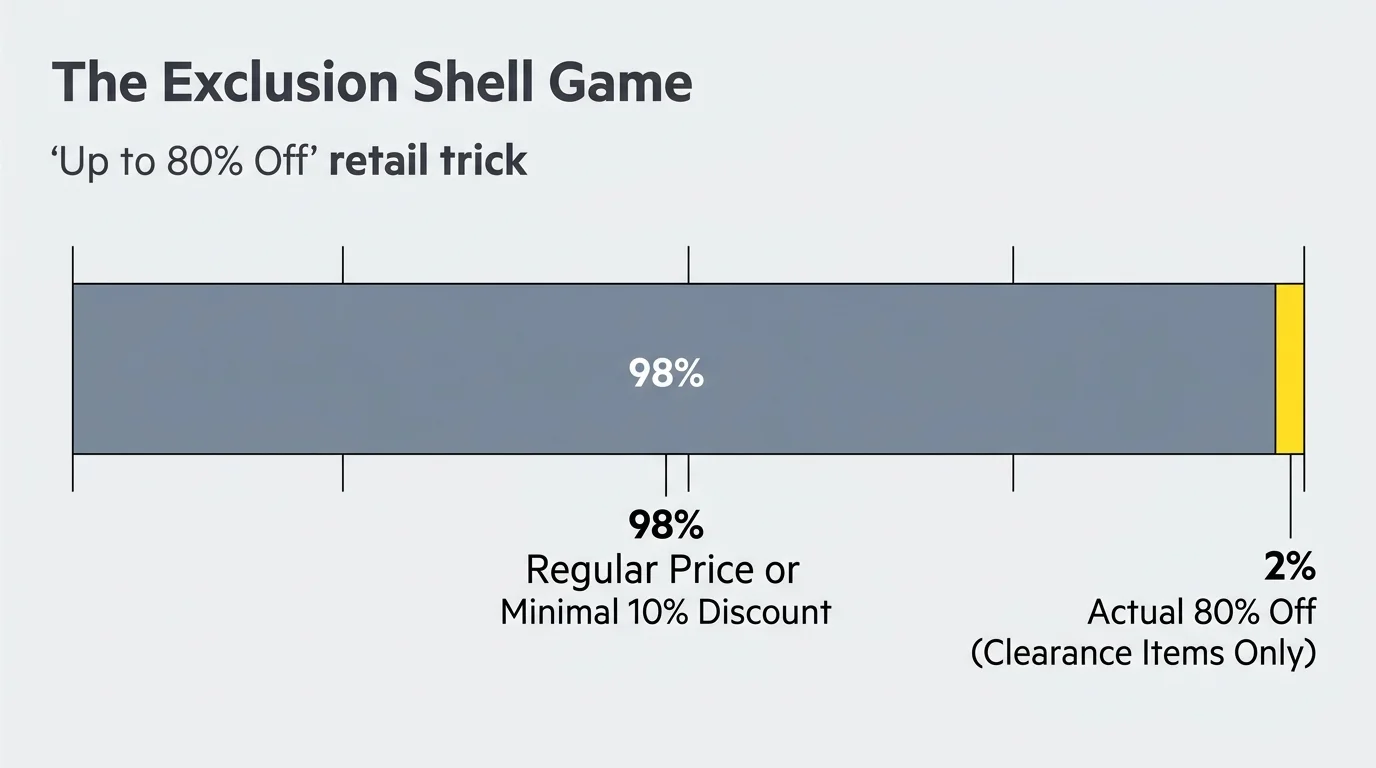
Promotional banners trumpeting discounts “up to 80% off” serve as powerful clickbait, drawing millions of budget-conscious shoppers into digital storefronts.
However, when you dig into the actual catalog, you quickly discover that the steep 80% markdown applies exclusively to three irregular items in undesirable sizes or obsolete colorways.
The mainstream, high-demand products featured in the marketing imagery carry a negligible markdown of five or ten percent—or find themselves excluded entirely from the sale.
Retailers frequently hide extensive exclusion lists behind tiny asterisks and buried terms of service.
You spend twenty minutes filling your cart with items you assume qualify for the promotional event, only to discover at the final payment step that your selections are ineligible for the discount code.
Brands count on “sunk cost fallacy” here; once you invest time selecting items and filling out your shipping details, you are far more likely to complete the transaction anyway even without the advertised discount.
Save your time by filtering promotional categories strategically.
Whenever you land on a flash sale collection, immediately sort the results by “Discount: High to Low” or “Price: Low to High.” This simple adjustment reveals whether the merchant stocked meaningful quantities of deeply discounted goods or merely used a handful of junk clearance items to justify an exaggerated marketing headline.
Tip #5: Derivative Products and Stripped-Down SKUs
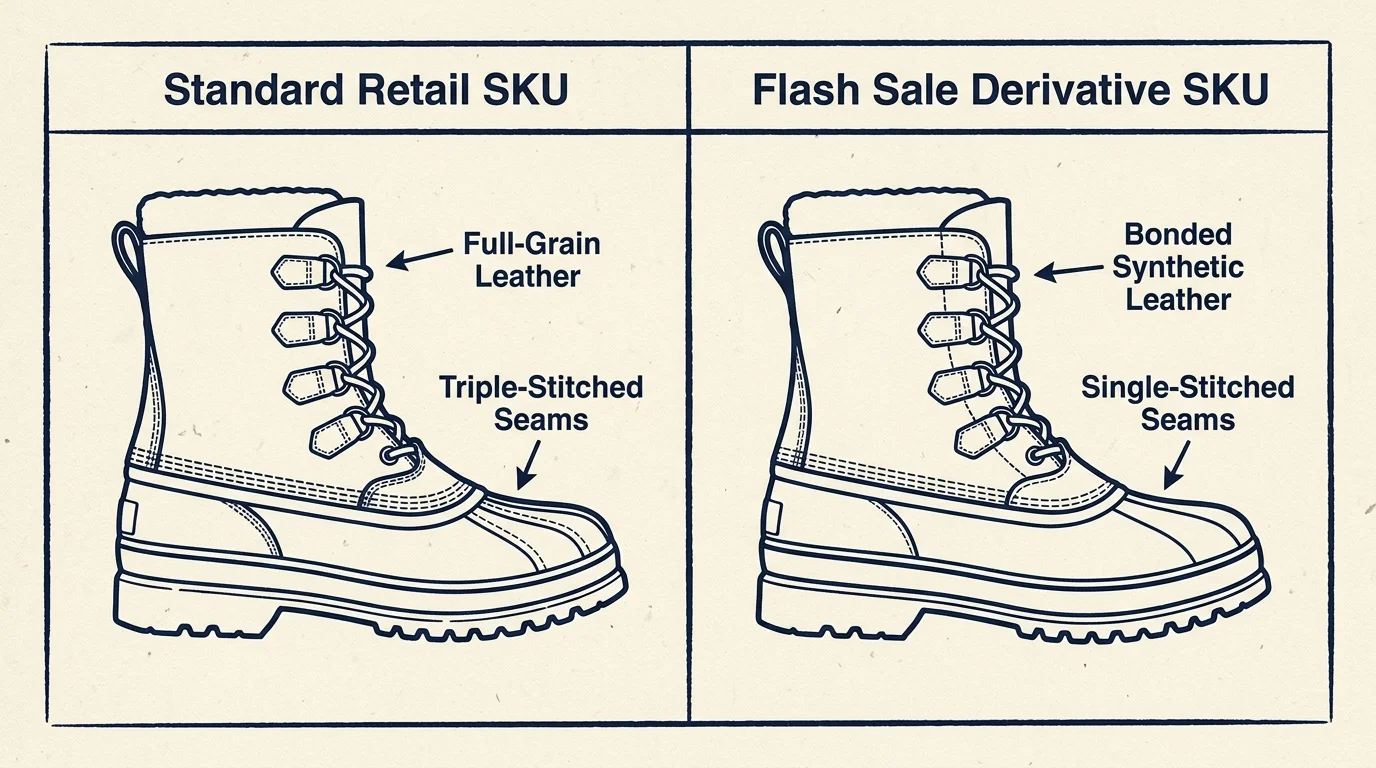
Are flash sales really discounts on premium goods, or are you buying an inferior product engineered specifically for doorbuster pricing? Major manufacturers in consumer electronics, home appliances, and apparel frequently produce “derivatives”—specialized product lines built with cheaper components to hit aggressive promotional price points.
While the product looks nearly identical to a flagship model on the outside, its internal specifications tell a very different story.
In the electronics sector, flash-sale televisions and laptops often feature slight alterations to their model numbers (such as an extra letter at the end of the SKU).
These derivative versions may include fewer HDMI ports, lower-grade display panels, reduced internal memory, or plastic chassis parts substituted for durable aluminum casing.
Clothing brands apply the same principle to outlet and flash events by using synthetic fabric blends, single-stitched seams, and omitted linings while branding the garment with their recognizable designer logo.
Always cross-reference the exact alphanumeric model number before buying an electronic device or appliance during a limited-time promotion. Search the manufacturer’s primary catalog to see if that specific model exists outside the sale event.
If independent product reviews and technical specification sheets for that exact SKU are nonexistent, you are likely looking at a stripped-down derivative designed to sell cheap rather than perform well over the long haul.

Tip #6: Restrictive Return Policies and All-Sales-Final Traps
A legitimate retailer stands behind the quality of its merchandise regardless of the purchase price.
In contrast, predatory flash sale storefronts frequently modify their standard return terms during promotional events, quietly classifying discounted purchases as “Final Sale” or “Non-Returnable.” By the time your order arrives damaged, defective, or completely misaligned with the online description, you find yourself stuck with zero recourse.
Other merchants bury punitive terms inside their checkout conditions, such as mandatory 20% restocking fees or requirements that you pay return shipping back to an international warehouse.
When return shipping on a 40-dollar pair of shoes costs 25 dollars plus a restocking penalty, returning the item becomes financially pointless. Retailers leverage these strict policies to offload slow-moving, returned, or low-grade stock permanently from their ledgers onto unsuspecting consumers.
Never complete a flash sale transaction without locating and reading the return policy specifically applicable to sale items. If the merchant refuses to accept returns on defective merchandise or fails to provide clear prepaid return options, take your business elsewhere.
True savings never require you to surrender basic consumer protections.
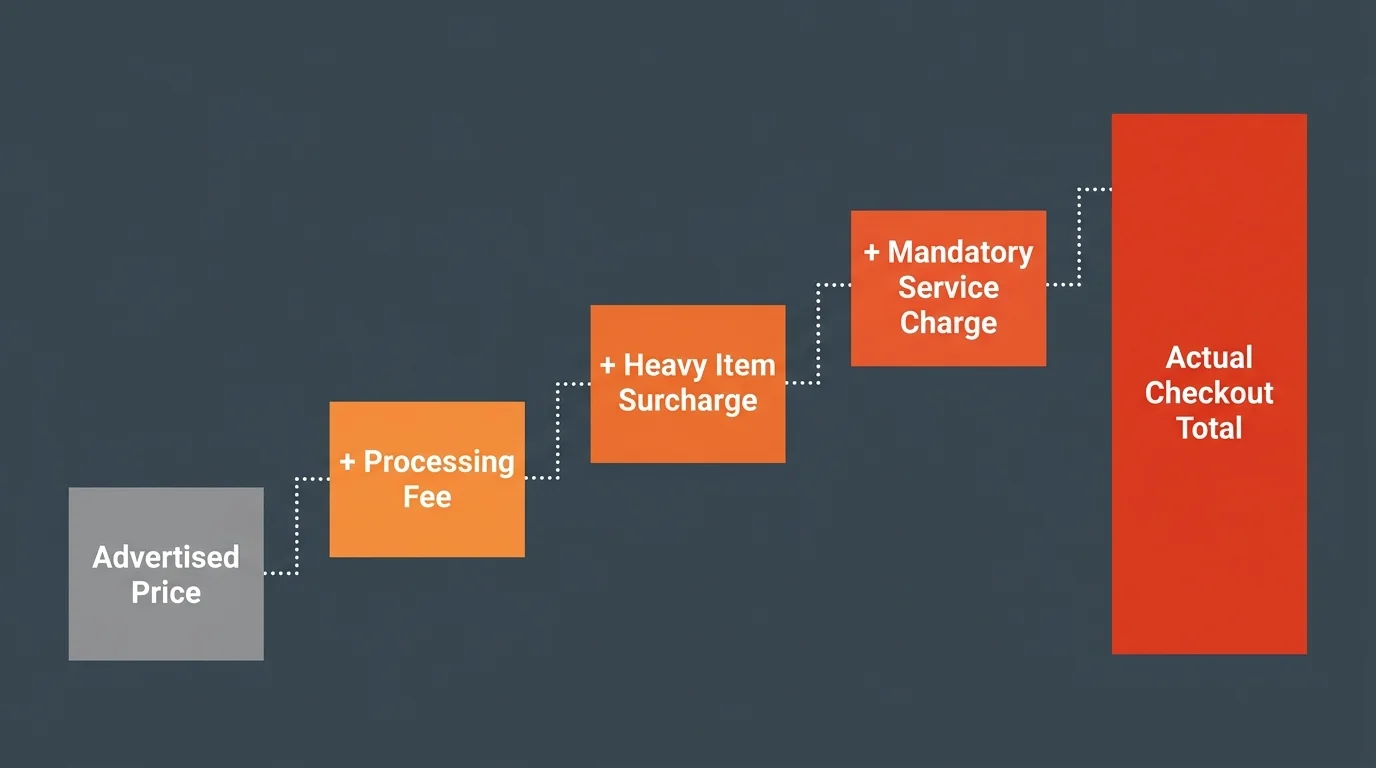
Tip #7: Drip Pricing and Checkout Surcharges
Drip pricing occurs when an online store advertises an ultra-low base price at the start of the shopping journey, only to increment the final cost incrementally with mandatory fees as you move through the checkout funnel.
A flash sale offering a pair of premium headphones for 35 dollars sounds incredible until the final payment screen tacks on an 18-dollar “promotional handling fee,” a 6-dollar “warehouse processing surcharge,” and inflated shipping rates.
By the time you reach the final confirmation button, the total cost exceeds standard market pricing.
Merchants use drip pricing because it exploits your psychological commitment. Having already typed your name, home address, and credit card number, you experience mental friction against abandoning the purchase over a few unexpected fees.
This deceptive practice masks the true price of the product until the absolute last moment, making fair price comparisons almost impossible during fast-moving sales.
Calculate your total landed cost before you evaluate whether a flash sale provides genuine value. Add up the base price, shipping fees, processing charges, and taxes to establish the real out-of-pocket expenditure.
If the merchant obscures these costs until the final click, cancel the transaction; honest businesses maintain transparent pricing from the product page to the receipt.
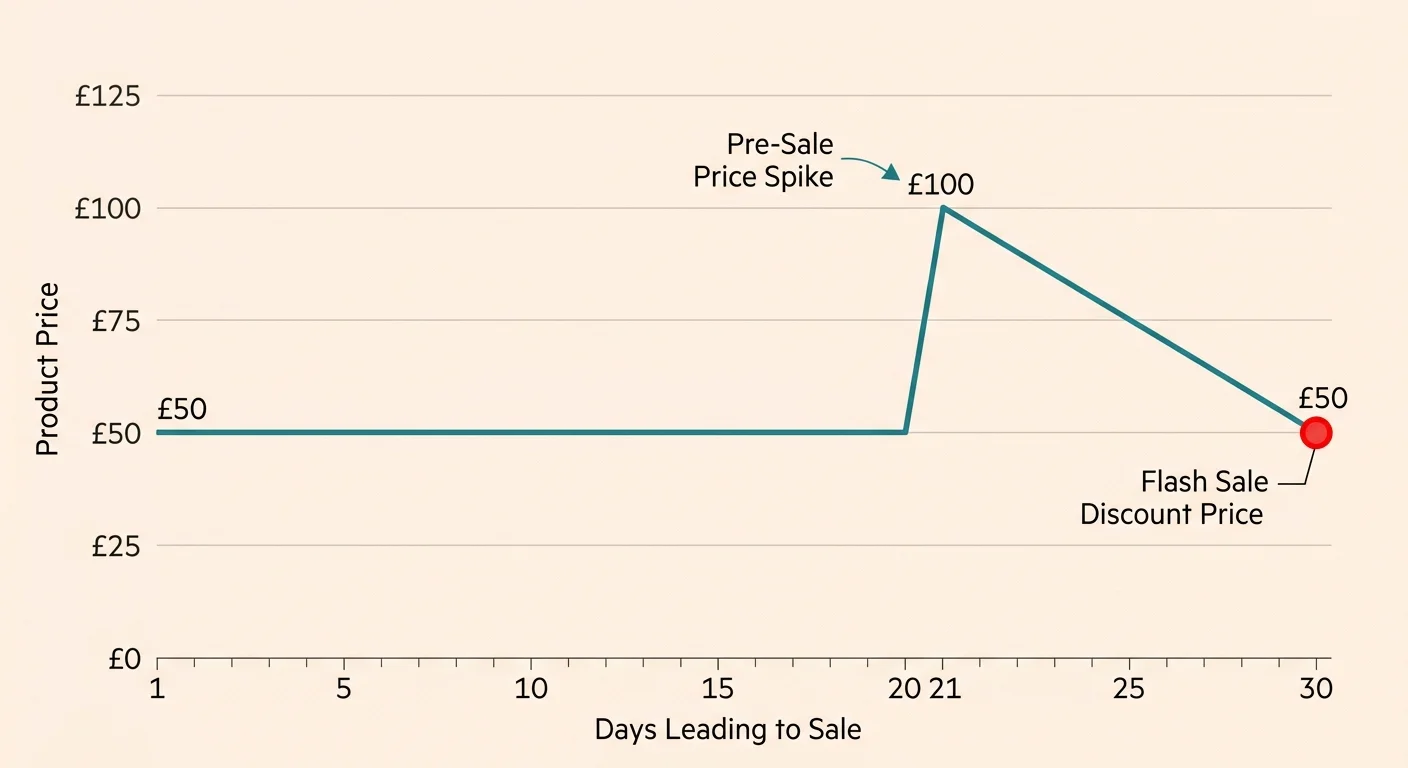
Tip #8: Cyclical Price Hikes Before Seasonal Events
Retail pricing follows predictable seasonal waves, and many advertised flash sales merely return an item to the price it carried two weeks prior. Ahead of major shopping holidays and quarterly clearance blowouts, stores often quietly elevate base prices by fifteen to thirty percent.
When the promotional banner goes live, they slash prices back to their standard baseline, marketing normal retail costs as a dramatic limited-time markdown.
Independent historical price-tracking data exposes these cyclical pricing roller coasters instantly. Tools like Camelcamelcamel and Keepa track the complete pricing history for millions of products on Amazon, showing every price adjustment across months or years.
Extensions like PayPal Honey and Capital One Shopping provide similar historical insights for general retail websites, allowing you to audit whether an advertised discount represents an actual all-time low or just normal pricing wrapped in flashy marketing.
Make historical price verification a mandatory habit before buying anything during a high-pressure promotional window.
If a product regularly sells for 80 dollars, jumps to 100 dollars for three days, and drops to 79 dollars during a “Massive 24-Hour Blowout,” you are witnessing basic marketing theater rather than a genuine discount event. Disciplined buyers check the data rather than trusting the promotional banner.
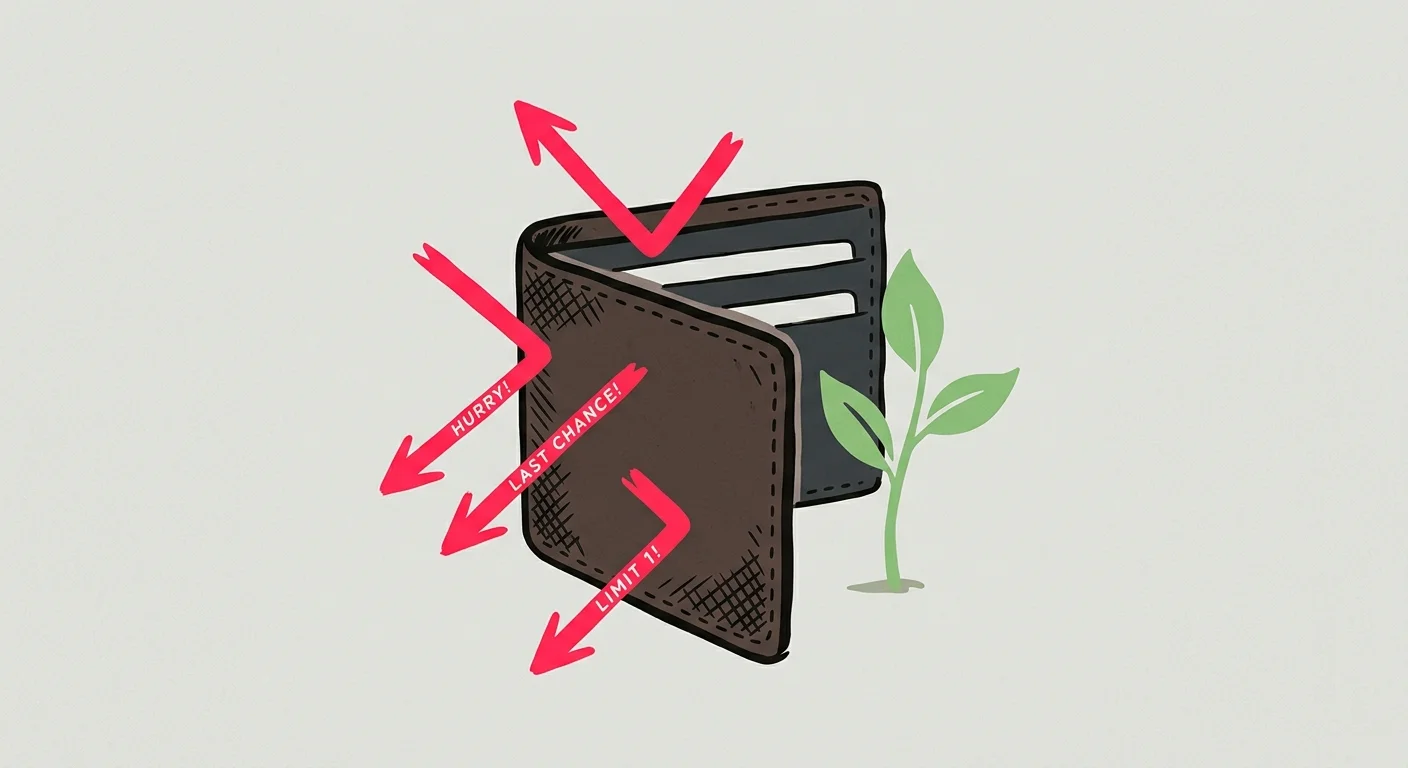
The Bottom Line: What This Means for Your Wallet
Flash sales are engineered to make you act on emotion rather than logic. Retailers leverage sophisticated psychological triggers—manufactured countdowns, artificial reference pricing, fake scarcity alerts, and hidden fees—to push you into impulse purchases that disrupt your budget.
When you understand the mechanics behind these promotional illusions, you strip marketing departments of their power to manipulate your spending habits.
Smart shopping requires an objective, methodical approach. Keep a written list of items you genuinely need, track their baseline prices over time using independent software, and ignore flashing banners designed to manufacture urgency.
If a deal is genuinely exceptional, the math will hold up under scrutiny without the help of a fake ticking clock. Protect your wallet by slowing down, verifying the historical data, and refusing to let artificial deadlines dictate your financial decisions.
For consumer protection information, visit the Federal Trade Commission (FTC) and the Consumer Financial Protection Bureau (CFPB). For product safety and reviews, consult Consumer Reports.
Disclaimer: This article is for informational purposes only and does not constitute financial advice. The content reflects the author’s opinion and research at the time of writing.
Always do your own research before making financial decisions.
Frequently Asked Questions
Are all flash sales deceptive, or do genuine deals actually exist?
Genuine flash sales do exist, particularly when established retailers need to clear seasonal inventory to free up physical warehouse space for incoming product lines. Overstock liquidations and end-of-season apparel clearances often offer legitimate, deep discounts.
The key difference lies in transparency: authentic sales do not rely on fake resetting clocks or inflated reference prices to justify their discounts.
How can I verify whether a flash sale price is truly the lowest historical price?
Use free price-tracking extensions such as Keepa or Camelcamelcamel for Amazon listings, which plot every historical price fluctuation on an interactive chart. For broader retail websites, tools like Capital One Shopping and PayPal Honey display recent pricing trends.
If the current promotional price sits at or near the 90-day median price, the sale is purely cosmetic.
What should I do if a retailer refuses to refund a defective item bought during a flash sale?
Review the merchant’s posted return policy to see if they disclosed “Final Sale” terms prior to purchase. If the merchant sent a damaged, broken, or materially misrepresented item, you retain rights under credit card consumer protection rules.
Contact your credit card issuer and file a dispute or chargeback, providing documentation of the merchant’s refusal to resolve the issue.
Why do online stores continue to use fake countdown timers if consumers are aware of them?
Stores continue using fake countdown timers because empirical sales data shows they work. Manufactured urgency taps into subconscious loss aversion, which frequently overrides analytical thinking during online checkout.
Until regulatory enforcement under consumer protection laws becomes universal and costly for deceptive retailers, brands will continue deploying these dark patterns to maximize their short-term conversion rates.