Retail giants want you to think both memberships pay for themselves automatically, yet choosing wrong drains fixed budgets fast. When comparing Amazon Prime vs. Walmart+ for retiree savings, the true winner depends on whether you buy weekly groceries or specialty boxes.
Base prices already show a stark divide at $139 per year for Prime versus $98 for Walmart+. Worse, sneaky add-on fees for food delivery, ad-free shows, and prescriptions quickly erase advertised discounts.
Here is what retailers hide inside the fine print—and how to keep hundreds of extra dollars in your retirement account this year.
Shopping Trap #1: The Sticker-Price Illusion and Monthly Billing Creep
Households headed by someone aged 65 and older spent an average of $64,445 per year in 2025, according to U.S. Bureau of Labor Statistics data released in October 2026. Spending drops even lower to $57,959 annually once retirees reach age 75 and older.
Every dollar matters on a fixed income, which explains why 55% of U.S. adults planned to slash subscriptions in 2026, per a NerdWallet survey. Yet both stores nudge shoppers toward expensive monthly auto-renewals instead of upfront annual plans.
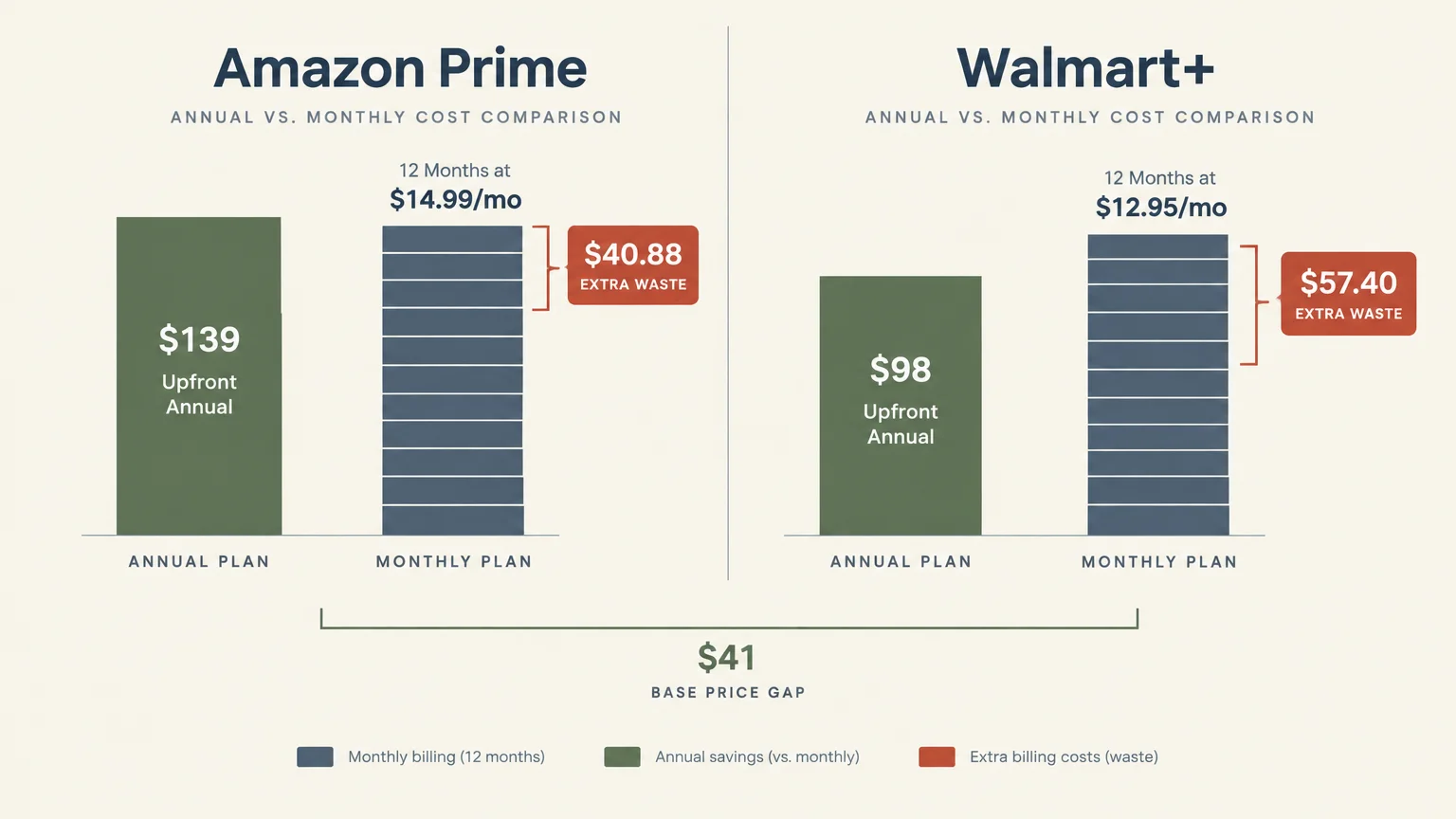
Amazon Prime charges $139 per year or $14.99 every month. Choosing monthly billing quietly costs you $40.88 extra over twelve months for the exact same Prime benefits.
Walmart+ pulls the same trick at $98 per year or $12.95 monthly plus tax. Paying month by month adds $57.40 in wasted fees every year, wiping out more than half the annual savings.
Even when you pay annually, standard Walmart+ undercuts Amazon Prime by $41 right out of the gate. That gap widens if you actually audit how many bundled perks sit unused on your account.
Walmart also pushes a $120-per-year bundle combining Walmart+ with a Sam’s Club Plus membership, including free Sam’s Club delivery on $50 orders. Before biting, verify you actually buy bulk staples worth that extra annual fee.
How to Beat the Billing Trap
Never stay on a monthly plan past your initial 30-day free trial unless you plan to pause during summer travel. Switch immediately to annual billing if you intend to keep the membership year-round.
Look out for periodic Walmart+ promotions offering your first month for $1 before standard pricing kicks in. Set a calendar alert three days before any trial expires so auto-billing never catches you off guard.
Shopping Trap #2: The Medicare Eligibility Myth on Discounted Plans
Both retailers heavily advertise half-price plans for seniors, creating a widespread myth that your Medicare card unlocks instant savings. Here is what they don’t want you to know: neither discount grants eligibility based solely on Medicare or standard Social Security retirement benefits.
Retailers bury those rules deep on enrollment pages while splashy banners promise easy access. Many retirees waste time uploading documents only to hit an unexpected rejection wall.
Amazon Prime Access costs $6.99 per month—over half off monthly Prime—but locks you into monthly billing with no annual option. Worse, it carries a strict four-year lifetime limit and forces mandatory annual re-verification.
To qualify for Prime Access, you must receive needs-based aid such as SNAP, EBT, Medicaid, SSI, WIC, or TANF, or pass income verification. Standard retirement checks alone will not get you approved.
Walmart+ Assist beats Amazon on both price and flexibility at $49 per year or $6.47 monthly plus tax. Eligibility verifies annually through SheerID without Amazon’s rigid four-year cutoff.
Walmart+ Assist also accepts a broader list of assistance programs. Alongside SNAP, WIC, Medicaid, SSI, and TANF, it welcomes LIHEAP heating aid, Federal Public Housing Assistance, and the Veterans and Survivors Pension Benefit.
Check Your Aid Letters First
If you receive SSI, Medicaid, SNAP, or heating assistance through LIHEAP, Walmart+ Assist saves you substantially more per year than Prime Access. Always apply using an official award letter before paying full price.
If you only receive Medicare and standard Social Security, test income verification on Prime Access if your household income is modest. Otherwise, skip the verification hoop and judge both services at their standard annual rates.

Shopping Trap #3: The Grocery Delivery Paywall That Ambush-Taxes Your Pantry
Groceries eat a huge chunk of retiree budgets, and online shopping for seniors often starts with avoiding heavy produce runs. Both companies dangle fresh food delivery—but only one includes it in the base sticker price.
Amazon hides unlimited grocery delivery behind a steep second subscription. On top of your $139 Prime fee, Amazon charges another $9.99 monthly or $99.99 per year for unlimited delivery from Whole Foods Market, Amazon Fresh, and local grocers.
Even Prime Access and registered EBT cardholders must fork over $4.99 extra per month for that grocery pass. Without the add-on, Prime members still pay a $9.95 delivery fee at Whole Foods on top of higher organic prices.
Think about the math before falling for bloated value claims. J.P.
Morgan analyst Doug Anmuth estimated Prime’s standalone perks at $1,000 to $1,430 yearly, yet adding grocery delivery nearly doubles your annual cash outlay before tax.
Walmart+ includes unlimited free store and grocery delivery on orders of $35 or more with zero extra subscription fee. Only orders under $35 trigger a $6.99 minimum order fee.
Walmart estimates annual members with at least twelve months of membership save an average of $382 per year, excluding the $98 fee. Avoiding repeated Whole Foods markups and secondary delivery passes explains how that gap adds up quickly.
Stop Paying Double for Milk and Eggs
If weekly groceries drive your online orders, Walmart+ wins this membership comparison effortlessly. Batch your pantry staples, produce, and paper goods into one weekly cart to cross that $35 free-delivery hurdle every time.
Keep driver tips in mind when budgeting for standard grocery drop-offs at either store. If tipping eats into your weekly grocery savings, compare Walmart’s tip-free upgrade options before committing.
Shopping Trap #4: Free Two-Day Shipping Minimums and Third-Party Bait
Retailers love advertising free shipping as an all-access pass, then slip minimum thresholds and exclusions into checkout screens. Knowing how both giants restrict shipping protects you from paying avoidable fees on small household replacements.
Amazon Prime includes free two-day shipping on millions of Prime-eligible items. However, free same-day or next-day delivery often demands a $25 order minimum, and smaller carts can trigger surprise fees for faster speeds.
Without Prime, Amazon forces non-members to spend $35—or $25 on books—just to unlock slow five-to-eight-day shipping. That friction pushes retirees into buying impulse filler items just to avoid a delivery charge.
Walmart+ delivers a sharper edge on small orders by offering free next-day and two-day shipping with zero order minimum. You can order a single bottle of vitamins without padding your cart to hit Walmart’s standard $35 non-member threshold.
Here is the catch Walmart hopes you overlook: zero-minimum shipping excludes most third-party Marketplace sellers. Independent merchants operating on both Amazon and Walmart frequently impose separate shipping costs, slow transit times, and rigid return rules.
Worse, third-party listings often appear right next to official store inventory with nearly identical packaging. Many buyers realize too late they bought from an unverified reseller instead of Walmart or Amazon directly.
Filter Out Marketplace Traps Every Time
Check the seller line right below the buy button before entering payment details. On Walmart, filter search results to items sold and shipped by Walmart so your zero-minimum perk actually applies.
On Amazon, look for the Prime badge and verify the ship-from and sold-by lines match Amazon. When an item is not urgent, compare whether grouping a non-Prime $35 cart beats paying $139 a year altogether.
Shopping Trap #5: Streaming Bundles and the Ad-Free Price Hike
Stores bundle video streaming to justify higher annual dues, banking on retirees overlooking what they actually watch. Worse, both platforms load base tiers with commercials and steadily hike the toll to silence them.
Amazon Prime includes ad-supported Prime Video, worth $8.99 monthly as a standalone plan. Starting April 10, 2026, Amazon raised its ad-free upgrade—now branded Prime Video Ultra in the U.S.—from $2.99 to $4.99 monthly or $45.99 annually.
Adding ad-free video pushes your true Prime bill to $184.99 per year before tax. That quiet increase turns an advertised shopping membership into a pricey cable alternative.
Walmart+ takes a smarter angle by letting you pick between ad-supported Paramount+ Essential or Peacock Premium at no extra charge. Better still, you can switch between the two streaming services every 90 days.
Given Peacock Premium’s standalone price climbed to $12.99 per month in August 2026, that single perk already exceeds the entire $98 annual cost of Walmart+. Watch one series on Peacock, then flip to Paramount+ next quarter without paying twice.
Still, Walmart+ uses the same ad-free upsell game. Removing ads costs $5 monthly or $50 yearly for Paramount+ Premium, or $7 monthly or $84 yearly for Peacock Premium Plus.
Do Not Subsidize Ads You Already Hate
Audit your television habits over the past thirty days before counting streaming toward your savings math. If you stream Prime Video only occasionally, stop valuing that perk at $8.99.
If you choose Walmart+, set a quarterly reminder every 90 days to toggle between Peacock and Paramount+. Tolerating brief ad breaks keeps your annual membership pinned under $100.

Shopping Trap #6: Prescription Add-Ons and Healthcare Cost Blind Spots
Healthcare drains retirement accounts faster than almost any other category. Households aged 65 and older spent an average of $7,986 on healthcare in 2025 compared with $6,470 across all U.S. households, per October 2026 Bureau of Labor Statistics figures.
A March 2026 Peterson-KFF analysis also showed adults 65 and older accounted for 38% of total U.S. health spending despite making up 18% of the population. With seniors projected by the U.S. Census Bureau to exceed 20% of Americans by 2030, pharmacy markups hit hard.
Amazon markets healthcare convenience heavily, yet almost every meaningful medical feature requires another monthly bill. Its RxPass program adds $5 per month on top of Prime to cover 60-plus eligible generic drugs with free delivery.
Want virtual or clinic visits through One Medical? Amazon charges Prime members another $9 monthly or $99 annually for that access.
Walmart+ skips the extra subscription wall on prescriptions and builds delivery straight into your base membership. Members receive free same-day pharmacy delivery with no order minimum on eligible medications.
Even better, Walmart connects members to generic prescriptions starting at $4 while accepting standard insurance, FSA, and HSA cards. Skipping extra monthly pharmacy subscriptions protects more of your fixed income.
Verify Your Formulary Before Switching Pharmacies
List every maintenance medication you take and price each prescription at Walmart’s $4 generic list versus Amazon Pharmacy and RxPass. If you only take a single common generic, paying $5 every month for RxPass wastes money.
Double-check whether your local Walmart pharmacy supports same-day prescription delivery on your specific medications, as certain controlled or refrigerated drugs require counter pickup. Always confirm insurance copays before transferring refills.
Shopping Trap #7: Mobility Barriers, Heavy Returns, and In-Home Upsells
Hauling heavy bags of pet food, bottled water, or bulky household returns gets tougher as joints age. Both chains monetize physical convenience differently, and picking the wrong setup leaves heavy boxes sitting in the rain or trunk.
Amazon Prime includes Amazon Key In-Garage Delivery at no extra subscription fee. However, it only works if you already own or purchase a compatible smart garage door opener and live in an eligible area.
Returning oversized Amazon items can also create hassles when drop-offs require repacking or driving to a shipping counter. That extra errand turns simple returns into wasted afternoons.
Walmart+ shines for homebound or mobility-conscious seniors by including free doorstep return pickups in eligible neighborhoods. You do not even need to print a label or hunt down packing tape.
If lifting groceries off your front porch is a strain, Walmart+ sells an InHome add-on for $40 per year or $7 monthly plus tax. In eligible ZIP codes, trained associates place orders directly inside your kitchen or garage.
Best of all, Walmart+ InHome eliminates both delivery fees and driver tips on $35 minimum orders. Frequent shoppers who would otherwise tip every driver save far more than the $40 add-on fee over twelve months.
Measure Convenience Against Actual Physical Savings
Check your ZIP code on Walmart’s site before banking on doorstep return pickups or InHome kitchen placement. Rural retirees often discover that advanced delivery tiers stop at suburban boundaries.
If InHome is available near you and heavy lifting risks a fall, that $40 upgrade pays for itself quickly in saved tips. If you prefer keeping strangers out of your house, standard porch drop-off works fine.

Shopping Trap #8: Hidden Savings at the Pump, Auto Bay, and Drive-Thru
Most retirees evaluate Amazon Prime and Walmart+ strictly through cardboard boxes arriving at the door. Meanwhile, massive everyday discounts on fuel, tires, dining, and pet care sit untouched inside their membership dashboards.
At the gas pump, Walmart+ cuts 10 cents off every gallon—5 cents in Alabama and Oklahoma—at 13,000 to 14,000-plus Exxon, Mobil, Walmart, and Murphy stations, plus member fuel rates at Sam’s Club. Filling a 15-gallon tank weekly saves $78 a year, covering nearly 80% of your dues.
Amazon Prime counters with 10 cents off per gallon through the Earnify app, though across a smaller network of over 7,500 participating stations. Always check which participating pumps actually sit along your normal driving routes.
Car maintenance tilts heavily toward Walmart+ thanks to exclusive perks at over 2,500 Walmart Auto Care Centers. Members get free flat tire repairs—normally $15—plus a free road hazard warranty saving $10 per tire on new tires installed there, excluding New York state due to state law.
Everyday leisure perks differ sharply between the two rivals. Walmart+ serves up 25% off Burger King digital orders every day, a free Whopper every three months with purchase, and free 24/7 online vet care through Pawp.
Travelers also gained a boost in June 2026 when Walmart+ Travel, powered by Expedia, doubled rewards to 10% Walmart Cash on hotels, car rentals, and activities plus 2% on flights. Amazon answers with free Grubhub+ delivery fees, unlimited full-resolution Amazon Photos storage, Prime Reading, and Amazon Music Prime.
Pick Perks You Already Spend Cash On
Never count a 25% fast-food discount or hotel reward as savings if it tempts you to buy meals or trips you would otherwise skip. True savings only happen when a perk replaces cash you already spend.
Photo hoarders with decades of family snapshots get tremendous value from Amazon’s unlimited photo backup. Pet owners and frequent drivers usually extract far quicker cash returns from Walmart’s gas, tire, and Pawp vet benefits.
Shopping Trap #9: The Co-Branded Credit Card Debt Trap
Both stores push no-annual-fee 5% cash-back credit cards at checkout, knowing reward shoppers spend more per visit. Those rebates look generous until a single carried balance wipes out an entire year of savings in interest.
The Chase Amazon Prime Visa pays an unlimited 5% back at Amazon, Audible, Whole Foods Market, and Chase Travel, plus 2% at gas stations, restaurants, and local transit, and 1% elsewhere. As of November 5, 2026, approved applicants also grab an instant $200 Amazon Gift Card.
Here is the trap: cancel Prime and your 5% Amazon reward drops immediately to 3%. That hidden penalty locks hesitant members into renewing Prime just to preserve credit card earnings.
Walmart’s new OnePay CashRewards Mastercard from Synchrony Bank, which replaced Walmart’s old Capital One card, plays the exact same retention game. It earns 5% cash back at Walmart in stores, online, and in-app for Walmart+ members, plus 1.5% everywhere else.
Drop Walmart+ and your Walmart reward rate shrinks from 5% down to 3% overnight. Both cards quietly penalize you for leaving the subscription ecosystem.
Retailers also count on spouses accidentally paying for two separate memberships under one roof. Amazon Family lets one Prime member share shipping, deals, Prime Video, and Amazon Music with one additional adult in the household, and Walmart+ supports sharing too.
Never Pay Interest for Five-Percent Rebates
Set either store card to autopay the full statement balance every month from your checking account. Carrying debt at typical retail card interest rates destroys 5% rewards in a single billing cycle.
Audit your household logins tonight to confirm two spouses are not double-paying for overlapping accounts. Linking one shared household account cuts your annual membership overhead in half immediately.
Your Action Plan: How to Be a Smarter Shopper
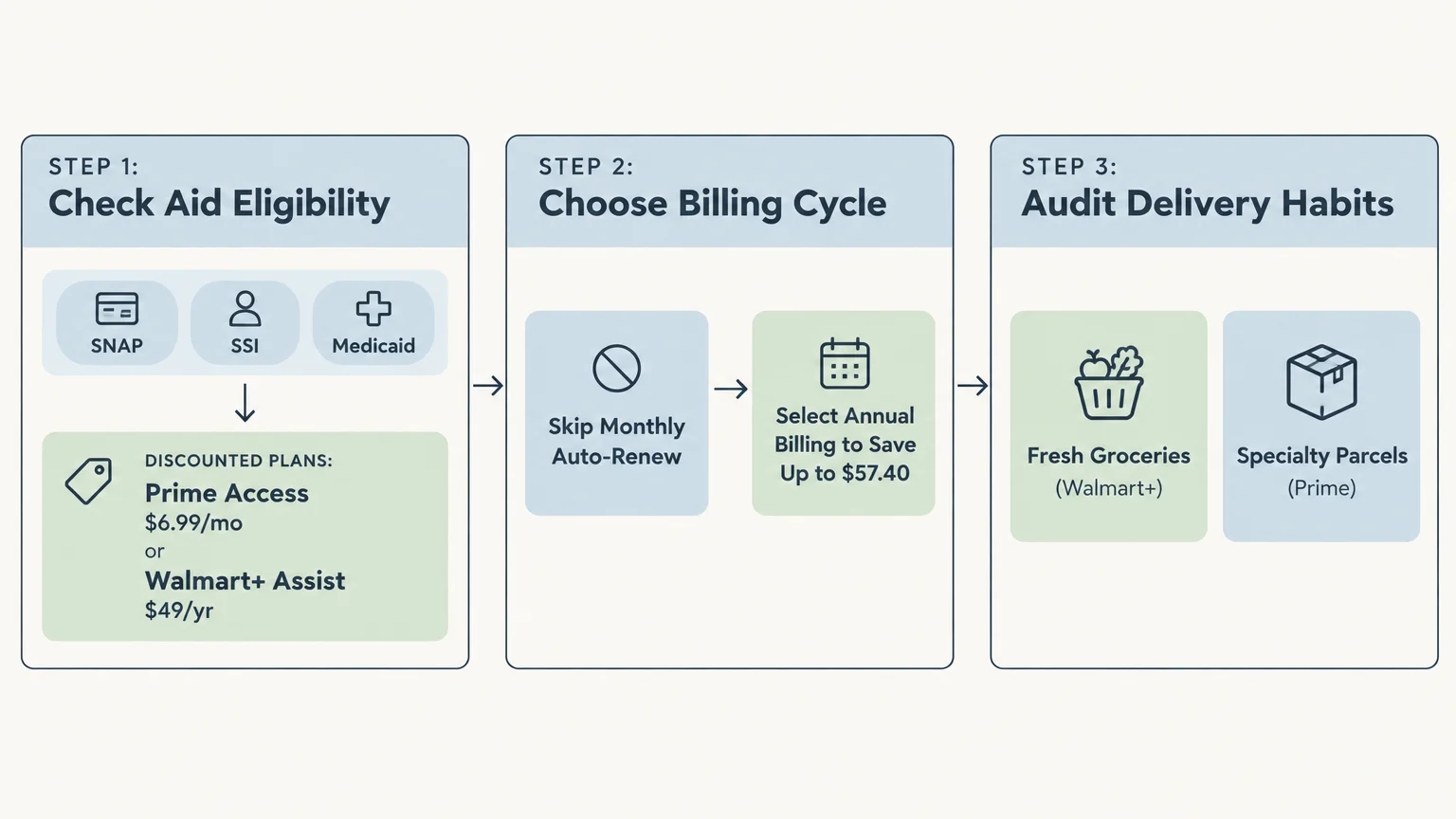
Choosing between Amazon Prime and Walmart+ comes down to mapping your real monthly receipts instead of chasing flashy ad claims. Follow this simple four-step plan before paying another renewal dollar.
Step one: Check needs-based eligibility first. If anyone in your household receives Medicaid, SSI, SNAP, LIHEAP, or a Veterans and Survivors Pension Benefit, grab Walmart+ Assist for $49 a year and skip Prime Access’s four-year cap.
Step two: Track where your regular cash goes over the next 30 days. If you buy weekly groceries, pick up prescriptions, fuel up weekly, or rely on local tires and repairs, Walmart+ at $98 delivers far stronger retiree savings.
Step three: Reserve Amazon Prime at $139 for specialty shopping and digital perks you truly use. Prime wins only if you consistently use Grubhub+, back up thousands of family photos, shop Whole Foods, or order niche items Walmart does not stock.
Step four: Use a 30-day free trial—or a $1 first-month Walmart+ promo—to test delivery speed in your exact neighborhood before committing annually. Once verified, ditch monthly billing for the annual rate and eliminate unused duplicate subscriptions.
To check for scams and false advertising, visit the FTC. For unbiased product reviews, consult Consumer Reports.
Business ratings are available at the Better Business Bureau.
Frequently Asked Questions
Can retirees get Amazon Prime or Walmart+ free with Medicare?
No, neither retailer offers a free or discounted membership simply for having Medicare or receiving standard Social Security retirement checks. You must qualify through income-based assistance programs like Medicaid, SSI, SNAP, or LIHEAP, or pass Amazon’s income verification.
Which membership saves more on groceries and prescriptions for seniors?
Walmart+ saves significantly more on everyday essentials because free grocery delivery on $35 orders and free same-day pharmacy delivery come included at $98 yearly. Amazon charges an extra $99.99 annually for unlimited grocery delivery plus $5 monthly for RxPass generics.
Can two retired spouses share one Amazon Prime or Walmart+ account?
Yes, both services let household members avoid paying twice for duplicate subscriptions. Amazon Family lets one Prime account share shipping, Prime Video, deals, and music with one other adult, while Walmart+ also supports shared household benefits.
What happens to my 5% credit card rewards if I cancel my membership?
Both store cards slash your top earning tier immediately once your membership ends. Dropping Prime reduces your Chase Amazon Prime Visa rate from 5% to 3%, and canceling Walmart+ cuts your OnePay CashRewards Mastercard Walmart rate from 5% to 3%.
Disclaimer: The opinions in this article are for informational and entertainment purposes. Brands, products, and store policies can change.
Always verify information and prices before making a purchase.