Buying chicken at ALDI looks like an effortless win for your grocery budget until you inspect the fine print on those bargain packages. Hidden water weight, quiet markdown changes, and strict return loopholes can turn cheap poultry into an expensive mistake.
Retailers rely on rushed shoppers who only glance at the big price sign above the cooler. Learning how to spot enhanced meat, time weekly ad drops, and check for texture defects protects both your wallet and your dinner table.
Before you toss another family pack into your cart, look behind the curtain at how ALDI prices and sources its poultry.
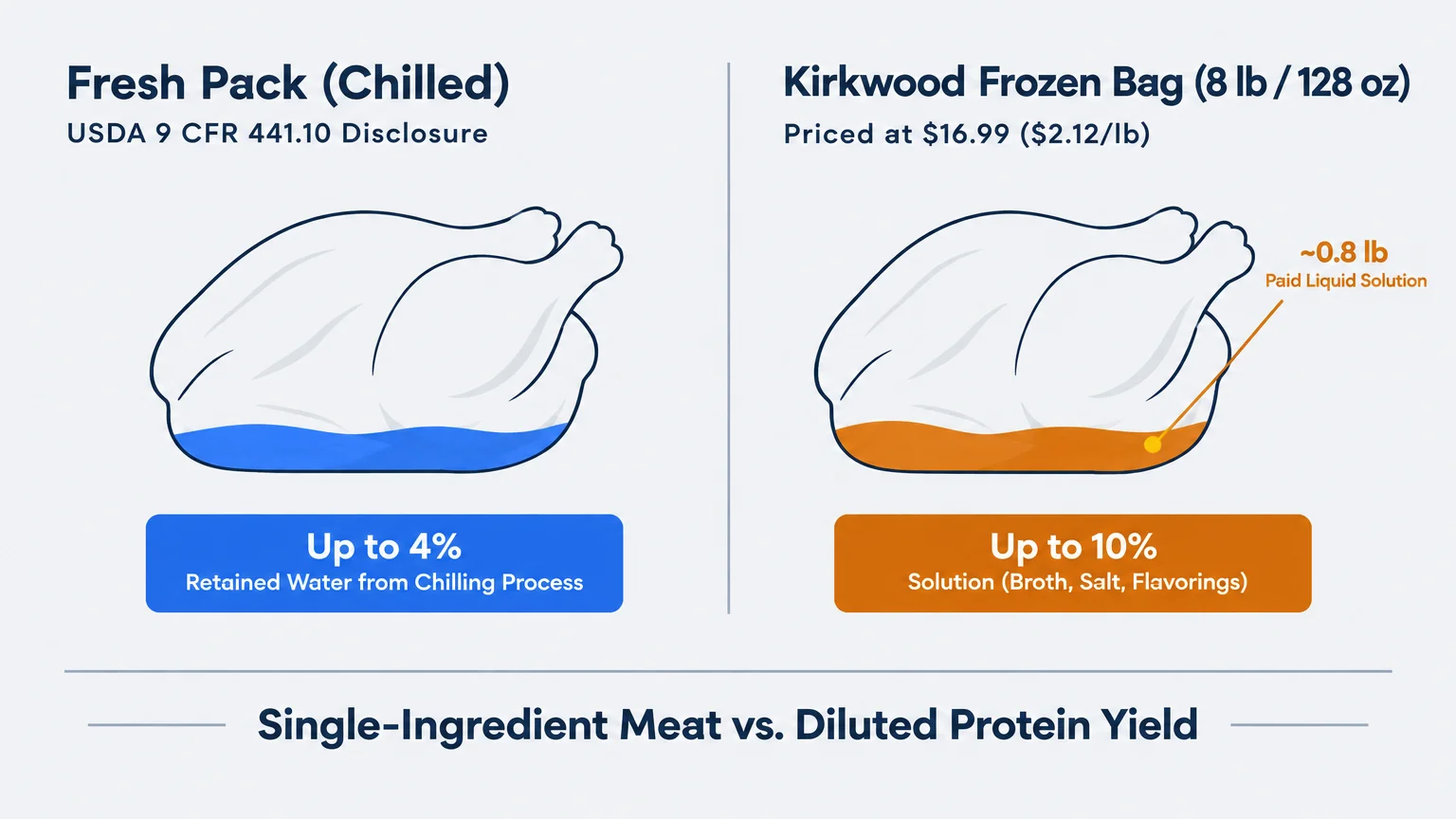
Shopping Trap #1: Paying for Water and Salt Solutions Disguised as Poultry
A low per-pound sticker on grocery store chicken loses its shine fast when part of that weight evaporates in your skillet. Many shoppers grab frozen bags or value packs without noticing how much added liquid they are paying for at the register.
The Retained Water Rule Every Shopper Should Read
During commercial processing, poultry absorbs moisture while being washed and chilled before packaging. Under USDA Food Safety and Inspection Service (FSIS) regulation 9 CFR 441.10 and FSIS Directive 6700.1, Rev.
3, processors face strict transparency standards.
Issued on March 6, 2026, with a July 1, 2026 compliance deadline, this federal rule requires raw, single-ingredient poultry to declare its maximum absorbed moisture on the label. Only poultry showing less than 0.5% retained water—such as air-chilled chicken—avoids this disclosure.
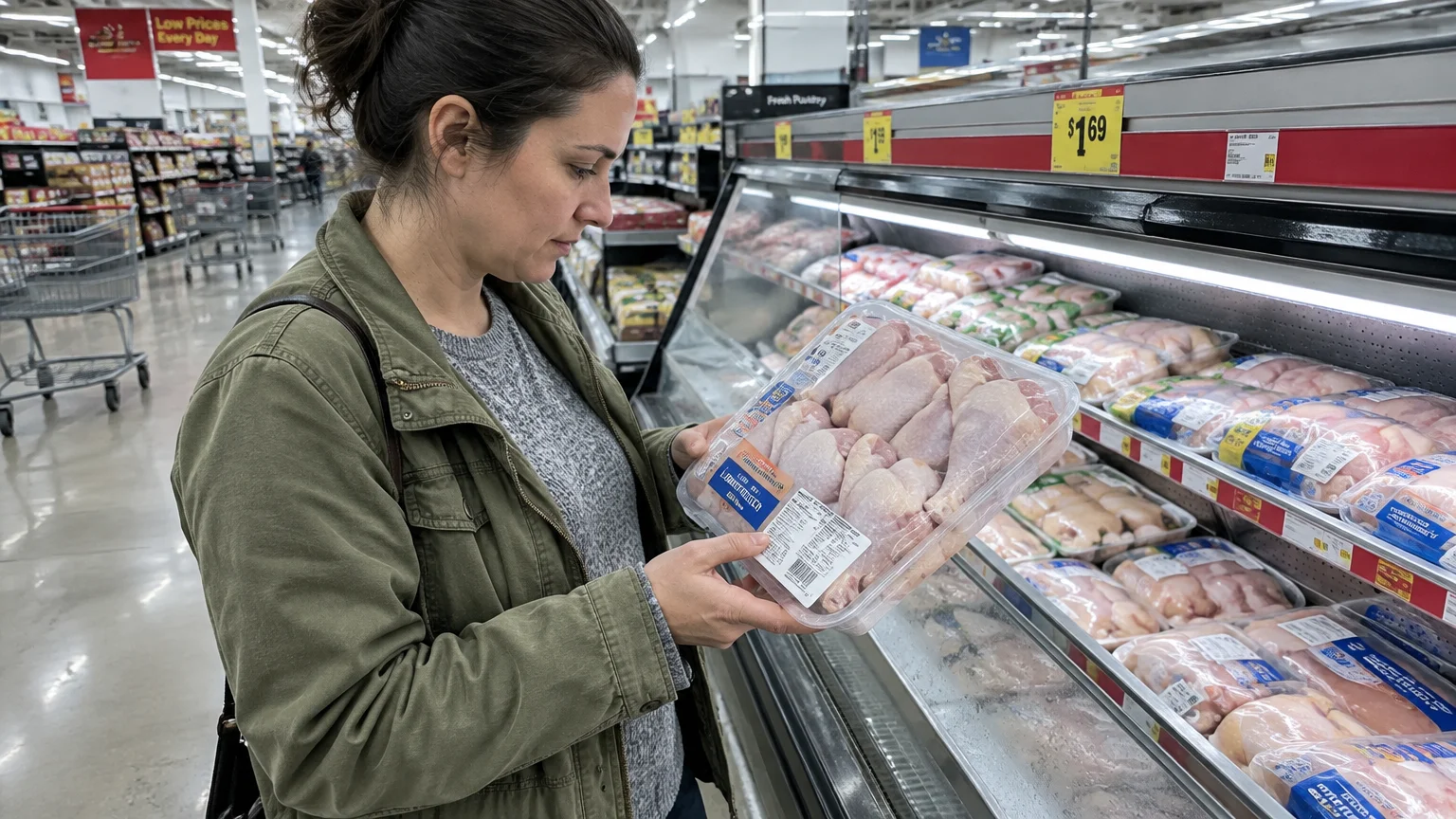
When you pick up fresh ALDI drumsticks, look closely near the bottom edge of the front wrap. You will often spot fine print stating the package contains “up to 4% retained water” from the chilling process.
Hidden Broth Solutions in Frozen Bags
Frozen bags present an even bigger trap for budget-conscious buyers comparing unit prices across the freezer aisle. A March 2025 breakdown by Snarkle-Sauce on Wry highlighted an 8-pound (128-ounce) bag of Kirkwood frozen chicken breasts priced at $16.99.
On paper, roughly $2.12 to $2.19 per pound looks like an easy bargain compared to fresh cuts at traditional supermarkets. However, frozen bags may have a salt solution added prior to freezing.
Some Kirkwood frozen or enhanced chicken breasts carry labels admitting the meat “contains up to 10% solution of chicken broth, salt, and flavorings.” That means up to one-tenth of every dollar you spend buys seasoned liquid instead of protein.
Extra sodium also ruins recipes when you season your chicken normally at home. Your stir-fry or sheet-pan dinner turns overly salty while pooling water keeps the meat from browning properly.
Exposing the “No Added Hormones” Label Trick
While scanning labels for water disclosures, you will probably notice bold claims boasting that the birds received zero hormones. Marketing teams plaster that phrase across poultry packaging because it makes standard store meat feel like a luxury upgrade.
According to USDA FSIS guidance in Chicken from Farm to Table (Sept. 2024), no hormones are used in raising chickens anywhere in the U.S. Federal rules prohibit them because the FDA has never approved steroid hormone implants for poultry growth.
Every chicken on every grocery shelf in America shares that exact same standard by law. Never pay a higher price per pound just because a colorful badge brags about hormone-free poultry.
How to Outsmart Liquid Markups in the Store
Flip every bag and tray over to read the ingredient statement before committing it to your cart. True single-ingredient raw chicken lists only chicken—nothing about broth, salt, or flavorings.
Next, scan the front label for retained-water percentages so you can compare true meat value fairly. If an air-chilled package sits close in price to a water-chilled pack, the drier bird gives you better browning and higher actual yield.
Shopping Trap #2: Falling for the House-Brand Illusion and Small-Pack Markups
Walking down the refrigerated aisle at ALDI feels refreshingly simple because you are not buried under twenty competing brands. Still, that streamlined shelf layout hides steep price gaps between identical cuts packed in different sizes.
Who Actually Makes Kirkwood Poultry
Over 90% of ALDI’s store assortment consists of private-label brands rather than national household names. As Aldi Reviewer reported in January 2025, Kirkwood is not an independent poultry company or boutique farm.
Kirkwood is simply ALDI’s in-house label for poultry, sourced from various commercial suppliers across the country.
Buying Kirkwood can certainly save you money compared to conventional stores, but the brand name itself guarantees nothing special about sourcing. Treating the label like an artisan guarantee stops you from spotting better deals sitting right beside it.
The Massive Price Gap Between Regular Packs and Family Packs
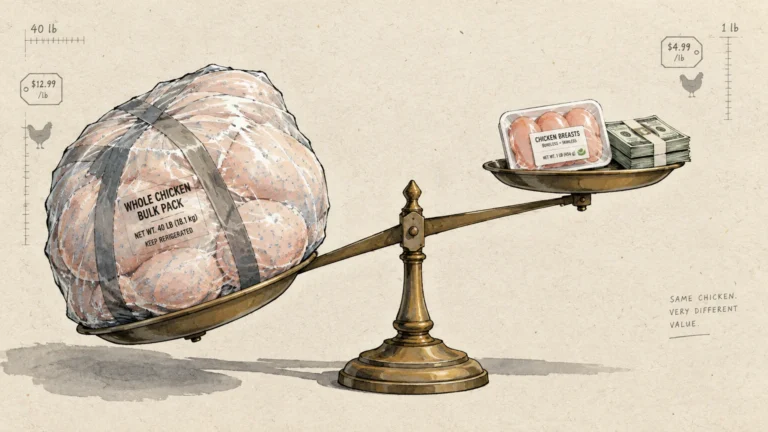
Your biggest everyday leak when buying chicken at ALDI comes from grabbing convenient smaller trays instead of random-weight family packs. Those smaller Kirkwood-branded packs carry a quiet convenience tax built straight into the per-pound rate.
Aldi Reviewer (Jan. 2025) documented a 5.14-pound unbranded family pack of All Natural Chicken Drumsticks priced at just $1.19 per pound.
Right next to similar offerings, regular-sized packs ran $1.89 per pound—nearly sixty percent higher per pound for the exact same cut.
You can see an even sharper contrast when comparing ALDI’s weekly ad specials against national averages. U.S. Bureau of Labor Statistics (BLS) data placed the U.S. city average retail price for boneless chicken breast at $4.10 per pound in October 2026.
That October 2026 figure dipped 1.7% from $4.17 per pound in October 2025, with a full-year 2026 average of $4.16 per pound. Meanwhile, fresh whole chicken averaged $2.03 per pound ($2.026/lb) nationally in October 2026, down 1.7% from $2.064/lb a year earlier.
Now look at ALDI’s November 11, 2026 Weekly Ad specials by comparison. Fresh meat features included Tyson Fresh Chicken Breast and Mega Pack Chicken Breast at $1.69 per pound—averaging $5.07 per Tyson package—and One Fine Chicken Family Pack Boneless Skinless Chicken Thighs at $2.49 per pound.
Regional pricing shifts wildly, too, depending on your ZIP code and local competition. In the Buffalo, NY market between October 26 and November 3, 2026, Fresh Family Pack Chicken Breasts ran $1.99 per pound.
Portion and Freeze Like a Pro
Small households often skip mega packs because they worry five pounds of chicken will spoil before Friday. Knowing safe home handling rules turns those bulk bargains into your smartest weekly habit.
Per USDA FSIS food safety guidelines, raw chicken thaws safely in your refrigerator over one to two days or longer depending on package thickness. Once thawed in the fridge, raw chicken remains usable for one to two days before you need to cook it.
Best of all, chicken thawed inside your refrigerator can safely be refrozen without cooking if your dinner plans suddenly change. Divide cheap family packs into two-portion freezer bags the same evening you shop, label the dates clearly, and beat the small-pack markup permanently.
Shopping Trap #3: Banking on the Mythical 50%-Off Sticker and Ignoring Ad Timing
Social media haul videos love showing carts overflowing with red-stickered meat marked down by half. Relying on that viral treasure hunt for your weekly meal plan will leave you empty-handed more often than not.
The Quiet Shift Away from Universal 50% Markdowns
For years, savvy ALDI shoppers timed morning runs to snag 50%-off stickers placed on meat one to two days before its sell-by date. That predictable system made budget meal planning remarkably easy.
As Sporked reported in March 2026 alongside store employee accounts, ALDI’s once-standard 50%-off sticker is no longer universal. Markdown decisions now rest with individual store leadership and local managers.
Some locations still apply 30% off two days before the date and 50% off with one day remaining. Other stores have switched to flat $1 or $2 off stickers, while certain locations stopped discounting close-dated meat altogether.
A $1 discount on an $8 tray saves far less than you think compared to hitting a fresh weekly meat special. Always check the final price per pound after the sticker deduction instead of blindly chasing red tags.
Understanding Weekly Ad Drops and “While Quantities Last”
If you want consistent savings on aldi chicken, timing your trip around the Weekly Ad beats hunting random clearance stickers. Most U.S. ALDI stores launch their new Weekly Ad—including Fresh Meat Specials—every Wednesday, running Wednesday through Tuesday.
Select regional markets have historically turned their ads over on Sundays instead, so verify your local store’s start day on the ALDI website or app. Whichever day your store flips its signage, morning shoppers hold a huge advantage.
Many weekly fresh meat specials carry a strict “Available while quantities last” disclaimer right on the flyer. Once the morning rush clears out the $1.69-per-pound Tyson breasts or $2.49-per-pound family thigh packs, that promotional item may be gone until the next cycle.
Remember also that ALDI does not accept manufacturers’ coupons under any circumstances. Even when a national brand like Tyson shows up in the Fresh Meat Specials case, leave your paper and printable coupons at home.
What “Sell-By” Dates Really Mean for Your Wallet
Hesitating over meat with tomorrow’s date stamped on the wrap costs you easy savings when your local store does offer markdowns. Both the FDA and USDA clarify that “sell-by” and “best if used by” dates indicate peak quality—not food safety.
Stores pull packages around the sell-by window to keep inventory rotating, not because the meat suddenly turns dangerous at midnight.
Provided the package stays cold, tightly sealed, and free of off-odors, you can safely cook it that night or freeze it immediately when you get home.
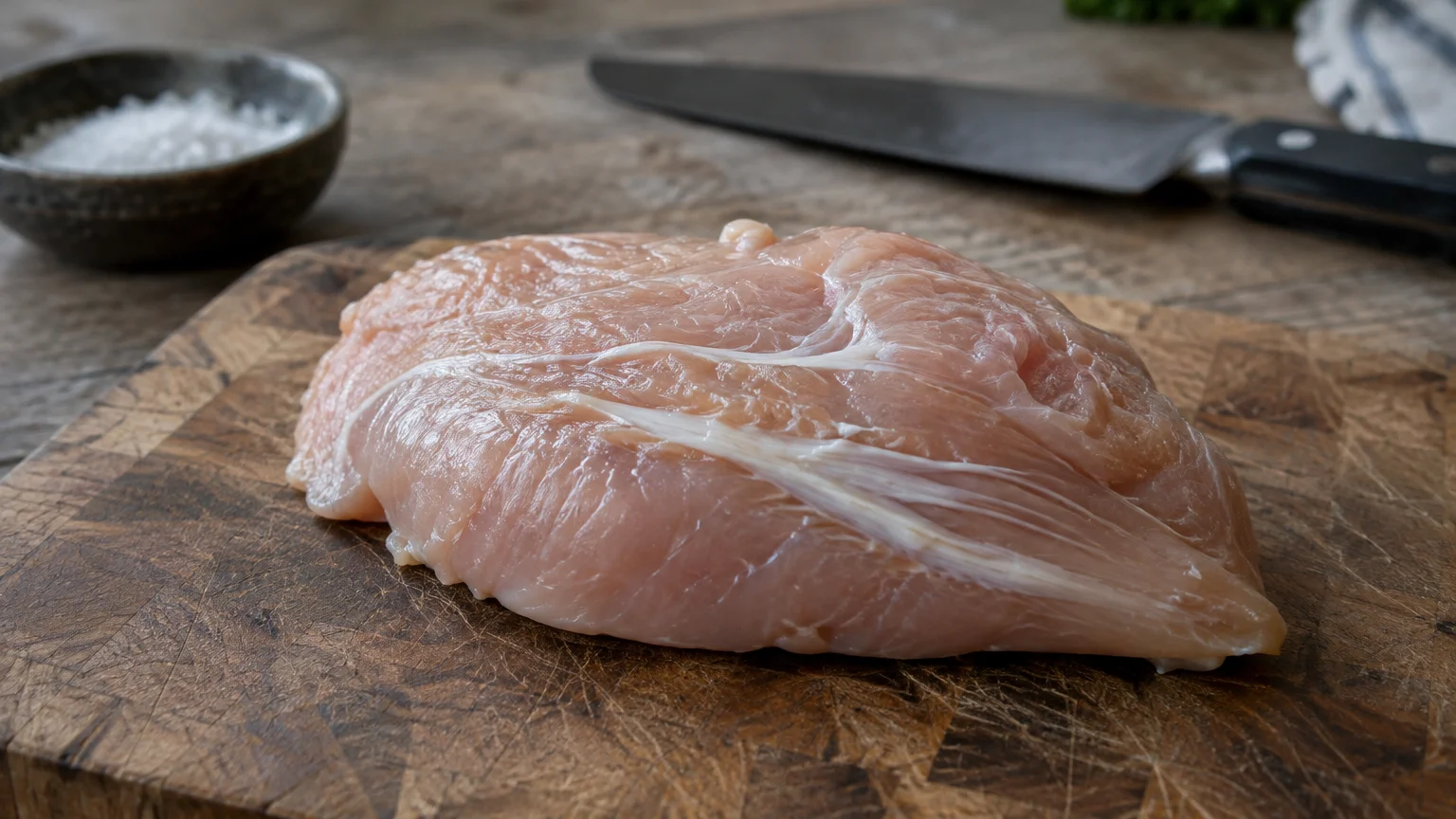
Shopping Trap #4: Ignoring the “Woody Breast” Texture Problem in Cheap Fillets
Price is not the only factor shaping aldi meat quality when you shop the poultry cooler. Even a $1.69-per-pound chicken breast turns into an expensive waste if your family refuses to eat its strange, crunchy texture.
Why Bargain Chicken Breasts Sometimes Feel Rubbery
If you have ever bitten into a thoroughly cooked chicken breast only to feel tough, fibrous resistance, you did not necessarily overcook it. You likely ran into a widespread agricultural defect known across the poultry industry as Woody Breast syndrome.
Research published by the USDA Agricultural Research Service (ARS) and Kansas State University in Frontiers in Physiology (2022) links Woody Breast directly to rapid broiler growth and oversized breast yields. As birds grow larger faster, muscle tissue develops hardened ridges and a dense, rubbery consistency.
Industry incidence rates were reported at 30% to 50% as of 2015, costing the U.S. poultry sector over $200 million annually. Separately, World’s Poultry Science Journal (2019) noted popular press estimates of 5% to 10% of commercial fillets affected.
Because ALDI sources high-volume commercial chicken to keep prices ultra-low, Woody Breast fillets show up in its coolers just like at competing grocers. Fortunately, the same scientific reviews confirm Woody Breast does not pose a food safety hazard—it is strictly a frustrating texture flaw.
How to Inspect Packages Before You Buy
You do not have to gamble at the checkout lane when selecting boneless skinless breasts. Use a quick two-step inspection right in front of the refrigerated case to weed out the worst fillets.
First, look through the clear plastic for pale, slightly bulging ridges running across the thickest end of the breast. Normal fillets look smooth, uniformly pink, and pliable inside the tray.
Second, press gently on the thickest portion of the meat through the plastic wrap without tearing the film. Soft fillets yield smoothly under your fingertip, whereas woody fillets feel strangely rigid, springy, or dense like raw cartilage.
Picking medium-sized fillets instead of massive, oversized breasts also improves your odds of tender meat. If every breast pack in the case feels suspiciously firm, pivot immediately to dark meat.
Smarter Cuts and Foolproof Cooking Temperatures
Boneless skinless chicken thighs—like the One Fine Chicken Family Pack priced at $2.49 per pound in ALDI’s November 2026 ad—stay naturally juicy and practically immune to Woody Breast texture issues.
Drumsticks at $1.19 per pound in family packs deliver even richer flavor for slow roasting or grilling.
When you do cook breasts, stop guessing doneness by slicing into the center or checking juice color. USDA FSIS guidance in Chicken from Farm to Table (Sept.
2024) notes that hemoglobin in young birds can remain heat-stable, leaving cooked meat slightly pink even when fully safe.
Pull your chicken off the heat the moment an instant-read food thermometer hits 165°F in the thickest section. Overcooking meat out of paranoia dries out healthy fillets and makes mild Woody Breast ridges feel twice as tough.
Shopping Trap #5: Misunderstanding the “Twice as Nice Guarantee” and Recall Fine Print
Many loyal shoppers buy unfamiliar frozen meals or giant meat packs at ALDI without worry because they trust the store’s famous guarantee. Assuming that promise covers every poultry purchase sets you up for an awkward surprise at the register.
What the Twice as Nice Guarantee Actually Covers
ALDI promotes its Twice as Nice Guarantee as a safety net: if you are not 100% satisfied with an eligible product’s quality, the store refunds your money and replaces the item.
To claim it, you must bring the original packaging and any unused portion back to the store manager.
Look closely at ALDI’s official Help Center rules, though, before counting on double compensation. Consumer guides note that the policy targets ALDI’s private-label food items—meaning national brands like Tyson Fresh Chicken Breast typically fall outside the replacement bonus.
A receipt also changes how your refund arrives. Bring your paper receipt and ALDI refunds your original payment method; lose the receipt and you only receive an ALDI Merchandise Credit gift card matching the item’s current retail price.
Even more surprising is the multi-unit catch buried in the official policy. If you return three spoiled packs of the same chicken from a single quality issue, ALDI may refund all three qualifying packs—but the store will provide only one replacement item.
Delivery App and Online Order Exclusions
Convenience shoppers face the biggest blind spot under ALDI’s return rules. According to the official policy, the Twice as Nice Guarantee applies strictly to in-store purchases made at physical registers.
If you order groceries online through aldi.us or use third-party apps like Instacart, DoorDash, or Uber Eats, ALDI stores will not honor the double guarantee. You must resolve missing, spoiled, or poor-quality poultry claims directly through those delivery platforms instead.
Non-food ALDI Finds, prior claim replacements, alcohol national brands, and non-quality returns—such as simply buying the wrong cut by mistake—are also excluded from the replacement perk.
Watching Product Recalls on Frozen Poultry Items
Beyond quality quirks, smart shoppers keep an eye on safety alerts affecting frozen chicken meals and processed meats. ALDI posts active pull-from-sale notifications directly on its U.S. Product Recalls page at aldi.us.
Recent alerts show why checking your freezer periodically pays off. In January 2025, ALDI recalled Casa Mamita Chicken & Cheese Taquitos carrying Best By dates of 07/03/25 and 09/25/25 under establishment number EST.
P-40327 due to potential metal contamination reported to USDA FSIS.
More recently, on February 23, 2026, Bremer Italian Style Meatballs faced a recall for potential metal contamination as well. Whenever a recall hits, stop serving the affected lot immediately and return it to the store for a full refund or discard it as instructed.
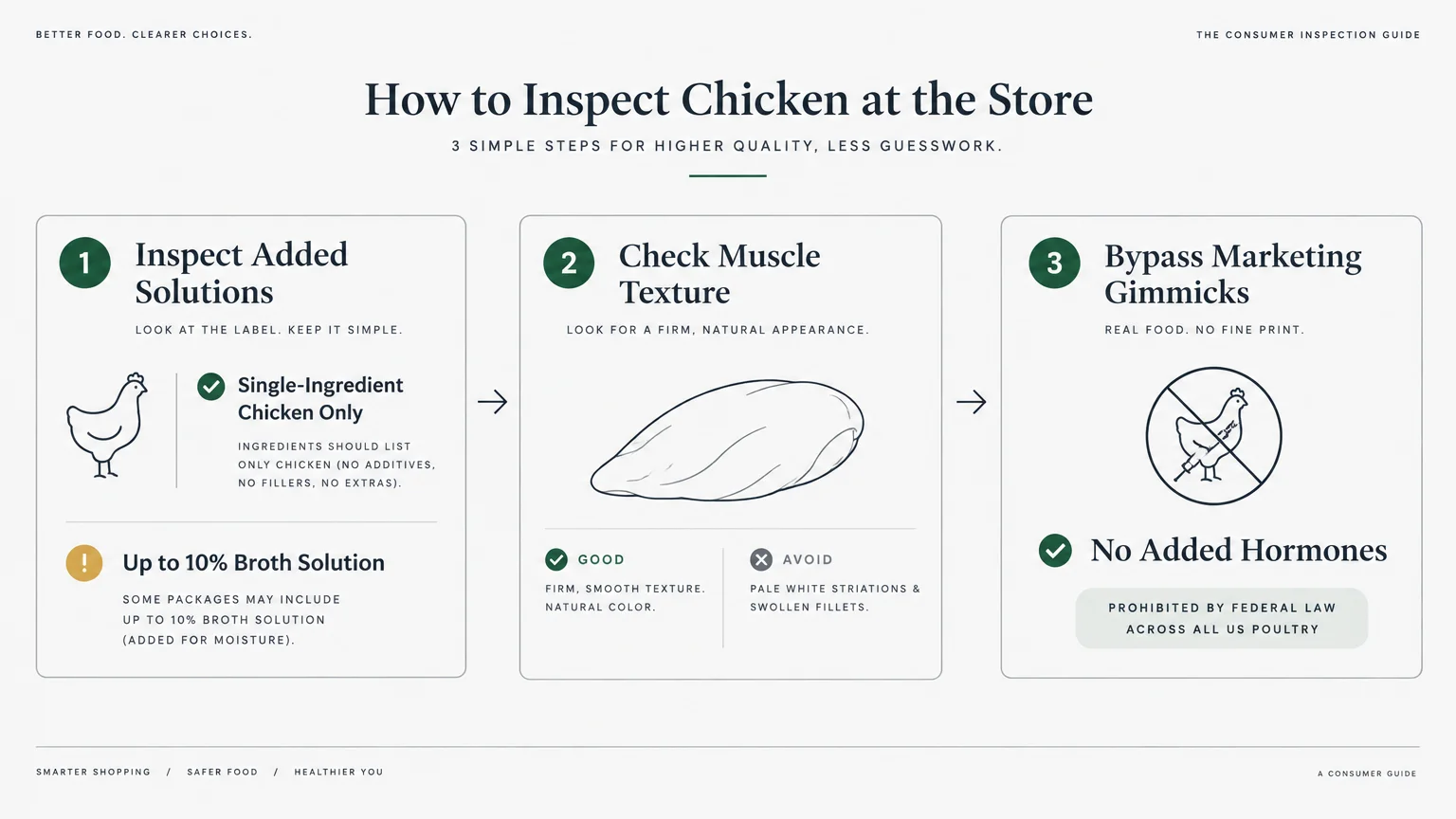
Your Action Plan: How to Be a Smarter Shopper
You do not need to abandon ALDI’s meat case to protect your grocery budget. Use these practical aldi shopping tips on your next visit to lock in genuine value every time you walk through the doors.
Step 1: Time Your Trip Around the Weekly Ad
Check your local store’s Weekly Ad launch day—usually Wednesday, or Sunday in select markets—before writing your dinner menu. Arrive early on launch day if you want limited “Available while quantities last” Fresh Meat Specials before shelves clear out.
Step 2: Read Every Label for Liquid Weight
Skip bags boasting “no added hormones,” since federal law already bans hormones across all U.S. poultry. Flip frozen and fresh packs over to reject “up to 10% solution” injections and watch retained-water disclosures closely.
Step 3: Choose Family Packs and Dark Meat
Bypass overpriced small trays in favor of unbranded family packs and bone-in or boneless thighs when prices dip. Portion bulk packs into freezer bags the day you buy them so nothing goes to waste.
Step 4: Touch-Test Breasts and Keep Your Receipt
Gently press raw chicken breasts through the wrapper to spot stiff Woody Breast ridges before buying. Save your paper receipt in your wallet or purse so you stay fully protected under the in-store Twice as Nice Guarantee.
Frequently Asked Questions
Is ALDI chicken safe and good quality compared to other supermarkets?
Yes, ALDI sources its Kirkwood and private-label poultry from established commercial U.S. suppliers inspected under federal USDA FSIS standards.
Quality varies mainly by whether a cut contains added broth solutions or shows Woody Breast texture, so checking labels and testing firmness makes a huge difference.
Does ALDI accept coupons on Tyson or national-brand chicken specials?
No, ALDI does not accept manufacturers’ coupons on any items, including national-brand Fresh Meat Specials like Tyson. Your savings come strictly from the store’s low everyday prices, weekly ad specials, and local manager markdowns.
Can I return thawed or opened chicken under ALDI’s Twice as Nice Guarantee?
You can return eligible private-label food purchased in-store if you bring the packaging and any unused portion back to the store manager. Keep your receipt for an original-payment refund, and remember that online or third-party delivery orders go through the delivery platform instead.
How long does ALDI chicken stay fresh if I buy a markdown package near its sell-by date?
Because sell-by dates measure peak quality rather than safety, intact cold chicken bought near that date should be cooked or frozen promptly. Once thawed in a refrigerator, raw chicken keeps for one to two days before cooking and can safely be refrozen raw if needed.
To check for scams and false advertising, visit the FTC. For unbiased product reviews, consult Consumer Reports.
Business ratings are available at the Better Business Bureau.
Disclaimer: The opinions in this article are for informational and entertainment purposes. Brands, products, and store policies can change.
Always verify information and prices before making a purchase.