Grocery chains want you to believe flashy tins and premium price tags guarantee the best store bought nuts, yet independent testing proves otherwise. Consumer Reports evaluated top snack picks on nutrition and taste, exposing huge gaps between hype and value.
Knowing which cans earn top marks—and which aisle tricks quietly drain your food budget—protects both your health and your wallet. You do not need gourmet labels to bring home crisp, nutritious snacks every week.
Below, you will uncover eight common nut-aisle traps, see the winning store brands, and learn how to beat 2026 price hikes.
Shopping Trap #1: Paying Extra for National Name Brands Over Store Labels
Walk down any snack aisle and eye-level shelves push familiar national brands in bright, oversized canisters. Retailers count on brand loyalty to convince you that store labels taste stale or skimp on quality.
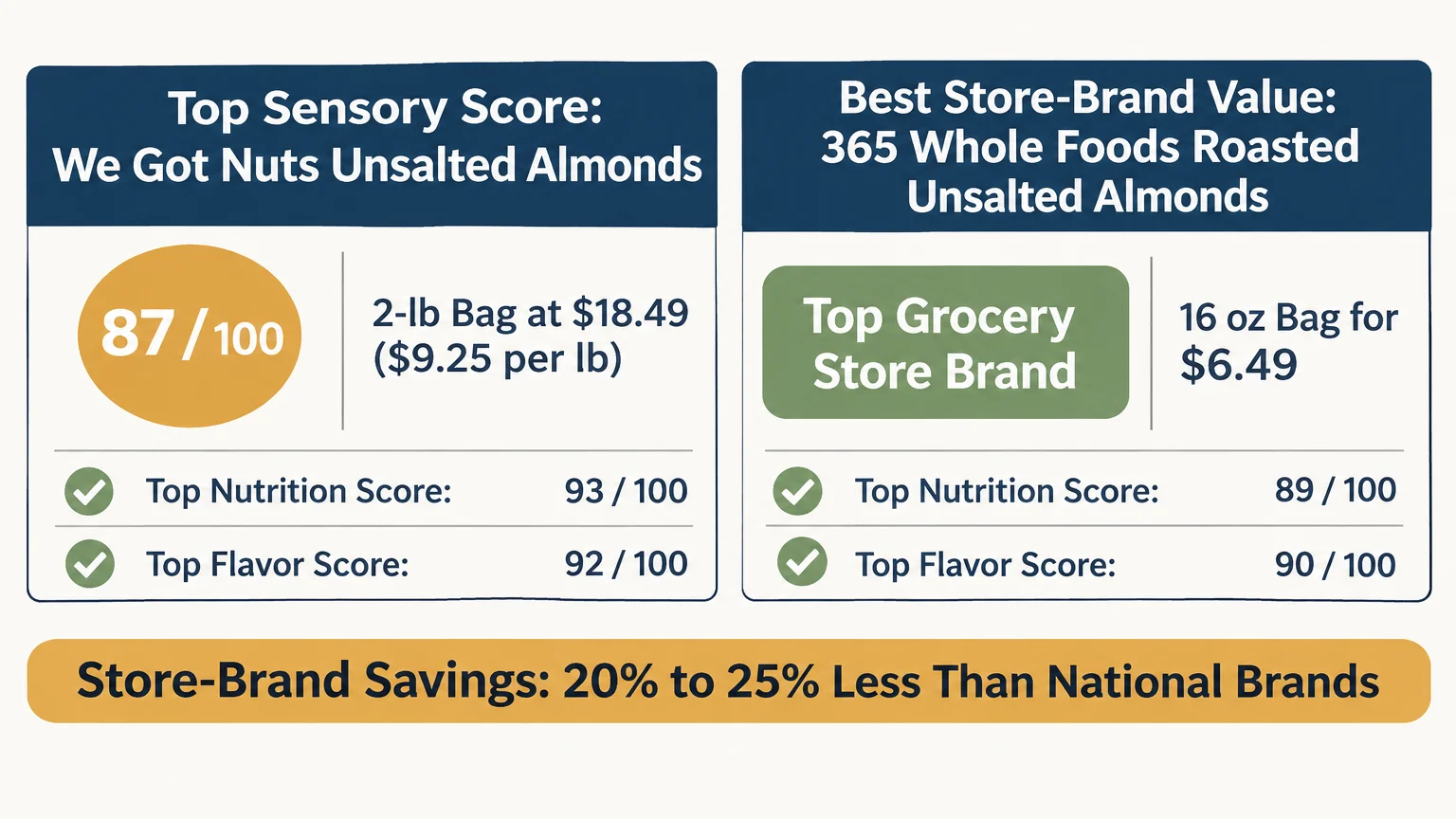
Independent testing tells a very different story when products are judged side by side. In its October 2026 evaluation of healthy snack nuts, Consumer Reports awarded the top overall score of 87 out of 100 to We Got Nuts Roasted Unsalted Almonds.
That winning option was listed on Amazon at $18.49 for a 2-pound bag, working out to roughly $9.25 per pound. Yet an even better everyday bargain sat right behind it on the grocery store nuts ranking.
In November 2026, Consumer Reports named 365 Whole Foods Market Roasted & Unsalted Almonds its second-place pick overall and the highest-rated grocery store-brand nut. You can grab a 16-ounce bag on Amazon for just $6.49.
Think about that price gap before you toss a celebrity-endorsed tin into your cart. A private-label bag beat pricier national competitors on both nutritional profile and flavor.
Consumer Reports did not guess at those scores; trained tasters evaluated flavor and texture alongside nutrition data. When store brands win blind sensory panels, paying extra for a familiar mascot makes zero financial sense.
In fact, retail consulting firm Strategic Resource Group told Consumer Reports that store-brand foods and beverages cost at least 20% to 25% less than equivalent name brands. Keeping a quarter of your snack budget adds up fast over twelve months.
Quality extends well beyond a single almond bag at Whole Foods, too. In Consumer Reports subscriber ratings of grocery store brands, Costco, Trader Joe’s, and Central Market from H-E-B each earned a perfect 5 out of 5 for store-brand quality.
Stores love putting high-margin national brands right at eye level while tucking house labels onto bottom shelves. Always crouch down, compare the unit price per ounce, and test your grocer’s store brand first.
Shopping Trap #2: Falling for Wellness Nut Butters Loaded With Hidden Oils
Nut butter jars wear some of the sneakiest health halos in the entire supermarket. Front labels boast about natural energy and plant protein while hiding cheap fillers in tiny print on the back.
Manufacturers routinely whip hydrogenated vegetable oils or palm oil into commercial spreads so the oil never separates on the shelf. That cosmetic shortcut keeps jars looking neat while watering down nutrition and flavor.
Consumer Reports tested nut spreads and found that options made with fewer ingredients—essentially just nuts without added hydrogenated vegetable or palm oils—were healthier and tasted noticeably better. Simpler recipes deliver cleaner fuel without industrial fats.
Four specific spreads stood out among Consumer Reports’ top-rated picks. Whole Foods 365 Everyday Value Almond Butter Creamy and Kirkland Signature Creamy Almond Butter both earned high marks for pure almond flavor.
Cashew lovers also have clean, top-rated choices that skip unnecessary additives. Whole Foods 365 Everyday Value Cashew Butter Creamy and Once Again Organic Creamy Cashew Butter both made the recommended list.
Before you assume every natural-looking jar is clean, flip it around and read the ingredient list. If you see palm oil, hydrogenated rapeseed oil, or corn syrup solids, put that jar right back on the shelf.
You do not have to pay luxury prices for clean spreads either, especially if your household eats nut butter by the spoonful. Commercial peanut butter averages just $1.72 to $2.18 per pound as a dependable, zero-tariff protein staple.
Yes, natural nut butter with zero stabilizers separates in the cabinet, leaving a thin layer of oil on top. Stir it once with a butter knife and store the jar upside down or in the fridge to keep it smooth.
Keep portion sizes realistic when scooping spreads onto toast or apple slices. According to the USDA and the American Heart Association, one standard serving of nut butter is 2 tablespoons, delivering roughly 160 to 200 calories.
Shopping Trap #3: Ignoring 2026 Tariff Exposure at the Nut Display
If your favorite mixed-nut canister feels noticeably more expensive this year, inflation alone is not the culprit. Global trade shifts are reshaping what you pay in the produce and snack aisles.
Analyses of USDA 2026 food price forecasts and tariff schedules updated on September 19, 2026 project nuts and dried fruit prices to climb 8% to 12% in 2026. Shoppers who buy on autopilot will absorb that full hike.
Not every nut on the shelf faces the same upward pressure, because geography decides tariff exposure. Knowing where your snack grows gives you an instant advantage at checkout.
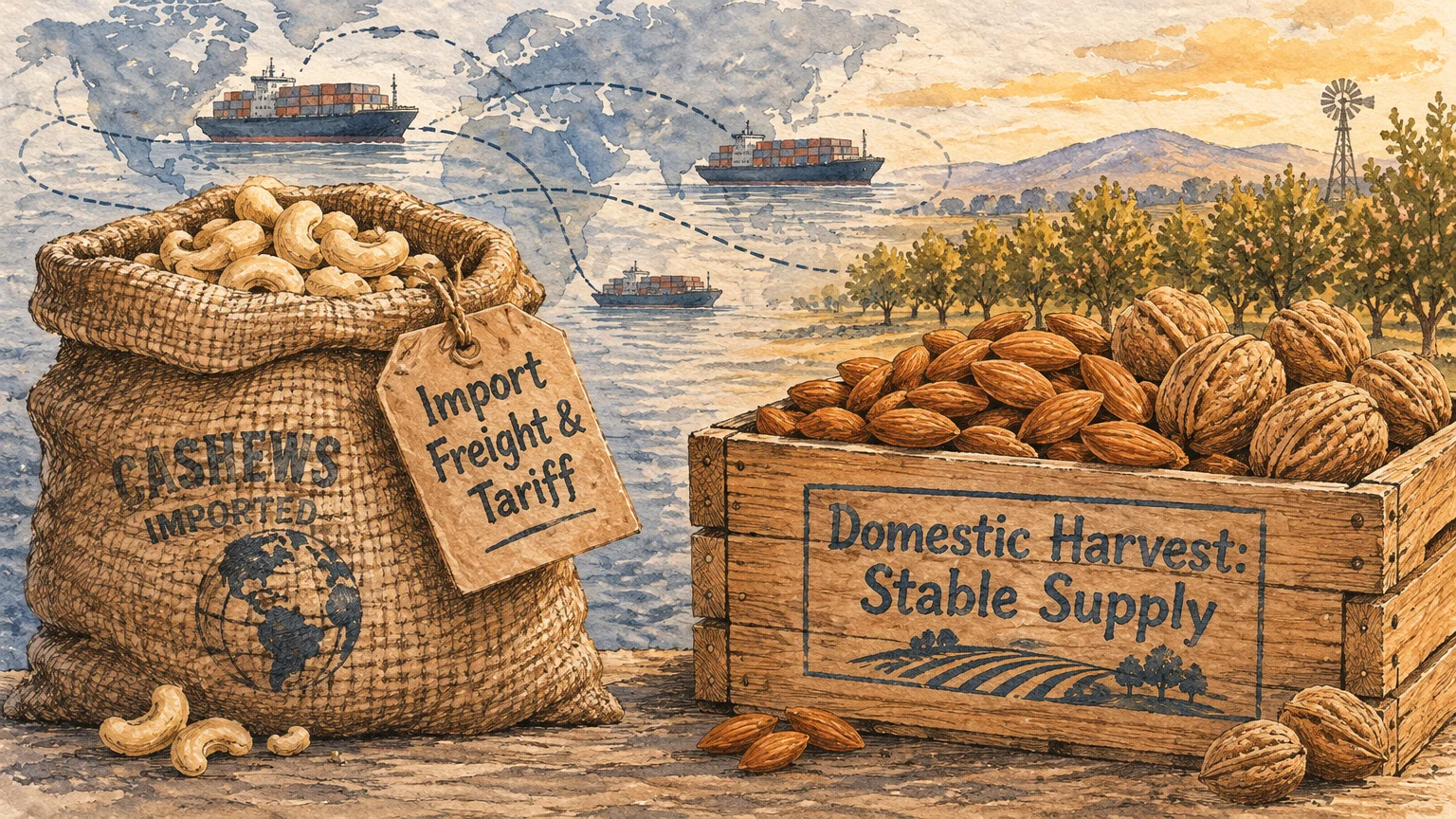
Almonds, peanuts, pecans, and walnuts are domestically produced and remain largely insulated from import tariffs. In fact, the United States produces roughly 81% of the global almond supply, with California growing 99% of commercial U.S. almonds.
Cashews, Brazil nuts, and non-California pistachios tell a completely different story. Because cashews come mainly from Vietnam and India, they carry direct 2026 tariff exposure that retailers pass straight to your receipt.
Supermarkets know shoppers rarely switch habits easily, and data confirms our cravings leave us vulnerable. A February 2026 National Snack Day survey by Nuts.com found cashews are America’s favorite snack nut at 43% overall, rising to 51% among Boomers.
Meanwhile, 42% of Gen Z and Millennials pick peanuts as a top snack choice, giving younger shoppers a built-in price shield. Retailers gladly feature pricey cashew tins up front while keeping budget-friendly peanut bags tucked away.
Warehouse club pricing from September 2026 shows exactly how wide that wallet gap has grown. A 3-pound bag of almonds runs $14 to $16—roughly $4.67 to $5.33 per pound—compared with $20 and rising for cashews at $6.67 or more per pound.
Commodity benchmarks underscore how cheap domestic peanuts remain at the farm gate. USDA NASS reported a 2025 Marketing Year average peanut price of $470 per ton, or about $0.235 per pound, triggering a $160 per ton farm payment.
While the July 2026 USDA NASS grower price index for fruit and tree nuts reached 175—up 0.5% year-over-year from July 2025—domestic nuts still beat imported tubs on value. Swap tariff-hit cashews for California almonds or U.S. peanuts whenever prices jump.
Shopping Trap #4: Buying Gourmet Mixes Packed With Sodium and Added Sugar
Fancy trail mixes, honey-roasted almonds, and sea-salt caramel pecans look tempting in clear plastic tubs near the register. Retailers charge boutique prices for those upgrades while quietly swapping heart-healthy fats for sugar and salt.
When a snack mix costs more per pound than plain roasted almonds, check how much of that weight comes from cheap pretzels, yogurt drops, or candied fruit. You end up paying nut prices for candy filler.
Both USDA MyPlate and the American Heart Association advise shoppers to choose unsalted nuts. Plain roasted or raw nuts let their natural crunch shine without blowing through your daily nutritional guardrails.
Salt-dusted canisters pose an especially sneaky threat if you mindlessly grab handfuls while working or watching TV. The American Heart Association recommends limiting total daily sodium to 1,500 milligrams, or cutting current intake by at least 1,000 milligrams per day.
Sweet glazes and chocolate coatings trigger an equally steep penalty on the nutrition label. The American Heart Association caps added sugars at 25 grams per day for women and 36 grams per day for men.
Just two generous scoops of honey-glazed peanuts or yogurt-covered almonds can burn through half your daily sugar allowance before dinner. Worse still, sugary coatings mask lower-grade, stale nuts that would taste flat without syrup.
Keeping nuts plain protects the exact cardiovascular upside you bought them for in the first place.
An FDA qualified health claim approved in 2003 and cited by USDA ARS notes that eating 1.5 ounces per day of most nuts within a low-saturated-fat, low-cholesterol diet may reduce heart disease risk.
You do not have to sacrifice flavor just because you skip pre-seasoned cans. Buy the winning unsalted store-brand almonds, toss a bowl with a tiny spritz of olive oil, and dust them with smoked paprika, cinnamon, or rosemary at home.
Homemade seasoning costs pennies and lets you control every grain of salt. Your taste buds get bold crunch without paying a retail markup for corn syrup and maltodextrin.
Shopping Trap #5: Falling for Misleading Serving Sizes and Calorie Blindness
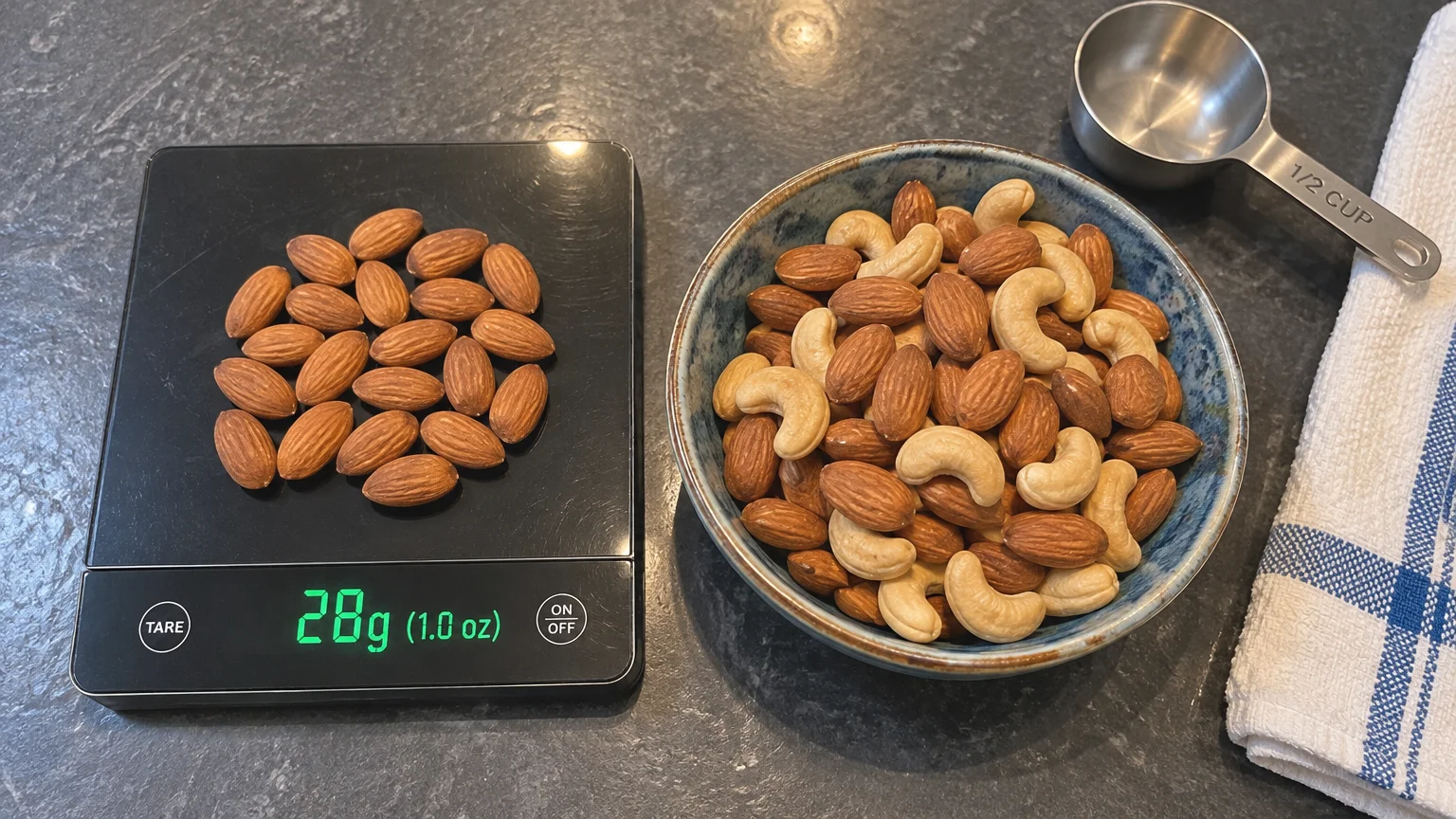
Big resealable pouches create a dangerous illusion on movie night because a few handfuls barely dent the bag. Unfortunately, nutrition panels base every calorie and fat line on a single modest ounce.
According to the USDA and the American Heart Association, one standard serving equals 1 ounce—or 28.4 grams, roughly a quarter cup or small handful—of whole nuts. Cleveland Clinic notes that single portion already delivers roughly 160 to 200 calories.
Dip into a family-size tub three or four times without measuring and you can accidentally eat an entire meal’s worth of calories before dinner. Understanding exact visual counts keeps healthy snack nuts working in your favor.
Using benchmarks from the USDA, Cleveland Clinic, and the International Tree Nut Council, you can eyeball a 1-ounce serving without dragging out a kitchen scale. Pistachios give you the biggest visual pile at 47 to 49 nuts per ounce.
Peanuts come next at 28 to 35 nuts, followed closely by almonds at 23 to 24 whole nuts per serving. Cashews drop to 16 to 18 whole nuts, while hazelnuts range between 12 and 20 nuts.
Larger halves fill your ounce fast, so slow down when snacking on baking staples. One ounce holds just 15 to 20 pecan halves, 8 to 14 English walnut halves, or 10 to 12 macadamia nuts.
Brazil nuts require extra caution beyond simple calorie math because they pack massive trace minerals. A 1-ounce serving equals only 6 to 8 nuts, and USDA ARS notes that portion exceeds your daily requirement for selenium.
In fact, eating just 1 single Brazil nut delivers 100% of your daily selenium value. Treat them like a potent supplement rather than an endless bowl snack.
Under USDA MyPlate rules, even half an ounce of nuts or seeds counts as a 1-ounce equivalent from the Protein Foods Group, out of 5.5 equivalents recommended daily on a 2,000-calorie diet. Pre-portion big bags into tiny reusable jars right after unloading groceries.
Shopping Trap #6: Picking the Wrong Nut for Your Nutrition Goals
Supermarket endcaps lump every nut under vague wellness banners, pretending all varieties nourish your body equally. In reality, each nut carries a distinct nutritional profile and cost-per-nutrient payoff.
If you want the best all-around tree nut for protein and gut-friendly fiber, Consumer Reports’ top-ranked category earns its crown honestly. Almonds pack more protein and fiber than any other tree nut per 1-ounce serving.
Each ounce of almonds delivers 6 grams of protein, 3.5 grams of fiber, and 14 grams of fat—including 9 grams of monounsaturated fat—for 164 calories. You also get nearly 50% of your daily vitamin E, 27% of manganese, and 18% of magnesium.
Store-brand winners match that nutritional punch closely on the label. A 30-gram serving of Whole Foods 365 Roasted & Unsalted Almonds supplies 6 grams of protein, 3 grams of fiber, 15 grams of total fat, and just 1 gram of saturated fat.
When pure protein per penny matters most to your grocery budget, peanuts remain nearly impossible to beat. Although botanically legumes, peanuts lead every snack nut with 7.3 grams of protein per 1-ounce serving.
Shoppers hunting plant-based omega-3 fatty acids should skip pricier macadamias and put English walnuts in their cart. Walnuts lead the pack in alpha-linolenic acid, making them smart toppers for oatmeal and salads.
Need extra fiber without doubling up on almonds? Both pistachios and hazelnuts supply 2.8 grams of fiber per ounce, and shelling in-shell pistachios naturally slows your eating pace.
Calorie counters also have smart choices when texture matters more than maximum protein. Cashews rank among the lowest-calorie snack nuts at 157 calories and 12 grams of fat per ounce, while chestnuts sit lowest overall at 88 calories and 1 gram of fat.
Before grabbing whatever variety sits on an impulse display, match the nut to your goal. Spend less for peanuts when you want protein, pick almonds for vitamin E and fiber, and reserve walnuts for omega-3s.
Shopping Trap #7: Wasting Bulk Savings Through Poor Pantry Storage
Warehouse clubs lure frugal shoppers with 3-pound bags that cut your cost per ounce nearly in half. Yet that smart math collapses fast if your nuts turn bitter, rubbery, and rancid before you finish the bottom third.
Nuts are rich in delicate unsaturated fats that oxidize quickly when exposed to heat, oxygen, and sunlight. Storing a jumbo bag above your stove or beside a sunny window ruins expensive groceries within weeks.
USDA FoodKeeper guidelines lay out clear rules to protect every dollar you spend in bulk. First, keep shelf-stable foods in a clean, dry, dark pantry stored below 85°F.
Packaging style makes a dramatic difference in how long peak flavor lasts at room temperature. Unopened jarred or canned nuts stay fresh for 12 months in the pantry, dropping to 2 to 9 months once opened.
Shelled bags behave far more delicately than sealed vacuum tins once you break the seal. According to USDA FoodKeeper, shelled peanuts, walnuts, and pecans hold peak quality for only about 4 weeks in the pantry.
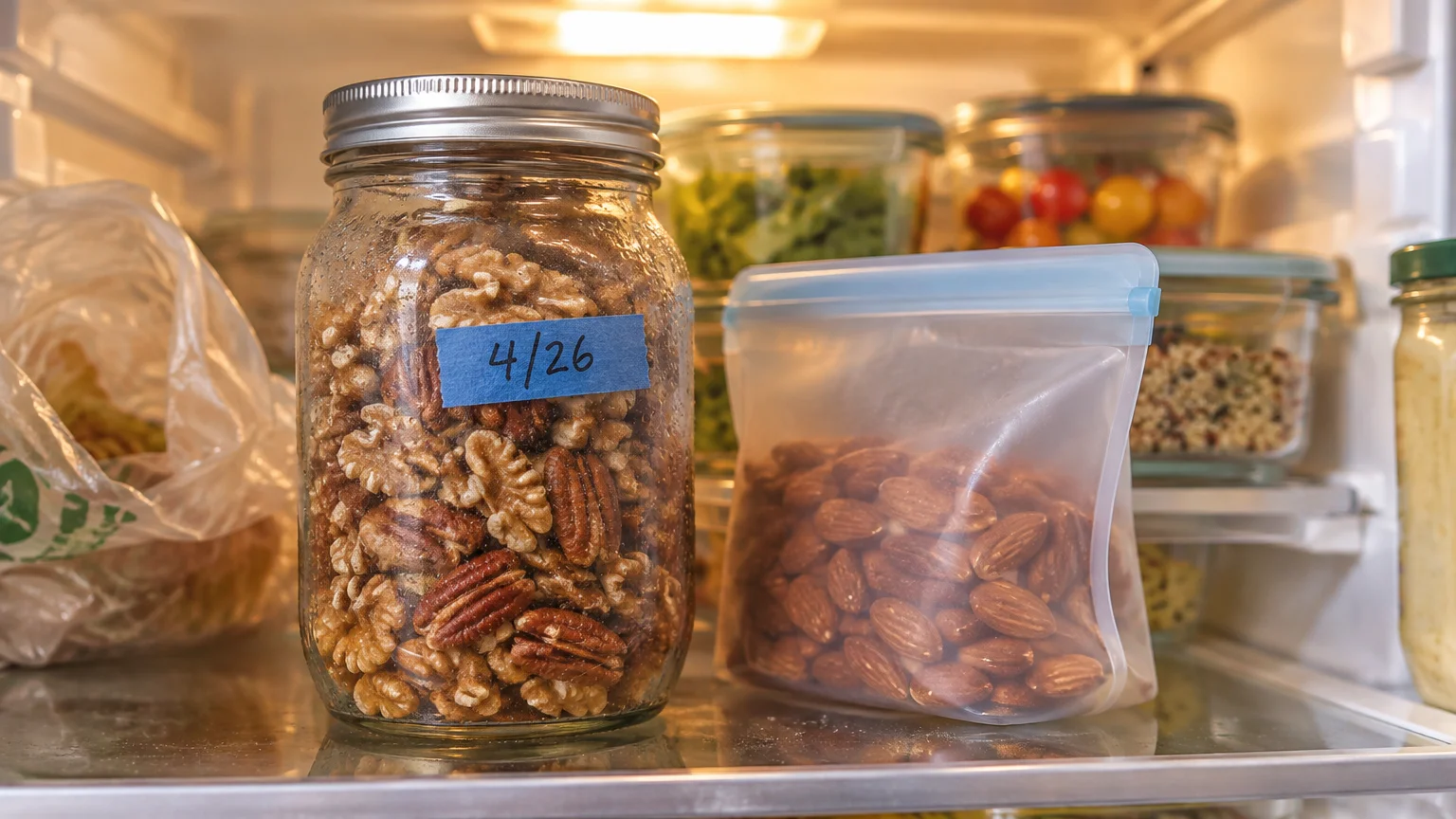
Move those exact same shelled nuts into cold storage and their usable lifespan skyrockets. They stay at peak quality for 12 months in the refrigerator and a full 24 months in the freezer.
Even jarred or canned nuts benefit hugely from cold air once opened, lasting 4 to 6 months in the fridge or 6 to 12 months in the freezer. In-shell nuts naturally resist rancidity longer at room temperature, allowing in-shell almonds to last up to 6 months versus 4 months shelled.
Always verify your appliance settings so cold storage actually does its job. The USDA and FDA require refrigerators to stay at 40°F or below and freezers at 0°F or below.
Remember that freezer month limits measure peak flavor and crisp texture rather than food safety; frozen food stays safe indefinitely at zero degrees. Pour one week’s supply into a dark cupboard jar and freeze the rest in airtight bags.
Shopping Trap #8: Overlooking Bulk-Bin Cross-Contact and Allergen Shortcuts
Self-serve bulk bins at natural grocers look thrifty because you can scoop exact amounts without paying for fancy bags. Unfortunately, open bins invite stale air, wandering hands, and risky allergen mix-ups.
Shoppers regularly swap scoops between almonds, cashews, and trail mixes, leaving invisible residue behind. Even if nobody in your home has allergies today, hosting guests or packing school lunches requires strict ingredient certainty.
Under FDA and USDA rules, peanuts and tree nuts rank among the 9 major U.S. food allergens requiring mandatory label disclosure. They join milk, eggs, fish, crustacean shellfish, wheat, soybeans, and sesame, which was added under the FASTER Act in 2023.
Despite strict federal labeling laws, undeclared tree nuts and peanuts remain a leading cause of U.S. food recalls. Open bulk bins wipe out the clear package warnings families rely on to stay safe.
Safety shortcuts can also happen behind closed factory doors when commercial roasters try to save money on oil. A March 3, 2026 FDA warning letter to a commercial nut roaster highlighted cross-contact risks from reusing roasting oil across different nut varieties.
That same warning letter stressed mandatory sanitation controls against dangerous pathogens like Salmonella and Listeria. Clean processing lines cost manufacturers money, which explains why bargain-bin mystery brands sometimes cut corners.
When shopping for households with allergies, skip open grocery bins altogether in favor of factory-sealed bags with clear allergen disclosures. High-turnover store brands from trusted retailers keep stock moving briskly so bags spend less time sitting in warm warehouses.
Inspect every label for advisory statements about shared equipment before tossing snacks into school backpacks. Saving fifty cents at an unsealed scoop bin is never worth an emergency room visit.
Your Action Plan: How to Be a Smarter Shopper
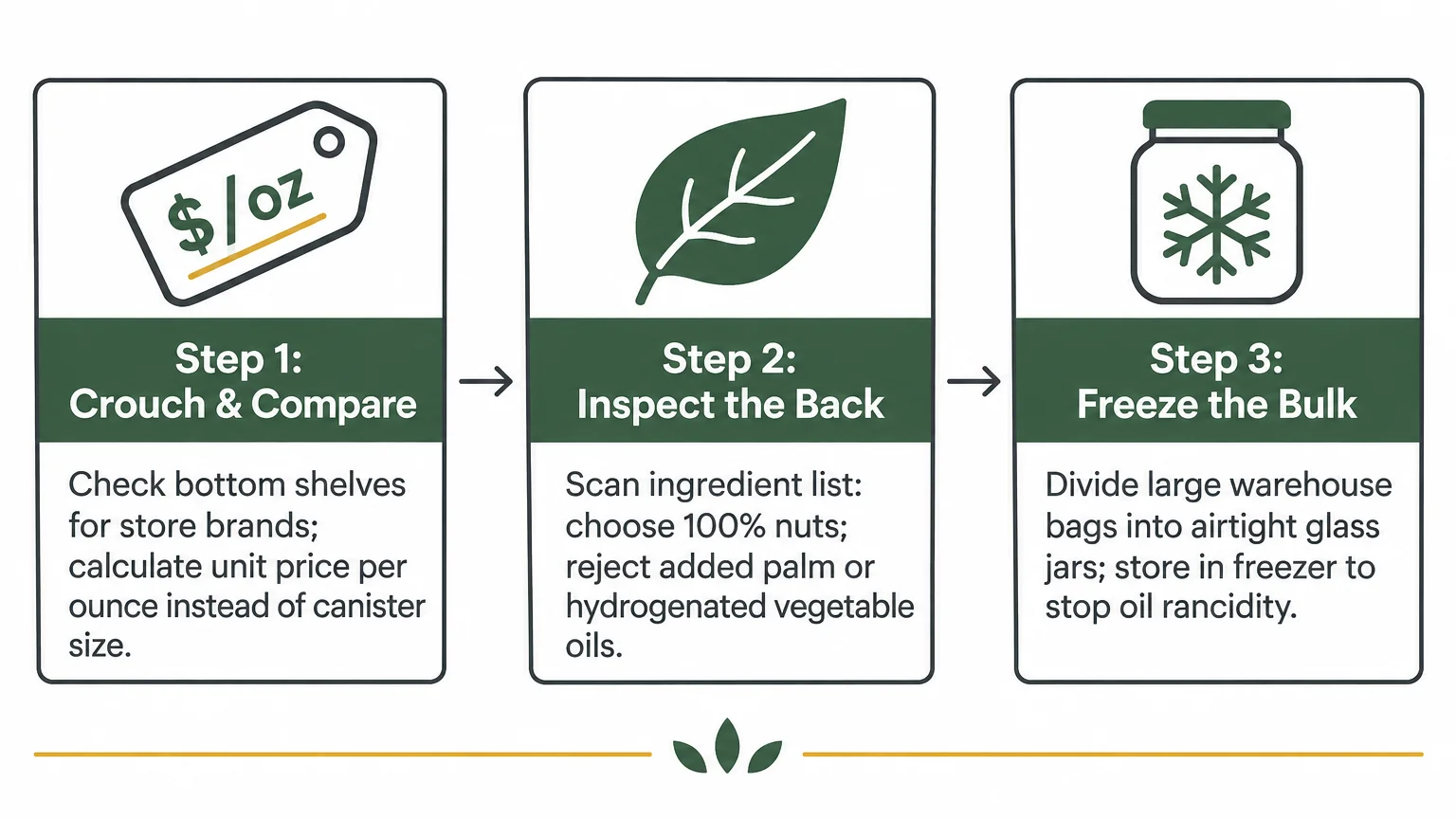
Beat the nut-aisle markup on your very next grocery run with a quick, repeatable checklist. Five minutes of label reading and smart storage turns pricey impulse buys into nutritious snacks that stretch your budget.
Step 1: Default to Store-Brand Unsalted Almonds or Peanuts
Skip eye-level national tins and grab top-rated store brands like 365 Whole Foods Market Roasted & Unsalted Almonds or trusted picks from Costco, Trader Joe’s, and H-E-B. You save 20% to 25% instantly while avoiding 2026 import tariffs on cashews.
Step 2: Read Nut Butter Labels Backward
Flip every almond, cashew, or peanut butter jar over before putting it in your cart. Choose clean spreads made solely from nuts—like Kirkland Signature Creamy Almond Butter or Whole Foods 365 Everyday Value jars—and reject anything with palm or hydrogenated oils.
Step 3: Season and Portion at Home
Avoid sugar-glazed and heavily salted gourmet tubs that blow past AHA limits of 1,500 milligrams of sodium and 25 to 36 grams of added sugar. Pre-portion 1-ounce servings—about 23 almonds or 48 pistachios—into small containers and season them yourself with pantry spices.
Step 4: Freeze Bulk Purchases Immediately
Buy 3-pound warehouse bags for $4.67 to $5.33 per pound on domestic almonds, then divide them into airtight freezer bags right away. Your freezer at 0°F keeps shelled nuts fresh for up to 24 months instead of letting them spoil in a month on the shelf.
Frequently Asked Questions
What did Consumer Reports name the best store-bought nuts overall?
Consumer Reports gave its highest score of 87 out of 100 in October 2026 to We Got Nuts Roasted Unsalted Almonds. In November 2026, 365 Whole Foods Market Roasted & Unsalted Almonds placed second overall and ranked as the best grocery store-brand nut.
Are grocery store brands really just as good as national nut brands?
Yes, independent sensory panels and nutrition checks show top store labels match or beat pricier national cans while costing 20% to 25% less. Costco, Trader Joe’s, and Central Market all earned 5 out of 5 subscriber quality scores from Consumer Reports.
Why are cashews getting more expensive than almonds in 2026?
Analyses of USDA 2026 forecasts and tariff schedules project nut prices to rise 8% to 12%, hitting imported cashews from Vietnam and India with tariff exposure. California grows 99% of commercial U.S. almonds, keeping 3-pound warehouse almond bags around $14 to $16 while cashews hit $20 and up.
How long do shelled nuts stay fresh in the pantry versus the freezer?
According to USDA FoodKeeper, shelled peanuts, walnuts, and pecans stay at peak quality for only about 4 weeks in the pantry. Moving those same shelled nuts into a 40°F fridge stretches quality to 12 months, while a 0°F freezer preserves flavor for 24 months.
To check for scams and false advertising, visit the FTC. For unbiased product reviews, consult Consumer Reports.
Business ratings are available at the Better Business Bureau.
Disclaimer: The opinions in this article are for informational and entertainment purposes. Brands, products, and store policies can change.
Always verify information and prices before making a purchase.