You walk into the store expecting massive savings, but your receipt tells an entirely different story. Buying fresh meat can either slash your family budget or quietly drain your hard-earned cash every month.
Retail giants Costco and Aldi battle fiercely for your grocery dollars using distinct store psychology and packaging strategies. Knowing where to buy poultry, beef, and pork determines whether you actually save money or fall for expensive traps.
Here is what the retail giants do not want you to know about where your money truly belongs.
Shopping Trap #1: The Bulk Illusion That Drains Your Wallet
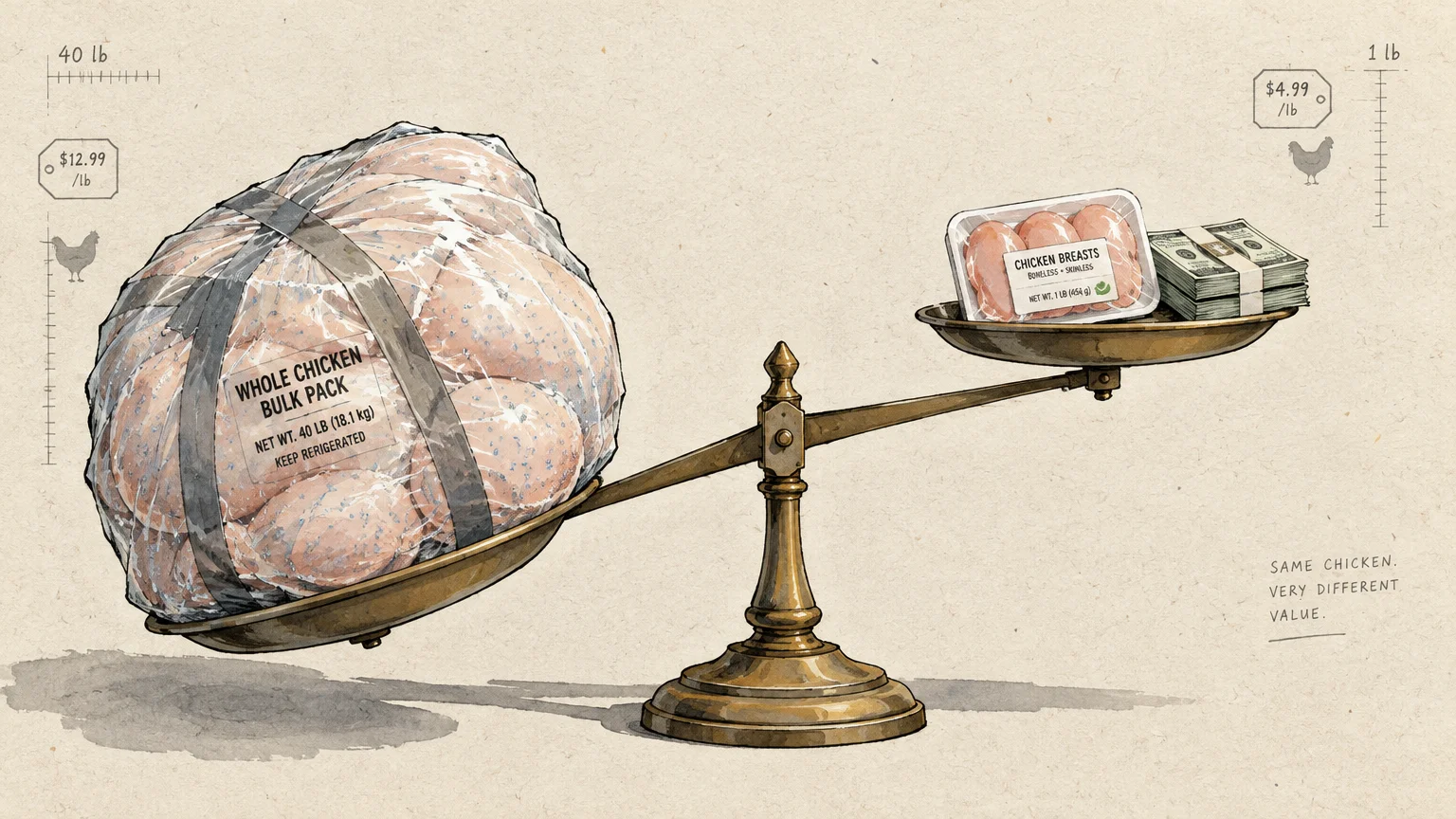
Warehouse clubs rely heavily on the bulk bias to loosen your purse strings. When you see massive plastic packages loaded with protein, your brain automatically assumes you are capturing a wholesale bargain.
A recent grocery price comparison reveals the shocking truth about poultry pricing. You often pay substantially more per pound at the warehouse club than at your local discount grocer.
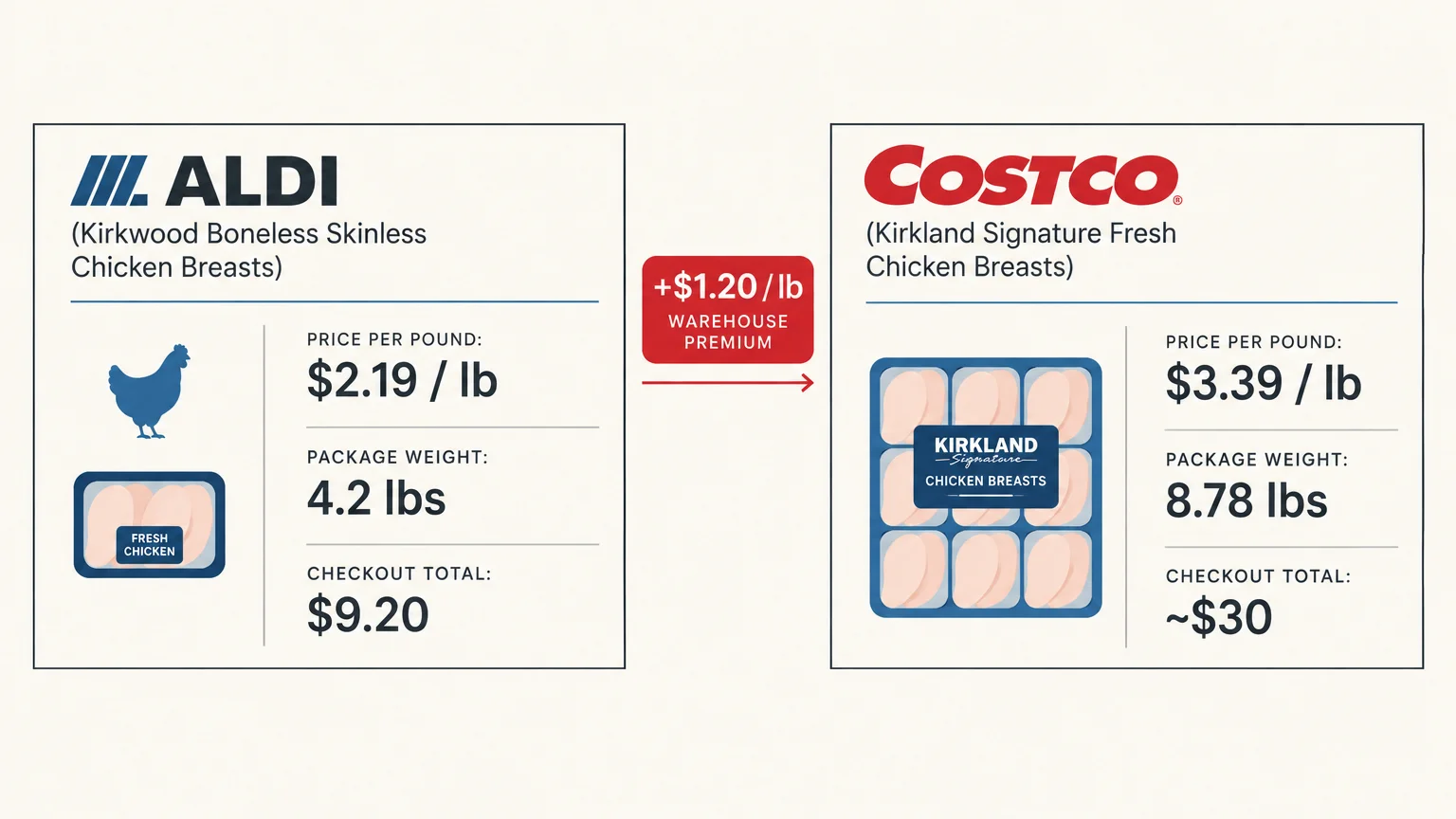
In an October 2026 price study, Aldi sold Kirkwood boneless, skinless chicken breasts for just $2.19 per pound. The typical package weighed around 4.2 pounds, costing shoppers roughly $9.20 total.
Costco offered Kirkland Signature fresh boneless, skinless chicken breasts at $3.39 per pound during the exact same shopping period. That represents a steep premium of $1.20 more per pound for warehouse shoppers.
Costco also forces you to buy packages averaging 8.78 pounds, demanding an upfront investment of roughly $30. You hand over triple the cash at checkout for poultry that costs over fifty percent more per pound.
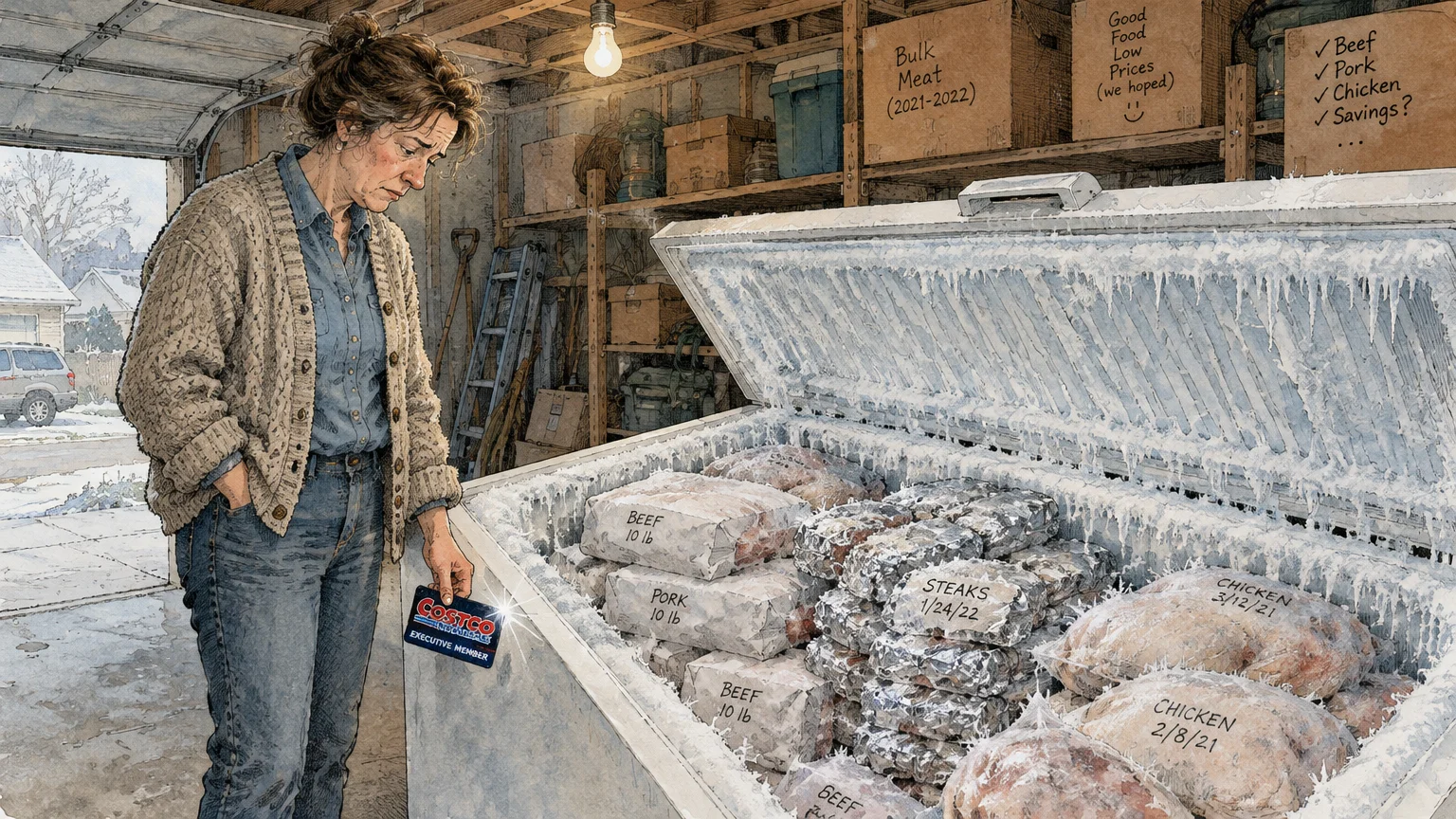
Bulk shopping traps your household capital in a deep freezer. Unless you feed an army immediately, frozen poultry risks severe freezer burn before you cook it.
Freezer burn ruins the cellular structure of lean chicken breasts, leaving them dry, woody, and flavorless when thawed. Throwing away two freezer-burned chicken breasts erases any perceived volume discount you thought you secured.
Aldi lets you purchase manageable four-pound family packs without locking up thirty dollars at a time. You eat fresh poultry every single week without sacrificing refrigerator space or burning cash on spoilage.
Shopping Trap #2: The Hidden Needles in Premium Steaks
Most consumers assume warehouse steaks represent the pinnacle of grocery store quality and safety. However, an aggressive mechanical process lurks behind the butcher counter at Costco that few shoppers understand.
Costco mechanically tenderizes most of its fresh steak and roast selections. High-speed industrial machines pierce whole cuts of beef with thousands of tiny stainless steel blades to artificially soften tough muscle fibers.
Mechanical blade tenderization creates a major food safety hazard that alters how you must cook your meat. Dense muscle meat naturally keeps surface bacteria on the outside of the cut.
When mechanical needles plunge repeatedly into the beef, they push surface pathogens straight into the sterile interior core. That process drives organisms like Salmonella and pathogenic E. coli directly into the center of your steak.
Under USDA Food Safety and Inspection Service regulations, processors must clearly label mechanically tenderized beef. Regulators mandate that you cook blade-tenderized beef to an internal temperature of 145°F followed by a strict three-minute rest period.
That mandatory cooking temperature instantly ruins high-end steaks for anyone who loves rare or medium-rare beef. Pulling a thick ribeye at 145°F yields a well-done piece of leather rather than a juicy, tender cut.
Aldi sells intact, case-ready steaks that never pass through mechanical tenderizing machines. Their beef carries no added microbial risk pushed into the deep muscle tissue.
You can sear an intact Aldi steak to a perfect 130°F medium-rare with complete confidence. You get authentic, untouched beef without industrial needles tampering with your family’s safety.
Shopping Trap #3: The Grass-Fed Ground Beef Price Mirage
Ground beef prices continue to test consumer sanity across the entire United States. Finding clean, healthy ground beef at an affordable price requires looking past giant warehouse displays.
According to Bureau of Labor Statistics data from late 2026, domestic cattle supplies hit their lowest levels in over 50 years. That shortage pushed national average ground beef retail prices to a record $6.89 per pound in July 2026.
With beef prices climbing 9.4% year-over-year, grocers use misleading package sizing to disguise soaring costs. Costco bundles its ground beef into massive multi-pound chubs and bulky Styrofoam trays.
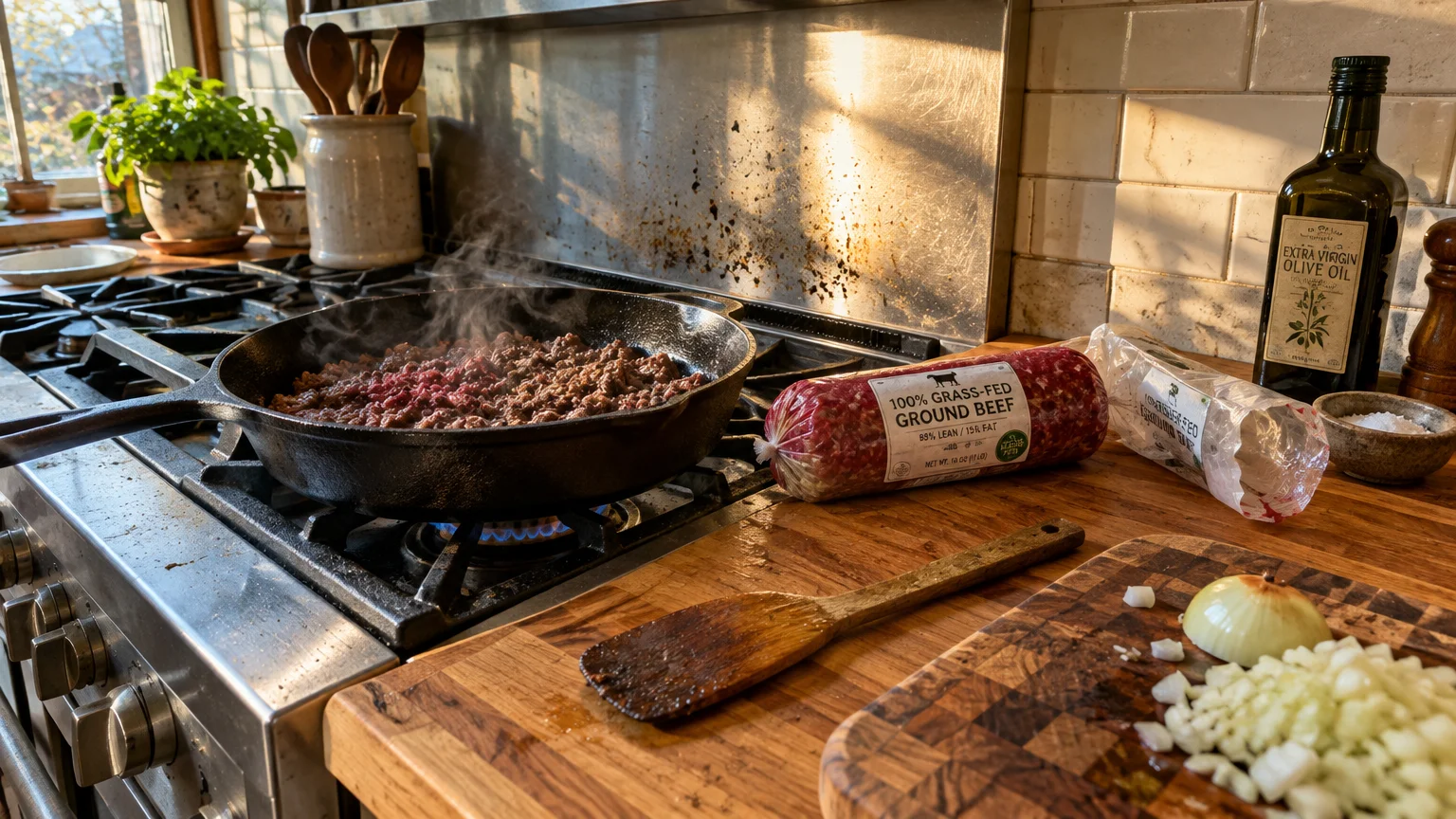
Aldi quietly dominates the market with its Simply Nature Organic Grass-Fed Ground Beef. Sold in compact one-pound vacuum-sealed bricks, this lean beef consistently undercuts warehouse club pricing.
A culinary retail analysis by The Daily Meal in late 2026 ranked Aldi ahead of Costco for ground beef value and quality. Aldi delivers rich, 100% grass-fed beef without forcing you to buy twelve pounds at once.
Costco packages require messy home butchering, portioning, and rolls of plastic wrap to preserve properly. If your freezer seals fail, ambient air ruins the bulk beef you worked so hard to divide.
Aldi’s thick, vacuum-sealed packaging protects the meat from oxygen exposure for months without any freezer burn. You simply drop the one-pound bricks into your freezer and thaw exactly what you need for dinner.
For shoppers seeking the best grocery store for meat, Aldi wins the ground beef battle on price, purity, and convenience. You get organic, grass-fed nutrition while staying well below national average retail prices.
Shopping Trap #4: The Annual Membership Tax on Your Meat Budget
Retail clubs rely on an upfront paywall to lock in your psychological loyalty. Once you pay an annual fee, you feel compelled to justify that overhead by purchasing all your food there.
Costco raised its annual membership fees in September 2024 to squeeze more revenue from loyal patrons. A standard Gold Star membership costs $65 per year, while an Executive membership costs a steep $130 per year.
Executive members earn an annual 2% reward on qualified purchases, capped strictly at $1,250 per twelve-month period. However, you must spend thousands of dollars annually on inflated groceries just to break even on that $130 upgrade.
Aldi charges zero membership fees to walk through its sliding glass doors. You never have to calculate complex break-even points before saving money on your weekly protein haul.
If you purchase chicken breast at Costco at $3.39 per pound, that extra $1.20 per pound compounds rapidly. Adding the $65 annual membership fee turns warehouse shopping into a serious financial drain.
Warehouse fans claim fuel discounts and free samples offset the hefty price tag. Yet smart consumers realize food spending represents the core driver of monthly household budgets.
You can walk into Aldi tomorrow, grab budget-friendly groceries, and keep your $65 in your pocket. Skipping the warehouse club door fee provides instant, guaranteed financial savings from day one.
Shopping Trap #5: The Sunk-Cost Guarantee Blind Spot
Every grocer promises high quality, but their return policies show how much they truly stand behind their products. Costco leans heavily on its Risk-Free 100% Satisfaction Guarantee to make shoppers feel secure buying bulk meat.
Costco will refund your purchase price if you bring unsatisfactory meat back to the returns desk. However, taking advantage of that warehouse guarantee requires significant effort and personal inconvenience.
You must navigate a massive parking lot, haul spoiled food inside, and stand in notoriously long customer service lines. Most busy working consumers simply throw bad meat away rather than wasting forty-five minutes claiming a refund.
Aldi eliminates this friction with an aggressive policy known as the “Twice as Nice” Guarantee. It applies to exclusive store brands like Kirkwood, Simply Nature, and Appleton Farms meats.
If you dislike an Aldi-exclusive meat product, the store provides both a full refund and a replacement item. You receive your money back onto your original payment method and walk out with fresh groceries.
This policy shows unmatched confidence in their case-ready supply chain. Aldi actively pays you for your trouble if a product fails to meet your household standards.
Next time you evaluate costco vs aldi policies, look beyond standard refund promises. Aldi provides double the protection while sparing you the massive warehouse service lines.
Shopping Trap #6: The Butcher Counter Custom-Cut Trick
Costco uses an open cutting floor behind giant glass windows to manufacture consumer trust. Watching workers in white coats slice massive sides of beef creates an illusion of old-fashioned, custom butcher shop value.
Retail psychologists call this theatrical presentation; it subtly convinces you that higher prices reflect superior artisanal craft. In reality, those warehouse workers are portioning pre-graded factory meat into high-margin family packs.
Aldi bypasses this expensive theater by utilizing modern, case-ready packaging facilities. Regional packing plants vacuum-seal cuts immediately after processing, eliminating costly in-store butcher labor and overhead.
Those operational savings pass directly to your receipt at checkout. You pay for the protein itself rather than funding the wages of a massive in-store meat department.
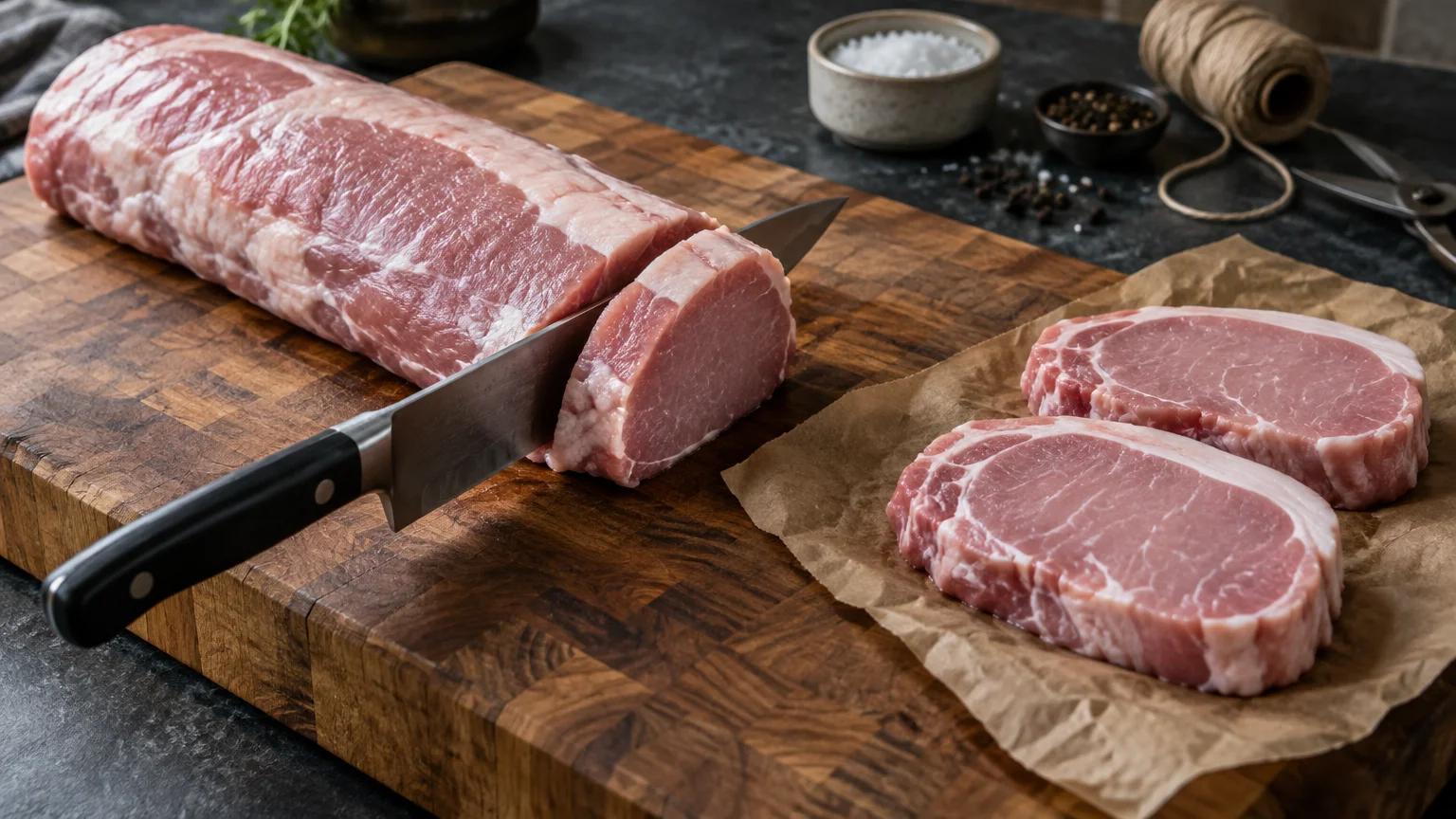
Costco does offer one genuine insider hack for shoppers determined to exploit the warehouse system. You can purchase whole muscle subprimals in sealed cryovac bags directly from their walk-in coolers.
Whole briskets, pork butts, and beef tenderloins inside original packer bags bypass the warehouse tenderizing machines entirely. They also carry significantly lower prices per pound than pre-cut steaks displayed on black foam trays.
If you possess sharp boning knives and basic butchering skills, buying intact cryovac subprimals at Costco makes financial sense. But if you want pre-sliced steaks without the butcher markup, Aldi remains the smarter destination.
Shopping Trap #7: The Specialty Cut Markup Game
Grocery stores extract their highest profit margins from premium, specialty cuts of steak. Shoppers who crave weekend barbecue treats frequently get ripped off by warehouse club displays.
Both grocers primarily stock USDA Choice grade beef for their standard cuts. However, their retail pricing strategies for identical grades could not be more different.
National retail data reveals that sirloin steak reached an average price of $14.59 per pound in late 2026. During that same timeframe, everyday chuck roast surged to a painful national average of $9.63 per pound.
Costco prices its thick-cut USDA Choice steaks between $11.00 and $14.00 per pound. They bundle three or four massive steaks together, pushing your total package cost over fifty dollars.
Aldi counters this aggressive pricing with exceptional weekly specials on traditional steakhouse cuts. In late 2026 retail comparisons, USDA Choice T-bone steaks at Aldi frequently sold for around $5.00 per pound.
Securing USDA Choice T-bone steaks for five dollars per pound saves you substantial cash compared to warehouse rates. You get identical USDA-graded meat at a small fraction of the warehouse price tag.
Costco does stock USDA Prime beef and authentic American Wagyu for affluent entertainers. If you host an upscale dinner party and need ultra-marbled Prime cap steaks, Costco provides access Aldi cannot match.
For standard family dinners, paying double for warehouse Choice cuts makes zero financial sense. Aldi delivers the same official USDA Choice grade while keeping your food budget completely intact.
Shopping Trap #8: The Shrink-Wrapped Water Weight Penalty
One of the quietest scams in the retail meat industry involves paying high protein prices for added saltwater. Commercial meat packers routinely inject raw chicken and pork with sodium-rich broths to plump up package weights.
Federal labeling guidelines allow processors to inject up to fifteen percent water, broth, or saline solution into fresh poultry. When you toss that meat into a hot skillet, the liquid leaches out, leaving you with shriveled meat.
Costco packages its Kirkland poultry in multi-compartment leak-proof plastic pouches. While clean and convenient, these thick plastic saddles sometimes trap substantial residual purging fluid around the chicken.
Aldi displays Kirkwood chicken on traditional foam trays lined with absorbent moisture pads. You can inspect the package directly to ensure you are not paying for pooling pink liquid.
Bureau of Labor Statistics data showed whole chicken national average retail prices dropping to $2.03 per pound in October 2026. That 1.7% year-over-year decline makes poultry one of the few bargains in the grocery aisle.
To capture genuine chicken savings, you must verify the true net weight of the usable protein. Paying $3.39 per pound for water-logged meat at the warehouse club destroys your weekly grocery margins.
Always inspect product labels for fine print stating raw meat contains added water solutions or flavoring broths. Buying pure, untreated protein at Aldi ensures every dollar spent contributes directly to your nutritional fuel.
Your Action Plan: How to Be a Smarter Shopper
Winning the grocery price comparison war requires ruthless discipline and zero retail brand loyalty. Implement this practical strategy on your next shopping run to extract maximum value from both retailers.
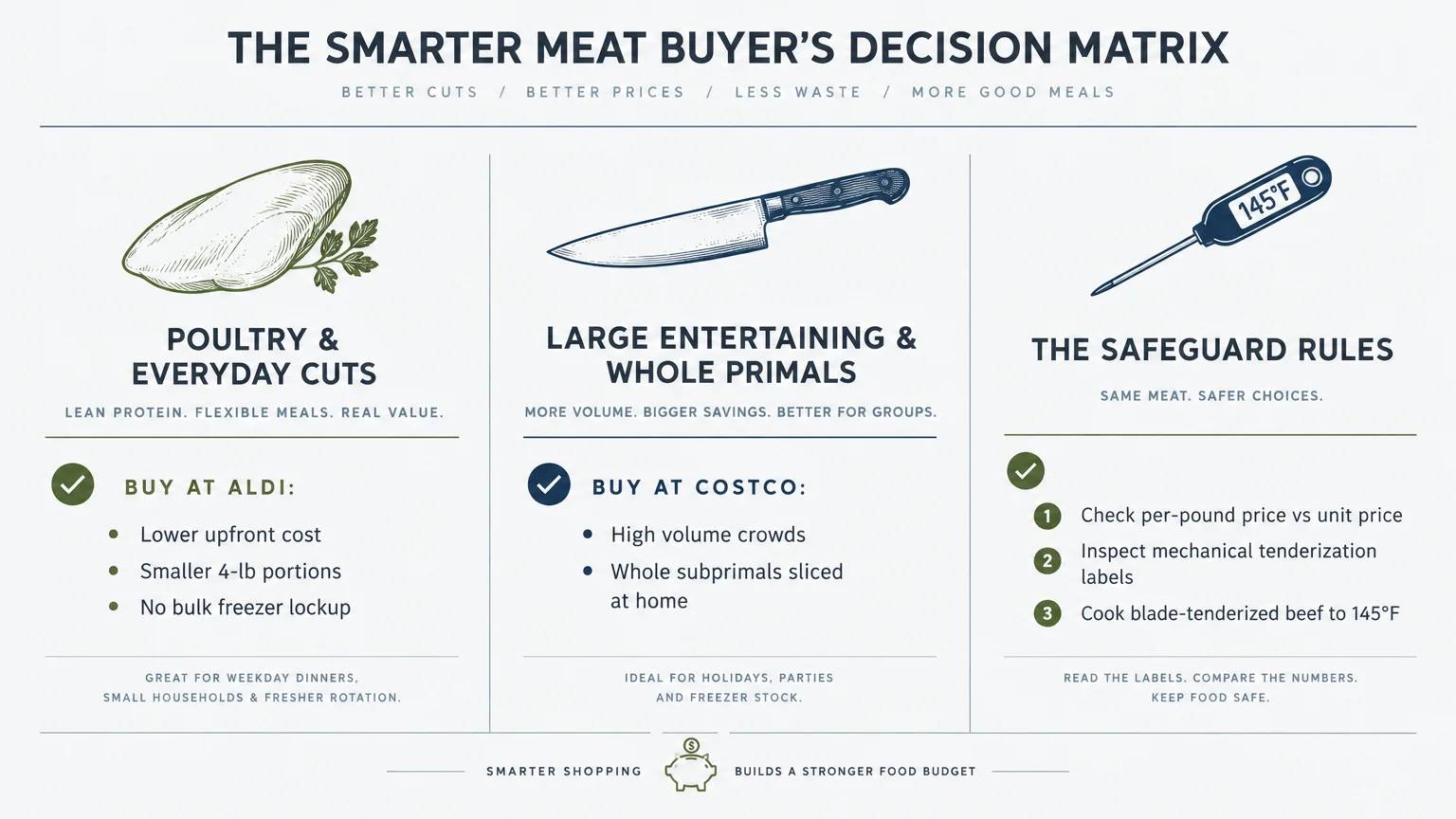
Purchase your weekly everyday poultry and lean ground beef exclusively at Aldi. You will dodge the $1.20 per pound chicken penalty and secure high-grade grass-fed beef without paying warehouse fees.
Inspect every package of warehouse beef for mechanical tenderization warnings before heading to the register. If you insist on cooking steaks rare or medium-rare, buy untouched, intact cuts from Aldi instead.
Reserve Costco exclusively for large, untenderized subprimals in factory cryovac packaging. Carving your own roasts and steaks at home lets you capture authentic wholesale savings while bypassing machine needles.
Take full advantage of Aldi’s Twice as Nice Guarantee whenever a product fails your freshness standards. Holding grocers accountable protects your wallet and guarantees premium value for your family.
To check for scams and false advertising, visit the FTC. For unbiased product reviews, consult Consumer Reports.
Business ratings are available at the Better Business Bureau.
Disclaimer: The opinions in this article are for informational and entertainment purposes. Brands, products, and store policies can change.
Always verify information and prices before making a purchase.
Frequently Asked Questions
Is Costco meat higher quality than Aldi meat?
Both grocers source standard everyday beef that meets identical USDA Choice inspection standards. Costco offers higher tiers like USDA Prime and American Wagyu, but Aldi matches or beats warehouse quality on daily cuts.
Why does Costco blade-tenderize its beef?
Costco uses mechanical needles to soften thicker muscle cuts for average home cooks. However, this process pushes exterior surface bacteria inside the meat, requiring you to cook steaks to an internal temperature of 145°F.
How does the Aldi Twice as Nice Guarantee work on fresh meat?
If you are unhappy with any Aldi-exclusive brand meat, return the product and receipt to the store. The manager will issue a full refund to your original payment method and provide a replacement item free.
Can I freeze Aldi meat directly in its original packaging?
Aldi vacuum-sealed beef, including Simply Nature Grass-Fed Ground Beef, freezes safely in its factory packaging for several months. For poultry packaged in standard trays, wrap the meat tightly in freezer paper first to prevent ice crystals.